AI-Powered Customer Support Systems: How They Work

Customer support can become difficult to scale as a business grows. More customers usually mean more questions about products, orders, subscriptions, bookings, accounts, technical problems, and company policies. Hiring additional support staff can help, but many of these conversations are repetitive and do not always require a human agent.

AI-powered customer support systems help businesses handle these routine conversations more efficiently. They can understand customer questions, search approved business information, provide relevant answers, collect details, create support tickets, and transfer complex conversations to human employees when necessary.

The goal is not to remove people from customer service. A well-designed AI support system handles the repetitive work while giving human agents more time for complaints, unusual problems, sensitive conversations, and situations that require judgment.

How an AI Customer Support System Actually Works

The process normally begins when a customer sends a message through a website, mobile app, customer portal, or other connected support channel. Instead of depending only on predefined buttons or exact keywords, an AI system can analyze natural-language questions and determine what the customer is trying to accomplish.

For example, a customer might write, “Where is my order?” The system can identify that the question is related to order tracking. If the customer is authenticated and the AI support platform is securely connected to the company’s order-management system, it may retrieve the relevant status and provide an appropriate response.

A question such as “What is your refund policy?” works differently. The AI may search an approved knowledge base containing company policies, frequently asked questions, help articles, and product documentation. It can then use that information to prepare a conversational answer instead of forcing the customer to manually search several pages.

Behind a useful AI support experience, there are usually several connected components working together: the conversational AI model, business knowledge, customer data, backend APIs, support workflows, and human-agent escalation.

Business Knowledge Makes the AI More Useful

A general AI model does not automatically know a company’s current products, policies, pricing, internal procedures, or support documentation. For business use, the system needs access to controlled sources of information that can help it answer questions accurately.

These sources might include FAQs, service descriptions, product documentation, troubleshooting guides, return policies, onboarding information, or internal support procedures. When a customer asks a question, the system can locate relevant information and use it as context for the response.

This approach is particularly valuable when a business has a large amount of documentation. Instead of expecting customers or support agents to remember where every answer is stored, AI can help retrieve the most relevant information from the available knowledge.

The quality of this information matters. Outdated policies or incomplete documentation can lead to poor answers, which is why maintaining the knowledge base should be part of the support process.

AI Can Connect Customer Questions With Real Business Systems

The biggest improvement often happens when AI moves beyond simply answering FAQs. Through secure APIs, the support system can work with existing CRM software, e-commerce platforms, booking systems, SaaS applications, subscription platforms, or other business tools.

This can allow the assistant to provide personalized information such as an order status, upcoming appointment, subscription details, or support-ticket progress. Depending on the workflow, AI may also collect information from the customer before another system performs an action.

For example, an AI assistant could identify that a customer wants to change a booking, collect the required details, and then send the request through the normal booking workflow. The AI handles the conversation, while standard application logic manages availability, permissions, database updates, and confirmation.

  • Answer frequently asked questions
  • Search products, policies, or documentation
  • Provide authenticated account information
  • Collect details before creating a support request
  • Summarize long customer conversations
  • Categorize and route support tickets
  • Suggest responses to human support agents

This combination of AI and traditional automation is important. AI is useful for understanding flexible human language, while predictable business actions should still be controlled by reliable backend rules.

What Happens When AI Cannot Solve the Problem?

A customer support system should never trap customers in an automated conversation. If the AI cannot answer confidently, the customer repeatedly asks for help, or the request involves a sensitive issue, the conversation should be escalated to a human agent.

A good handoff can include the customer’s existing conversation, a short AI-generated summary, the identified issue category, and any information already collected. This prevents the customer from having to explain the same problem again and gives the support employee useful context before joining the conversation.

Human involvement is especially important for complaints, unusual billing problems, account-security issues, complicated technical failures, or other situations where empathy and judgment matter more than response speed.

AI Can Help Support Employees Too

Not every AI customer support feature needs to communicate directly with customers. Some of the most practical applications work behind the scenes to help support teams operate more efficiently.

AI can summarize a conversation containing dozens of messages, search internal documentation while an agent is responding, suggest a draft answer, identify the type of problem, or highlight important customer information. The employee remains responsible for the final response but spends less time searching and organizing information.

This can be a useful starting point for businesses that are not ready to fully automate customer conversations. AI-assisted support allows employees to remain in control while still reducing repetitive work.

Request a Quote

Building AI Support Around the Customer Experience

AI customer support should be designed around real customer problems rather than added simply because AI is popular. Businesses should first identify the questions that consume the most support time, where customers frequently become stuck, and which requests can be safely automated.

Security and privacy also need careful attention when AI systems work with customer information. Users should only be able to access data they are authorized to see, sensitive credentials should remain protected on the backend, and important account actions should continue to use proper validation.

Encoder IT Limited develops AI-powered customer support solutions that can connect conversational AI with websites, mobile applications, SaaS platforms, business APIs, knowledge bases, customer portals, and existing support workflows.

A successful AI support system is therefore much more than a chatbot sitting in the corner of a website. It connects customer conversations with useful business knowledge and reliable software workflows, automates repetitive interactions, and brings human employees into the process when their experience provides greater value.

Essential Features Every E-commerce Website Needs

A successful e-commerce website needs more than attractive product pages and a working checkout. Customers should be able to discover products easily, understand what they are buying, trust the store, complete payment without unnecessary friction, and follow their order after purchase.

The exact functionality depends on the type of business, but several essential e-commerce website features provide the foundation for a reliable online shopping experience. These features should work together rather than feeling like separate plugins or tools added over time.

Product Discovery Should Be Fast and Simple

Customers should be able to find the right product without browsing through dozens of unrelated pages. Clear categories, logical navigation, useful search, and filtering become increasingly important as the product catalog grows.

Filters should reflect how customers actually compare products. A clothing store may need size, color, brand, price, and availability filters, while an electronics store may need specifications, compatibility, storage, screen size, or technical features.

Search should also provide useful results when customers use common product names or related terms. A technically accurate search system that returns no results because the customer did not type an exact product title can still create a poor shopping experience.

Once a customer reaches a product page, the information should make the purchasing decision easier. High-quality images, accurate pricing, product variations, availability, descriptions, dimensions, specifications, delivery details, and other important information should be clearly presented.

Cart and Checkout Need to Remove Buying Friction

The shopping cart should give customers a clear summary of what they intend to purchase. Products, quantities, selected variations, discounts, shipping-related information, and totals should be easy to review and change.

Checkout should then require only the information necessary to complete the transaction. Long registration processes, repeated fields, unclear validation errors, and unnecessary steps can cause customers to abandon a purchase they were already prepared to make.

Providing suitable payment options is equally important. The right methods depend on the market and customer base, but the checkout should connect securely with trusted payment providers and give customers clear confirmation when payment succeeds or fails.

  • Easy-to-edit shopping cart
  • Simple and mobile-friendly checkout
  • Multiple appropriate payment methods
  • Clear shipping costs and delivery options
  • Discount and coupon handling where required
  • Reliable payment and order confirmation

Businesses should also plan for failed payments, abandoned transactions, refunds, and cancellations. E-commerce systems need clear order states so customers and administrators can understand what happened without manually investigating every transaction.

Customer Accounts, Orders, and Communication

Customer accounts can make repeat purchases easier by storing useful information such as addresses, order history, saved products, subscriptions, or account preferences. However, businesses should avoid making account creation unnecessarily difficult when a simpler checkout experience would serve the customer better.

After purchase, customers should receive clear confirmation and be able to understand the status of their order. Depending on the business, this may include payment confirmation, processing updates, shipment notifications, tracking information, delivery status, or pickup instructions.

Automated email or mobile notifications can reduce support questions because customers do not need to contact the business simply to ask whether an order has shipped.

Customer support should also remain easy to access. FAQs, contact forms, live chat, support tickets, AI assistants, or other communication options can help customers resolve problems without leaving the store.

Inventory, Security, and Store Management Matter Behind the Scenes

Many essential e-commerce features are not immediately visible to customers. Inventory management, order administration, reporting, security, and integrations are critical to operating the store reliably.

Stock should update correctly when products are purchased, cancelled, returned, or restocked. Stores with product variations need accurate inventory at the variation level rather than only a total quantity for the parent product. Low-stock notifications can help businesses reorder popular products before they become unavailable.

Security needs to protect both customers and administrators. The store should use HTTPS, maintain plugins and software, secure administrator access, validate important actions on the backend, and integrate payment providers using supported secure methods.

Backups and monitoring are important too. If an update causes a problem or an integration stops working, the business should have a reliable way to identify the issue and recover the store.

Build a Better E-commerce Website

Integrations and Analytics Help the Store Grow

As an e-commerce business grows, the store often needs to connect with other systems. Shipping providers can generate rates and tracking information, CRM systems can receive customer data, accounting platforms can receive transaction information, and inventory systems can synchronize stock across several sales channels.

These integrations can reduce manual work, but they should be implemented carefully. The store should record errors, prevent duplicate updates, and provide administrators with enough information to understand when synchronization fails.

Analytics should also be part of the e-commerce foundation. Businesses need to know which products receive attention, which marketing channels generate sales, where customers leave the checkout process, and which pages create problems.

This information can guide improvements in product presentation, navigation, pricing, checkout, marketing, and customer experience instead of relying only on assumptions.

The Best E-commerce Features Support the Buying Journey

Not every store needs subscriptions, loyalty programs, advanced recommendations, AI search, marketplaces, or dozens of integrations. Adding features simply because competitors use them can increase complexity without improving sales.

Encoder IT Limited develops WooCommerce, Shopify, and custom e-commerce solutions with features such as product management, payment gateways, checkout customization, inventory and order systems, shipping integrations, customer accounts, API integrations, performance optimization, and ongoing maintenance.

The essential features of an e-commerce website are the ones that make shopping and store management reliable: customers can find products easily, understand what they are buying, pay securely, receive clear order information, and get support when they need it. Behind the scenes, the business should have accurate inventory, manageable orders, secure administration, useful reporting, and a platform that can continue growing as requirements change.

UI vs UX Design: What’s the Difference?

UI and UX are often discussed together, but they describe different parts of digital product design. A website, mobile app, SaaS platform, or e-commerce store can look attractive while still being difficult to use, just as a highly usable product can feel visually outdated or inconsistent.

UI design focuses mainly on how a digital interface looks and how its visual elements are presented. UX design focuses on how people move through the product, understand information, and complete important tasks.

The strongest digital products combine both. Good UX gives users a clear and efficient journey, while good UI makes that journey visually understandable, consistent, and engaging.

What Is UI Design?

UI stands for User Interface. It includes the visual and interactive elements users see when they interact with a website or application. Buttons, typography, colors, icons, forms, cards, menus, spacing, and page layouts are all part of the interface.

A UI designer works to make these elements visually consistent and easy to recognize. Primary actions should stand out, related information should feel connected, and the visual hierarchy should make it clear what deserves attention first.

For example, on an e-commerce product page, UI design influences how the product image, price, variation selectors, quantity controls, reviews, and Add to Cart button are presented. On a SaaS dashboard, it shapes navigation, tables, charts, status indicators, forms, and action buttons.

Good UI is not simply decoration. Visual decisions can directly affect usability. Weak contrast can make text difficult to read, inconsistent buttons can confuse users, and crowded layouts can make important information harder to find.

What Is UX Design?

UX stands for User Experience. It looks at the broader experience a person has while using a product. UX design asks questions such as: Can users find what they need? Is the navigation understandable? Are forms unnecessarily complicated? Does the checkout process contain too many steps?

UX often begins before detailed interface styling. Designers may research user needs, define important user journeys, create information architecture, build wireframes, plan navigation, and test prototypes before deciding exactly how every screen should look.

Consider a booking application. The UX includes how easily users can search for a service, choose a date, select an available time, enter required information, make payment, and receive confirmation. If this journey takes ten confusing steps when it could take four clear ones, changing colors and button styles alone will not solve the problem.

UX also includes error handling, empty states, onboarding, accessibility, responsiveness, loading behavior, and the clarity of messages users receive throughout the product.

Area UI Design UX Design
Main Focus Visual interface and presentation Overall usability and user journey
Typical Elements Colors, typography, buttons, icons, spacing, components Navigation, workflows, information structure, usability, interactions
Main Question How should this interface look and communicate? How should this experience work for the user?
Common Deliverables Visual designs, component libraries, design systems User flows, wireframes, prototypes, research and testing
Primary Goal Create a clear and consistent interface Make tasks easier and more intuitive to complete

How UI and UX Work Together

UI and UX should not be treated as completely separate stages. Decisions in one area frequently affect the other. A well-planned user flow still needs a clear visual interface, while a beautiful design still needs logical navigation and usable workflows.

Imagine a lead-generation website with an attractive hero section, modern typography, high-quality images, and polished animations. The UI may look excellent. But if visitors cannot understand the service or find the contact form, the UX is weak.

The opposite can happen too. A website may have simple navigation and a logical conversion journey but use inconsistent spacing, unreadable typography, outdated visual elements, and unclear buttons. Users may still complete tasks, but the interface can make the business feel less professional.

The most effective design process considers both at the same time. UX defines what users need and how the experience should flow, while UI turns that structure into an interface that is visually clear and consistent.

Improve Your Website or App UI/UX

Why Businesses Need Both UI and UX Design

Businesses sometimes focus heavily on visual design because it is the most immediately visible part of a website or application. However, attractive screens alone do not guarantee that visitors will become customers or that users will continue using a product.

A service website may need clearer calls to action and better information hierarchy. An online store may need simpler product discovery and checkout. A SaaS platform may need more focused dashboards and role-based navigation. A mobile application may need shorter forms and clearer feedback after important actions.

These are primarily UX problems, but solving them usually requires UI changes as well. A redesigned checkout flow still needs clear buttons, form states, typography, spacing, and visual feedback.

  • UI helps create a professional and consistent visual identity
  • UX helps users complete tasks with less effort
  • UI improves visual clarity and interaction
  • UX helps reduce confusion and unnecessary steps
  • Together they can improve engagement and conversion opportunities

UI/UX Design Is an Ongoing Process

Design decisions should continue to be evaluated after launch. Analytics, customer feedback, usability testing, support requests, and product behavior can reveal problems that were not obvious during the initial design process.

Users may ignore a button that designers expected to be important. A form may have higher abandonment than expected. Customers may repeatedly ask where certain information is located. These signals can guide future UI and UX improvements.

A mature digital product also needs consistency as it grows. New pages, modules, features, and integrations should follow the same design principles rather than introducing a different visual and interaction pattern every time something is added.

Encoder IT Limited provides UI/UX design for websites, mobile applications, SaaS platforms, dashboards, e-commerce stores, and custom web applications. Our work can include user-flow planning, wireframes, interface design, design systems, responsive layouts, frontend development, and conversion-focused improvements.

UI and UX have different responsibilities, but neither works at its best alone. UX creates a clear path for users, while UI makes that path understandable and visually effective. When both are planned together, businesses can create digital products that not only look professional but are also easier and more satisfying to use.

How Businesses Can Use ChatGPT API Integration

Businesses are increasingly looking for ways to add AI capabilities to their existing websites, mobile apps, SaaS platforms, and internal software. One practical approach is commonly described as ChatGPT API integration—connecting OpenAI’s models with business applications so AI can work alongside existing data, software, and workflows.

This can go far beyond adding a simple chatbot. AI can help answer customer questions, summarize documents, search business knowledge, classify requests, generate structured information, assist employees, and trigger actions through existing systems.

The most useful integrations usually start with a specific business problem. Instead of asking, “Where can we add AI?” a better question is, “Which repetitive or information-heavy process could become faster or easier with AI?”

Use AI to Improve Customer Support

Customer support is one of the most practical applications of AI integration. A business can connect an AI assistant to its website, mobile app, or customer portal and allow customers to ask questions using natural language.

The assistant can use approved information such as FAQs, product documentation, service details, troubleshooting instructions, or company policies when preparing responses. This can reduce the amount of time support teams spend answering the same questions repeatedly.

More advanced integrations can connect AI with existing business systems. An authenticated customer might ask about an order, subscription, booking, or account status. The application can retrieve the appropriate information through secure backend APIs and use AI to present it conversationally.

Human support should still remain available. Complaints, complicated billing problems, sensitive account issues, and situations requiring judgment can be passed to an employee with the conversation history and a useful summary already prepared.

Create an AI Assistant for Employees

AI integration can also be used internally rather than directly with customers. Employees often spend significant time searching documentation, reading long records, preparing summaries, or finding information across multiple systems.

An internal assistant can help staff search policies, product information, training documents, technical documentation, customer records, or other approved company information. Instead of manually opening several documents, an employee could ask a question and receive a focused answer based on the available knowledge.

This can be useful for support teams, sales departments, operations staff, HR teams, managers, and employees working with large amounts of information.

AI can also summarize long customer conversations, meeting notes, reports, support tickets, or documents so employees can understand the important information more quickly. The original records can remain available whenever a person needs to verify the details.

Connect AI With Real Business Workflows

The biggest value often appears when AI can do more than generate text. OpenAI’s function-calling capabilities allow applications to connect models with functions and data provided by the business’s own software.

For example, a customer could ask an AI assistant to check an order. The AI can identify what information is needed, while the application securely calls the existing order system and returns the result. Similar workflows can be created for bookings, customer accounts, support tickets, inventory, CRM records, or internal tools.

AI can also help interpret a request before traditional automation takes over. A customer might describe a problem in several sentences. AI can categorize the request and extract the relevant information, while normal backend logic creates the ticket, assigns the department, saves the record, and sends notifications.

This combination is often more reliable than trying to make AI responsible for the entire workflow. AI handles flexible language and unstructured information, while standard application code continues controlling predictable business rules, permissions, and database changes.

Search Documents and Business Knowledge More Naturally

Businesses often accumulate large amounts of information across documentation, policies, knowledge bases, product descriptions, manuals, and other text. Finding the right information through ordinary keyword search can become difficult as the amount of content grows.

AI-based search can help users find related information even when their wording does not exactly match the words stored in the source documents. OpenAI embeddings are designed to represent text numerically and can support applications such as search, classification, recommendations, and related-information retrieval.

This can support customer help centers, internal knowledge systems, SaaS documentation, product catalogs, employee portals, and other applications where users need to locate information quickly.

Automate Content and Information Processing

Many businesses have repetitive tasks that involve reading, organizing, or preparing text. AI integration can assist with these processes without requiring employees to manually handle every item from the beginning.

  • Summarizing reports, documents, or customer conversations
  • Classifying support requests and incoming messages
  • Extracting important information from submitted content
  • Preparing draft emails, descriptions, or responses
  • Organizing leads according to submitted information
  • Creating structured information for another business workflow

The final workflow should depend on the risk involved. Generating an internal summary may require little supervision, while financial, legal, healthcare, account-security, or other high-impact decisions should include stronger validation and appropriate human review.

Discuss Your AI Integration

Integrate AI Into the Software You Already Use

A business does not necessarily need to rebuild its website or application to start using AI. In many cases, AI functionality can be introduced through the existing backend and added gradually to specific workflows.

A website could receive an AI support assistant. A CRM system could gain automatic conversation summaries. A customer portal could provide intelligent document search. A mobile app could add a conversational interface while continuing to use the same authentication, database, and APIs that already power the application.

This gradual approach makes it easier to measure whether an AI feature is actually useful before expanding it across the business.

Security should remain part of the architecture. API credentials should be protected on the backend, users should only be able to retrieve information they are authorized to access, and sensitive business actions should still be validated by application logic rather than trusting generated text alone.

Encoder IT Limited helps businesses integrate AI into websites, mobile apps, SaaS platforms, customer portals, and internal software. Our work can include AI assistants, customer support automation, OpenAI API integration, knowledge search, backend APIs, document workflows, and custom business automation.

The strongest ChatGPT API integrations are usually not the ones that add AI everywhere. They identify a valuable business workflow, connect AI with the right information and software, and use traditional application logic wherever predictable control is required. That approach can make AI a practical part of business operations instead of simply another feature.

Custom Shopify Store Development for Modern Businesses

Shopify gives businesses a strong foundation for selling online, but a successful store usually needs more than installing a theme and uploading products. Branding, navigation, product presentation, checkout flow, integrations, performance, and ongoing management all influence how well an e-commerce website supports customers and business growth.

Custom Shopify store development allows businesses to adapt Shopify around their own products, customers, workflows, and brand instead of relying entirely on the default experience of a ready-made theme. The level of customization can range from improving an existing store to developing custom sections, product experiences, integrations, and functionality around specific business requirements.

Why Businesses Choose Custom Shopify Development

Ready-made Shopify themes can be a practical starting point, particularly for smaller stores with straightforward requirements. Problems often appear when a growing business needs a stronger brand identity or functionality that the theme was not originally designed to support.

A store may need a different product-page structure, advanced filtering, custom product options, bundles, subscriptions, specialized shipping logic, multilingual content, or integration with inventory and business-management systems. Trying to solve every requirement by adding another app can eventually make the store more complicated and harder to maintain.

Custom development provides greater control over these areas. Existing Shopify functionality can still be used where it works well, while the parts that directly affect the customer experience or business workflow can be adapted more carefully.

Design the Store Around How Customers Shop

E-commerce design should make it easy for customers to discover products, compare options, understand important details, and move toward checkout. A visually attractive homepage has limited value if visitors cannot find the product they need or understand which variation to purchase.

Custom Shopify design can create a clearer relationship between the brand and the shopping experience. Typography, colors, photography, product cards, navigation, filters, promotional sections, and calls to action can all be designed consistently rather than assembled from unrelated theme components.

Product pages deserve particular attention because they often influence the purchasing decision. Images, pricing, variations, stock information, delivery details, product descriptions, reviews, and purchase actions should be arranged according to the type of product being sold.

A fashion store, for example, may need size and color selection to be extremely prominent. A technical product may need specifications and comparison information. A premium brand may depend more heavily on photography, storytelling, and a carefully controlled visual experience.

Custom Functionality Can Support More Complex E-commerce Needs

As an online business grows, standard store functionality may not cover every workflow. Custom Shopify development can extend the store where necessary without changing the entire platform.

  • Custom product and collection templates
  • Advanced product filtering and search
  • Product bundles and custom options
  • Subscription or recurring purchase experiences
  • Custom cart and promotional logic
  • CRM, ERP, or inventory integrations
  • Shipping and fulfillment integrations
  • Custom customer-account functionality

These features should be introduced based on actual requirements. Adding too many apps or custom features can increase maintenance and affect performance, so businesses should prioritize functionality that improves an important customer journey or reduces meaningful operational work.

Custom integrations can also connect Shopify with systems already used by the business. Product information might synchronize with an ERP, orders could move into a fulfillment platform, customer information may be sent to a CRM, or inventory may need to stay synchronized across several sales channels.

Discuss Your Shopify Store

Performance Matters as the Store Becomes More Customized

E-commerce stores often become heavier over time as businesses add marketing scripts, tracking systems, apps, popups, reviews, recommendations, analytics, and custom features. Each tool may be useful individually, but together they can affect page speed and the shopping experience.

A custom development process should therefore include performance considerations from the beginning. Images should be optimized, unnecessary applications and scripts should be reviewed, and custom sections should be built efficiently rather than loading large resources for functionality the customer may never use.

Mobile performance is particularly important because customers frequently browse and purchase products from smartphones. Product images, menus, filters, variant selectors, cart controls, and checkout-related actions should remain easy to use on smaller screens.

Make the Store Easier to Manage After Launch

Custom development should not make routine store management unnecessarily difficult. Business teams still need to update products, pricing, collections, promotional sections, images, and other content without requesting development work for every small change.

Reusable Shopify sections and well-organized theme settings can provide flexibility while keeping the visual design controlled. This allows marketing teams to create new landing pages or promotional layouts without accidentally breaking the overall design system.

Businesses should also consider ongoing maintenance. Apps change, integrations need updates, new product requirements appear, and customer behavior evolves. A clean custom implementation is easier to extend than a store built around a large number of unrelated workarounds.

When Is a Custom Shopify Store Worth It?

Custom Shopify development makes the most sense when the store has requirements that directly affect branding, conversions, customer experience, or business operations. A very small catalog with simple products may work perfectly well with a carefully selected theme and limited customization.

A growing brand may benefit from deeper customization when it needs a distinctive shopping experience, complex product presentation, advanced integrations, improved performance, or more control over how customers move from discovery to purchase.

Encoder IT Limited provides Shopify design and development services for businesses that need custom storefronts, theme customization, responsive UI/UX, product and collection development, third-party integrations, performance improvements, and ongoing e-commerce support.

The purpose of custom Shopify development is not to customize every part of the platform. It is to keep the reliable e-commerce foundation Shopify provides while improving the areas that are important to your particular business. When design, functionality, integrations, and performance are planned together, the result can be a more distinctive store that is easier for customers to use and easier for the business to grow.

When Should You Hire a WordPress Developer?

WordPress makes it possible to build and manage websites without developing everything from scratch. For simple content updates, basic page changes, or plugin configuration, many website owners can handle the work themselves.

However, there are situations where hiring a professional WordPress developer can save time, prevent technical problems, and help you build a faster, more secure, and more scalable website.

If your WordPress website supports important business operations, custom functionality, online sales, or integrations, professional development can help prevent small technical issues from becoming larger business problems.

You Need a Custom WordPress Website

Pre-built themes can work well for basic websites, but they may become limiting when your business requires a specific design, layout, or functionality. A WordPress developer can create a custom theme that matches your brand and business requirements instead of forcing your website into an existing template.

Custom development can also help keep the website cleaner by avoiding unnecessary features that often come with large multipurpose themes.

You Need Custom Features or Functionality

You should consider hiring a developer when your website needs functionality that cannot be handled properly by existing plugins. This may include custom forms, calculators, dashboards, customer portals, booking systems, membership features, or specialized business workflows.

A developer can build the functionality around your actual requirements rather than combining many unrelated plugins and creating a difficult-to-maintain website.

You Need a Custom WordPress Plugin

Sometimes the website needs a feature that should remain independent from the theme. In this situation, a custom WordPress plugin can be a better solution.

Custom plugins can manage business logic, API integrations, automation, custom post types, reporting, user permissions, or other functionality while keeping the website easier to maintain and update.

Your WordPress Website Is Slow

A slow website can result from large themes, poorly coded plugins, oversized images, database problems, excessive scripts, or hosting limitations. Installing another optimization plugin does not always solve the underlying issue.

A WordPress developer can identify the actual bottleneck and improve areas such as image loading, scripts, caching, database queries, theme code, and plugin usage.

You Have WordPress Errors or Plugin Conflicts

Plugin conflicts, PHP errors, broken layouts, failed updates, and unexpected website behavior can be difficult to troubleshoot without technical experience. Randomly disabling plugins or modifying code may create additional problems.

A developer can inspect the error logs, identify the cause, and fix the issue without unnecessarily changing unrelated parts of the website.

You Need WooCommerce Customization

WooCommerce provides a strong foundation for online stores, but growing businesses often need more than the default functionality.

A WordPress developer can customize checkout workflows, shipping methods, pricing rules, product functionality, payment integrations, customer accounts, order management, or connections with external business systems.

You Need Third-Party API Integration

Businesses frequently need WordPress to communicate with CRM systems, payment gateways, booking platforms, accounting software, shipping services, or custom web applications.

A developer can create secure API integrations that automatically exchange information between WordPress and these platforms, reducing manual data entry and improving workflow automation.

You Are Redesigning or Migrating Your Website

Website redesigns and migrations can affect URLs, SEO, images, forms, plugins, databases, and existing functionality. A poorly managed migration can create broken pages, missing content, or unexpected downtime.

A WordPress developer can plan the migration, preserve important functionality, test the new website, and handle technical changes more safely.

Your Website Needs Better Security

WordPress security involves more than installing a security plugin. Themes, plugins, user permissions, hosting configuration, backups, and custom code can all affect website security.

A developer can review outdated components, remove unnecessary plugins, improve permissions, update custom code, and help maintain a safer WordPress environment.

You Need Ongoing WordPress Maintenance

Business websites require regular updates, backups, testing, performance checks, and security monitoring. Updates should also be reviewed carefully because plugin or theme changes can sometimes affect existing functionality.

Ongoing developer support can be valuable for businesses that depend on their website for leads, sales, bookings, customer services, or internal operations.

When You May Not Need a Developer

You may not need professional development for every WordPress task. Updating text, changing images, publishing blog posts, or configuring simple settings can often be handled directly through the WordPress dashboard.

Hiring a developer becomes more valuable when the work involves custom code, important business functionality, integrations, performance, security, or changes that could affect the stability of the website.

Benefits of Hiring a Professional WordPress Developer

  • Custom functionality based on business requirements
  • Cleaner and more maintainable website code
  • Better performance and security
  • Reliable troubleshooting and technical support
  • Custom WooCommerce and API integrations
  • A more scalable foundation for future development

How Encoder IT Limited Can Help

Encoder IT Limited provides custom WordPress development services for businesses that need more than a basic website. Our team can work with existing WordPress websites or develop complete solutions from the ground up.

Our services include custom theme development, plugin development, WooCommerce customization, API integration, performance optimization, website migration, maintenance, and troubleshooting.

Request a Quote

Final Thoughts

You should hire a WordPress developer when your website requires custom functionality, technical troubleshooting, better performance, stronger security, WooCommerce customization, API integration, or long-term maintenance.

For simple content changes, professional development may not be necessary. But when your website plays an important role in generating leads, managing customers, or supporting business operations, working with an experienced developer can help create a more reliable and scalable solution.

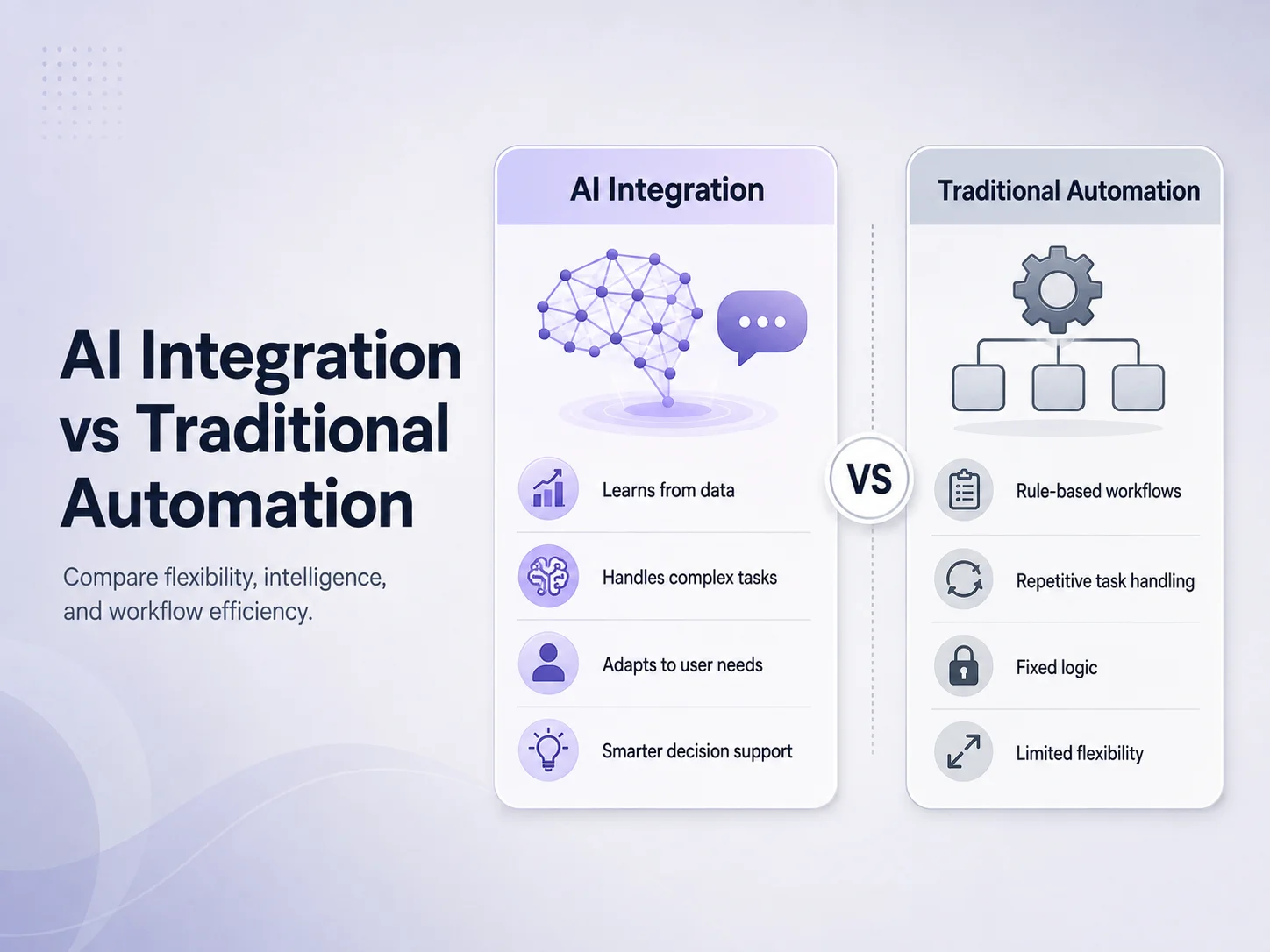
AI Integration vs Traditional Automation

Businesses have used automation for years to reduce repetitive work, improve consistency, and move information between systems. Traditional automation remains extremely useful, but artificial intelligence is expanding what can be automated by helping software work with language, documents, images, and other information that does not always follow predictable rules.

AI integration and traditional automation are not competing technologies. They solve different types of problems, and many of the strongest business systems use both together. Understanding the difference helps businesses choose the right approach instead of adding AI where a simple rule-based workflow would be faster, cheaper, and more reliable.

Traditional Automation Works Best With Clear Rules

Traditional automation follows predefined instructions. When a specific event happens, the system performs a known action. For example, when a customer submits a contact form, software can create a CRM lead, notify the sales team, and send a confirmation email. The workflow is predictable because the input and required actions are already understood.

This approach works especially well for calculations, approvals, notifications, scheduled tasks, data synchronization, invoice generation, status changes, and other processes where the business rules are clear.

Traditional automation is usually easier to test because the expected result can be defined in advance. If an invoice is paid, the system marks it as paid. If stock falls below a specific level, the system sends an alert. There is little need for interpretation.

AI Integration Handles Information That Is Less Predictable

AI becomes useful when software needs to interpret information rather than simply follow a fixed condition. Customer messages, documents, support tickets, images, meeting notes, product descriptions, and natural-language questions can vary significantly even when they represent the same underlying request.

For example, customers may describe the same delivery problem in dozens of different ways. Traditional automation would require developers to anticipate specific keywords or conditions. An AI-powered system can analyze the message, identify that it concerns delivery, summarize the problem, and pass structured information into the next part of the workflow.

AI can also help with document summarization, intelligent search, request classification, conversational assistants, content extraction, recommendations, and other tasks where the input is not completely structured.

Area Traditional Automation AI Integration
Best for Clear and predictable rules Language, documents and complex information
Output Usually deterministic Can vary depending on context
Example Send invoice after order approval Understand and categorize a customer request
Human language Limited unless rules are predefined Can interpret natural-language input
Control Very precise Requires appropriate validation

The Best Business Workflows Often Combine Both

A business does not usually need to choose between AI and traditional automation for an entire system. A better approach is to use each where it provides the most value.

Consider customer support. AI can understand a customer’s message, determine the likely issue, summarize the conversation, and identify important details. Traditional automation can then create the support ticket, assign the correct team, store the information in the database, and send a notification.

The same approach can work for lead management. AI can review an incoming enquiry and extract information such as the requested service, company type, or urgency. Standard business logic can then create the CRM record, assign a salesperson, schedule follow-up tasks, and update the lead status.

  • AI: understand, summarize, classify, extract, recommend
  • Traditional automation: calculate, validate, update, notify, approve, synchronize

This separation is important because AI-generated results are not always perfectly predictable. Financial calculations, access permissions, payment confirmation, account ownership, inventory updates, and other sensitive business rules should generally remain controlled by reliable application logic.

Which Approach Should Your Business Use?

If the workflow can be written as a clear series of conditions—“when this happens, perform these actions”—traditional automation is often the better solution. Adding AI to a simple deterministic workflow can increase cost and complexity without providing meaningful value.

AI integration becomes more valuable when employees spend significant time reading, interpreting, searching, categorizing, or summarizing information before they can take action. These are often the parts of a workflow that traditional automation struggles to handle.

Businesses should also consider accuracy requirements. An AI-generated product summary may tolerate some variation, while payroll calculations, payment processing, regulatory decisions, or account permissions require much stronger deterministic controls. In high-impact workflows, AI can assist employees without being responsible for the final decision.

Explore Business Automation Solutions

Build Automation Around the Process, Not the Technology

The most effective automation projects begin by examining the existing business process. Where are employees spending unnecessary time? Which tasks are repeated every day? Which steps depend on reading or interpreting information? Which actions already follow predictable rules?

Once those questions are answered, businesses can decide where standard automation is sufficient and where AI can provide additional value. This usually produces a more reliable system than attempting to make every workflow “AI-powered.”

Encoder IT Limited develops custom business automation solutions that can combine AI integration with traditional workflow automation. This can include AI assistants, document processing, customer support systems, CRM workflows, API integrations, SaaS platforms, internal business software, and custom process automation.

Traditional automation remains the strongest choice for predictable rules, while AI expands automation into areas that require interpretation and flexible understanding. Used together, they can reduce manual work without sacrificing the control businesses need for important operations.

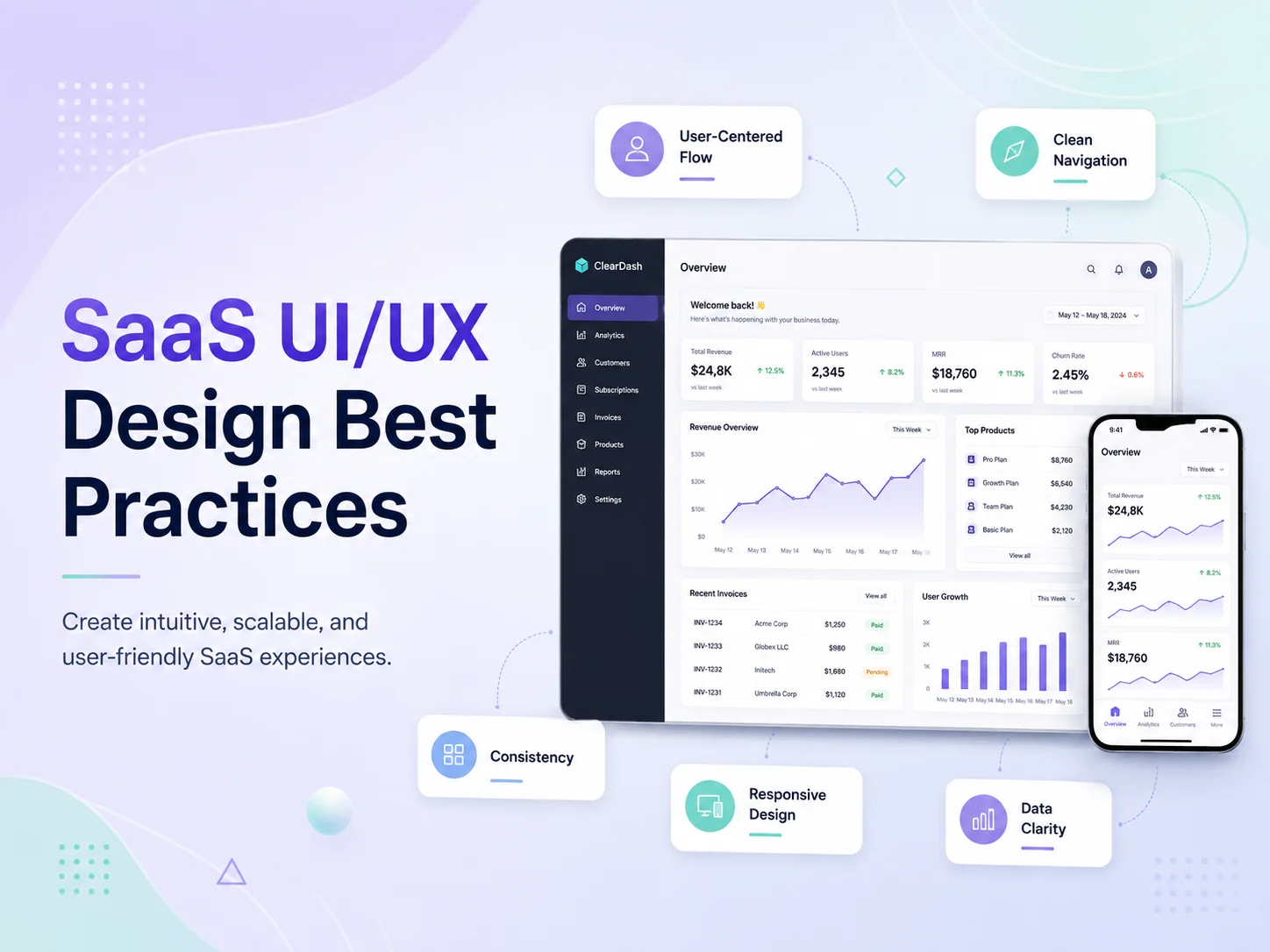
SaaS UI/UX Design Best Practices

SaaS products often contain more complexity than traditional websites. Users may need to manage accounts, teams, subscriptions, projects, reports, settings, notifications, billing, and large amounts of business data from the same application. Good SaaS UI/UX design helps organize that complexity so users can understand the product quickly and complete important tasks without unnecessary friction.

The best SaaS interfaces are not simply attractive dashboards. They help new users learn the product, make frequent actions easy to reach, present information clearly, and keep the experience consistent as more features are added. Strong UI/UX can also affect activation, product adoption, customer satisfaction, and long-term retention.

Design Around User Tasks, Not Around the Feature List

A common SaaS design mistake is organizing the interface around every feature the development team has built. This can lead to large navigation menus, crowded dashboards, and screens where too many actions compete for attention.

A better approach is to understand what users actually need to accomplish. A project-management platform may have dozens of features, but a typical user may spend most of their time checking assigned work, updating task status, communicating with teammates, and reviewing deadlines. Those workflows should be easier to reach than rarely used configuration options.

User roles also matter. Administrators, managers, employees, customers, and other users may need different information. Showing every user the same dashboard can create unnecessary complexity. Role-based navigation and dashboards can surface the features that are most relevant to each person’s responsibilities.

Progressive disclosure can also help. Advanced settings do not need to appear immediately if most users rarely change them. Keeping secondary options behind clear menus or expandable areas allows the primary interface to remain focused without removing functionality.

UIUX-banner-2

Make Dashboards Useful, Not Just Visually Impressive

The dashboard is often the first screen users see after logging in, so it should answer useful questions immediately. What requires attention? What changed recently? What should the user do next? A dashboard filled with decorative charts but no clear purpose can look sophisticated while providing very little practical value.

Important metrics should be selected based on the user’s goals. A sales manager might need pipeline value, upcoming follow-ups, and recent activity, while an employee dashboard may focus on assigned tasks, schedules, alerts, or deadlines. Information should be prioritized rather than giving every metric equal visual weight.

Charts and tables should also be easy to interpret. Labels, units, date ranges, status indicators, and filters need to be clear. Users should not have to guess whether a number represents today, the current month, or the complete account history.

When SaaS products contain large datasets, search, filters, sorting, saved views, pagination, and bulk actions become important UX features. A well-designed table can often be more useful than an elaborate visualization when users need to find and manage specific records.

Reduce Friction in Onboarding and Everyday Workflows

New users should be able to understand how to start without reading extensive documentation. Onboarding can guide them through the first meaningful actions, such as creating a workspace, inviting a teammate, connecting an integration, creating a project, or importing data.

However, onboarding should not become a long sequence of screens users are forced to complete before seeing the product. Contextual guidance is often more useful. Empty states can explain what belongs in a section and provide a direct action such as “Create your first project” or “Invite your team.”

The same focus on simplicity should continue after onboarding. Forms should avoid asking for information that is not required. Common actions should not be hidden under several menus. Users should receive immediate feedback when they save, update, delete, or submit something.

  • Keep primary navigation focused on frequent tasks
  • Use clear empty states with useful next actions
  • Reduce unnecessary form fields and steps
  • Provide visible success, error, and loading feedback
  • Use consistent labels for the same actions throughout the product
  • Make search, filtering, and bulk actions easy for data-heavy screens

Error states deserve particular attention. A message such as “Something went wrong” gives users little direction. When possible, explain what failed and what they can do next. If a payment method is declined, an integration disconnects, or a file upload fails, the interface should help users recover rather than leaving them stuck.

Build Consistency With a Scalable Design System

SaaS products frequently grow over several years. New modules, roles, settings, reports, and integrations are added by different designers and developers. Without a shared design system, interfaces can gradually become inconsistent.

A design system can define typography, colors, spacing, buttons, form controls, tables, cards, dialogs, alerts, navigation, status indicators, and other reusable components. This gives users a predictable experience while making new screens faster to design and develop.

Consistency is especially important for actions. If a primary button is blue in one area, green in another, and styled like a text link somewhere else, users need to relearn the interface repeatedly. The same applies to destructive actions, status colors, filters, confirmation dialogs, and form validation.

Responsive behavior should be part of the design system too. Many SaaS products are primarily used on desktop, but users may still check reports, approve requests, respond to notifications, or manage urgent tasks from tablets and phones. Important workflows should remain usable across appropriate screen sizes even if some complex administrative views are optimized for larger displays.

Improve Your SaaS Product Experience

Use Real Product Behavior to Improve the UX

SaaS UI/UX design should continue evolving after launch. Analytics can reveal which features are heavily used, where users abandon onboarding, and which workflows take more steps than expected. Support tickets and customer interviews can reveal problems that analytics alone cannot explain.

If customers repeatedly ask how to perform the same task, the issue may not be a lack of documentation. The interface itself may need to become clearer. If users rarely discover an important feature, its navigation or positioning may need improvement. If a form has a high abandonment rate, unnecessary fields or confusing validation may be creating friction.

Teams should prioritize improvements based on user impact rather than redesigning the product simply to make it look newer. Small changes to navigation, onboarding, table controls, forms, or feedback states can sometimes improve usability more than a complete visual redesign.

Encoder IT Limited provides UI/UX design and development for SaaS platforms, dashboards, customer portals, business applications, and other complex web products. Our work can include user-flow planning, wireframes, design systems, responsive interfaces, dashboard design, frontend development, and conversion-focused UX improvements.

Effective SaaS design makes complex software feel easier than it actually is. Clear navigation, useful dashboards, focused workflows, consistent components, strong feedback, and continuous improvement help users understand the product faster and accomplish more with less effort.

How AI Can Reduce Manual Work in Your Business

Many businesses still depend on employees to complete repetitive tasks such as reading emails, entering information, preparing summaries, categorizing requests, searching documents, updating records, and responding to similar customer questions every day. These activities may appear small individually, but together they can consume a significant amount of working time.

AI can reduce manual work by helping software understand information that traditional automation cannot easily process. Instead of requiring employees to read every message, document, or request from beginning to end, AI can identify useful information, organize it, prepare a response, or pass structured data into the next stage of a business workflow.

The goal does not need to be complete automation. In many businesses, the most effective approach is to let AI handle repetitive preparation while employees remain responsible for decisions that require experience, approval, or human judgment.

Start With the Work Employees Repeat Every Day

Before introducing AI, businesses should identify where employees spend unnecessary time. A useful starting point is looking for processes that happen frequently and require people to read, copy, organize, summarize, or search for information.

Customer enquiries are a common example. Employees may receive dozens of messages asking about similar products, services, order statuses, appointments, policies, or account information. AI can understand the incoming question, find relevant information, and prepare an answer. If the problem requires a person, the system can collect the important details first and send the conversation to the appropriate employee.

Another example is document processing. Businesses may receive invoices, forms, applications, reports, contracts, or customer documents that employees manually review before entering important details into another system. AI can assist by extracting information, identifying document types, summarizing content, or highlighting details that need attention.

The same principle applies to internal work. Employees frequently search policies, previous reports, product documentation, customer records, or training materials. An AI-powered internal assistant can make this information easier to find without requiring employees to manually search through multiple folders or systems.

AI Can Handle the Information Before Automation Handles the Action

Traditional workflow automation works extremely well when the input is already structured. If an invoice reaches its due date, software can send a reminder. If a customer completes an order, the system can update inventory and send a confirmation. The rules are known in advance.

Manual work often appears before these automated steps because information arrives in an unpredictable form. Customers write messages differently, documents use different layouts, and employees describe the same issue using different words. AI can help interpret this information and transform it into something the existing software can use.

For example, a customer may write a long message explaining that an order arrived damaged. AI can identify the order-related issue, summarize the complaint, extract an order number if available, and classify the request. Traditional automation can then create the support ticket, assign the correct department, update the CRM, and notify an employee.

This combination can be more practical than asking AI to manage the entire process. AI handles interpretation, while normal software continues controlling predictable and sensitive business actions.

Where Businesses Can Reduce Manual Work With AI

The best opportunities vary by company, but several types of work are especially suitable because employees repeatedly process large amounts of text or information.

  • Customer support: answer routine questions, summarize conversations, and categorize support requests.
  • Lead management: review enquiries, extract customer requirements, and organize leads before sales follow-up.
  • Document processing: summarize documents and extract useful information from submitted files.
  • Internal knowledge: help employees search company policies, procedures, documentation, and other business information.
  • Content preparation: prepare first drafts of descriptions, emails, reports, or routine communications.
  • Data organization: convert unstructured information into categories or structured fields that other systems can process.

Consider a sales team that receives enquiries through a website. Without automation, someone may need to read each submission, understand the requested service, determine its priority, create a CRM record, and assign it to a salesperson. AI can assist with the interpretation and classification, while the CRM workflow performs the record creation and assignment automatically.

In another business, employees may spend hours summarizing service reports or customer conversations. AI can prepare a first summary in seconds, allowing the employee to review and correct it rather than starting from an empty page. The employee remains involved, but the repetitive part of the work becomes much smaller.

Connect AI With the Software Your Business Already Uses

AI automation does not necessarily require replacing your current software. It can often be integrated into an existing website, mobile app, CRM, SaaS platform, customer portal, or custom business application through APIs.

An existing support platform can gain AI-assisted ticket categorization. A customer portal can receive an intelligent knowledge assistant. A mobile application can add document processing. A CRM can automatically summarize long conversations before a salesperson opens a lead.

This approach allows businesses to introduce AI gradually. Instead of rebuilding a complete system, the company can choose one high-value workflow, measure whether it reduces employee effort, and expand automation only when the results justify it.

Automate Your Business Processes

Decide What Should Stay Under Human Control

Reducing manual work does not mean every process should run without employees. AI can produce incorrect or incomplete results, especially when information is ambiguous or the system does not have enough context.

Businesses should therefore decide which actions AI can perform automatically and which require review. A draft support response may be safe for an employee to review quickly, while financial approvals, account permissions, legal decisions, healthcare decisions, or other high-impact actions require stronger controls.

Good automation also needs reliable data and clear processes. If employees currently follow several conflicting procedures, adding AI may automate the confusion rather than solve it. Businesses often benefit from simplifying the workflow first and then deciding which stages should use AI, traditional automation, or human approval.

Encoder IT Limited develops AI integration and business automation solutions for websites, mobile applications, SaaS platforms, customer portals, and internal systems. This can include AI assistants, customer-support automation, document processing, workflow automation, API integrations, intelligent search, and custom business software.

The most valuable use of AI is often not replacing an entire job or business process. It is removing the repeated work surrounding that process—reading, searching, categorizing, extracting, summarizing, and preparing information—so employees can spend more time on decisions, customers, and work that genuinely requires human expertise.

How to Build a Fast and Secure Online Store

A successful online store needs more than attractive product pages. Customers expect products to load quickly, search and filtering to respond smoothly, checkout to work without delays, and payments to be handled securely. If an e-commerce website is slow or appears unreliable, customers may leave before completing their purchase.

Building a fast and secure online store requires attention across the complete platform—from hosting, images, frontend code, and database performance to authentication, payments, software updates, APIs, and administrative access. Performance and security should be planned during development rather than treated as separate fixes after the store is already live.

Build Performance Into the Store From the Beginning

E-commerce websites can become heavy quickly because they contain product images, variations, filters, reviews, tracking scripts, payment services, promotional tools, search features, and third-party applications. Each individual feature may be useful, but together they can significantly increase the amount of work required to load a page.

Product images are one of the first areas to optimize. High-quality photography is important for online shopping, but customers should not need to download unnecessarily large files. Images should be resized for their actual display dimensions, compressed appropriately, and loaded efficiently. Product galleries should also avoid loading every large image immediately when only the first few are visible.

The same principle applies to scripts and plugins. WooCommerce, Shopify, and custom e-commerce stores often accumulate analytics tools, chat systems, marketing pixels, popup applications, recommendation engines, review widgets, and other extensions. Businesses should periodically review which tools genuinely support sales and remove unnecessary ones rather than allowing the store to become increasingly complex.

Hosting and backend performance matter as well. A store that works comfortably with fifty daily orders may need different infrastructure when traffic and product data increase significantly. Slow database queries, inefficient search, unnecessary API calls, or limited server resources can make product browsing and checkout noticeably slower as the business grows.

Protect Customer Accounts and Checkout

An online store handles information that deserves careful protection. Depending on the platform, this may include customer names, addresses, order histories, account credentials, payment-related information, and business transaction records.

The complete store should use HTTPS, and sensitive payment credentials should remain protected rather than being exposed in browser-side code. Payment gateways should be integrated using the secure methods provided by the payment provider, while the backend should verify important transaction events before marking an order as paid.

Customer and administrator authentication also requires attention. Strong passwords, appropriate account permissions, secure password recovery, and additional authentication for sensitive administrative access can reduce unnecessary risk. Employees should only receive the level of access required for their role.

For example, someone responsible for managing product descriptions may not need permission to install extensions or change payment settings. Limiting administrative privileges reduces the impact of both mistakes and compromised accounts.

A secure e-commerce store should never rely on the checkout screen alone. Payments, customer permissions, prices, order totals, discounts, inventory changes, and other important actions should be verified by trusted backend logic before the business treats them as complete.

Keep Checkout Fast, Simple, and Reliable

Checkout is one of the most important areas of an online store because even small problems can interrupt a purchase that was already close to completion. Customers should not need to navigate through unnecessary steps, create complicated accounts, or wait for several slow third-party services before paying.

Forms should request only the information required to process the order. Address fields, shipping options, discounts, payment methods, and order totals should update clearly so customers understand exactly what they are purchasing and how much they will pay.

The checkout also needs to handle failure correctly. A declined payment, temporary network problem, expired session, or failed external API should not leave the customer unsure whether an order was placed. Clear messages and reliable order states help prevent duplicate payments and unnecessary support requests.

  • Optimize product images and media
  • Reduce unnecessary apps, plugins, and scripts
  • Use reliable hosting and efficient caching
  • Protect customer and administrator accounts
  • Verify payments through secure backend processes
  • Keep checkout forms simple
  • Maintain extensions and third-party integrations
  • Use backups, monitoring, and recovery procedures

Security and Speed Continue After the Store Launches

An online store can be fast and secure when it launches and become slower or more vulnerable over time. New products are added, databases grow, marketing teams install additional tools, payment providers change integrations, and software receives updates.

For WooCommerce stores, WordPress core, themes, plugins, and custom integrations should be maintained carefully. Shopify businesses should also review installed applications, theme customizations, scripts, and integrations to make sure they are still necessary and functioning correctly. Custom e-commerce platforms require similar attention to frameworks, libraries, servers, APIs, and databases.

Monitoring can help businesses discover problems before customers report them. Checkout failures, unexpected downtime, slow database requests, unusual login activity, broken integrations, and repeated application errors can all indicate that something needs investigation.

Backups are equally important. Businesses should have a practical recovery process for website files, databases, orders, products, and other important information. A backup is most valuable when the team knows how to restore it if an update, technical failure, or security incident damages the store.

Improve Your Online Store

Balance Features With Performance and Security

E-commerce businesses naturally want to add features that improve marketing and customer experience. Product recommendations, loyalty programs, live chat, advanced filters, subscriptions, wishlists, reviews, and personalization can all be valuable. The problem begins when every feature adds another script, plugin, API request, or point of failure without being reviewed as part of the complete platform.

The strongest stores prioritize features that contribute directly to customer experience or business operations. A simpler store that loads quickly and processes orders reliably can often provide more value than a feature-heavy platform that becomes difficult to maintain.

Encoder IT Limited develops and optimizes WooCommerce, Shopify, and custom e-commerce platforms. Our services can include store development, performance optimization, payment gateway integration, security improvements, custom functionality, API integrations, checkout development, and ongoing e-commerce maintenance.

A fast and secure online store is created through many coordinated decisions rather than one plugin or optimization setting. Efficient code, optimized media, reliable infrastructure, secure payments, controlled access, careful integrations, and ongoing maintenance all contribute to an e-commerce experience customers can use with confidence.