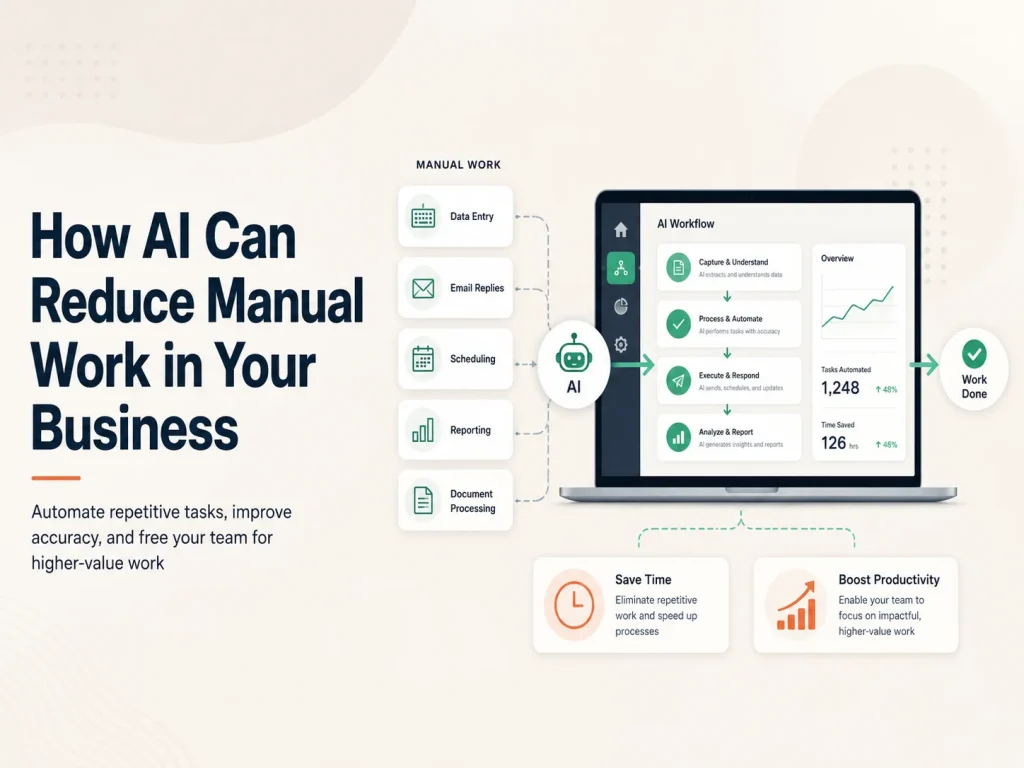
Businesses have used automation for years to reduce repetitive work, improve consistency, and move information between systems. Traditional automation remains extremely useful, but artificial intelligence is expanding what can be automated by helping software work with language, documents, images, and other information that does not always follow predictable rules.
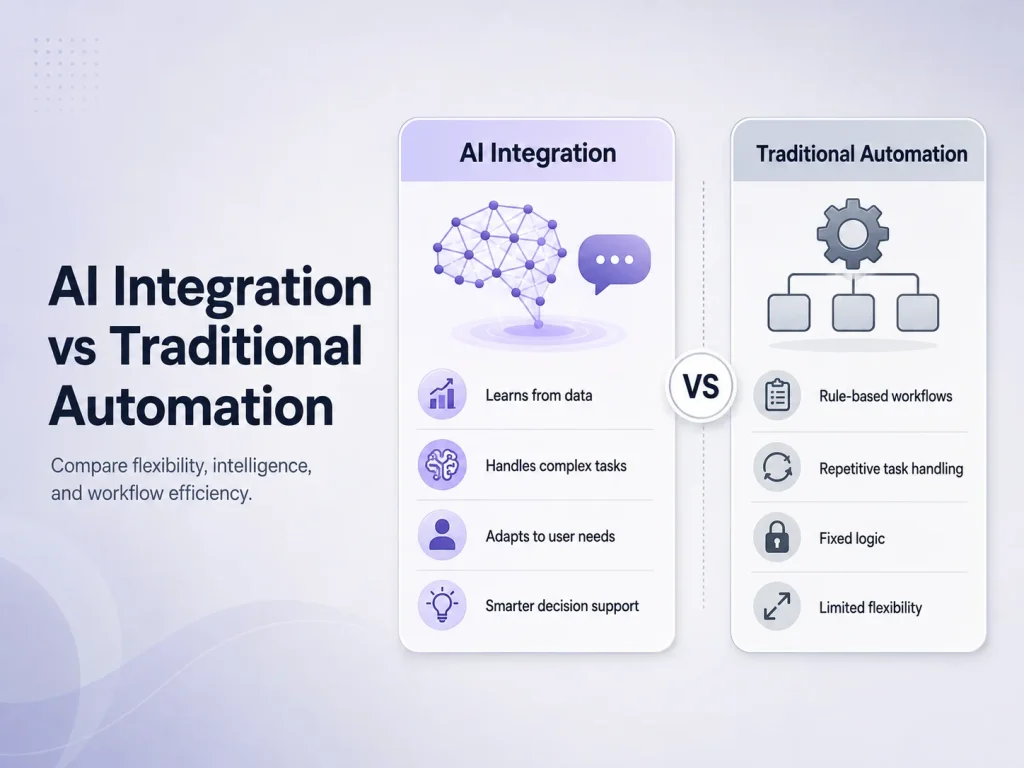
AI integration and traditional automation are not competing technologies. They solve different types of problems, and many of the strongest business systems use both together. Understanding the difference helps businesses choose the right approach instead of adding AI where a simple rule-based workflow would be faster, cheaper, and more reliable.
Traditional Automation Works Best With Clear Rules
Traditional automation follows predefined instructions. When a specific event happens, the system performs a known action. For example, when a customer submits a contact form, software can create a CRM lead, notify the sales team, and send a confirmation email. The workflow is predictable because the input and required actions are already understood.
This approach works especially well for calculations, approvals, notifications, scheduled tasks, data synchronization, invoice generation, status changes, and other processes where the business rules are clear.
Traditional automation is usually easier to test because the expected result can be defined in advance. If an invoice is paid, the system marks it as paid. If stock falls below a specific level, the system sends an alert. There is little need for interpretation.
AI becomes useful when software needs to interpret information rather than simply follow a fixed condition. Customer messages, documents, support tickets, images, meeting notes, product descriptions, and natural-language questions can vary significantly even when they represent the same underlying request.
For example, customers may describe the same delivery problem in dozens of different ways. Traditional automation would require developers to anticipate specific keywords or conditions. An AI-powered system can analyze the message, identify that it concerns delivery, summarize the problem, and pass structured information into the next part of the workflow.
AI can also help with document summarization, intelligent search, request classification, conversational assistants, content extraction, recommendations, and other tasks where the input is not completely structured.
| Area |
Traditional Automation |
AI Integration |
| Best for |
Clear and predictable rules |
Language, documents and complex information |
| Output |
Usually deterministic |
Can vary depending on context |
| Example |
Send invoice after order approval |
Understand and categorize a customer request |
| Human language |
Limited unless rules are predefined |
Can interpret natural-language input |
| Control |
Very precise |
Requires appropriate validation |
The Best Business Workflows Often Combine Both
A business does not usually need to choose between AI and traditional automation for an entire system. A better approach is to use each where it provides the most value.
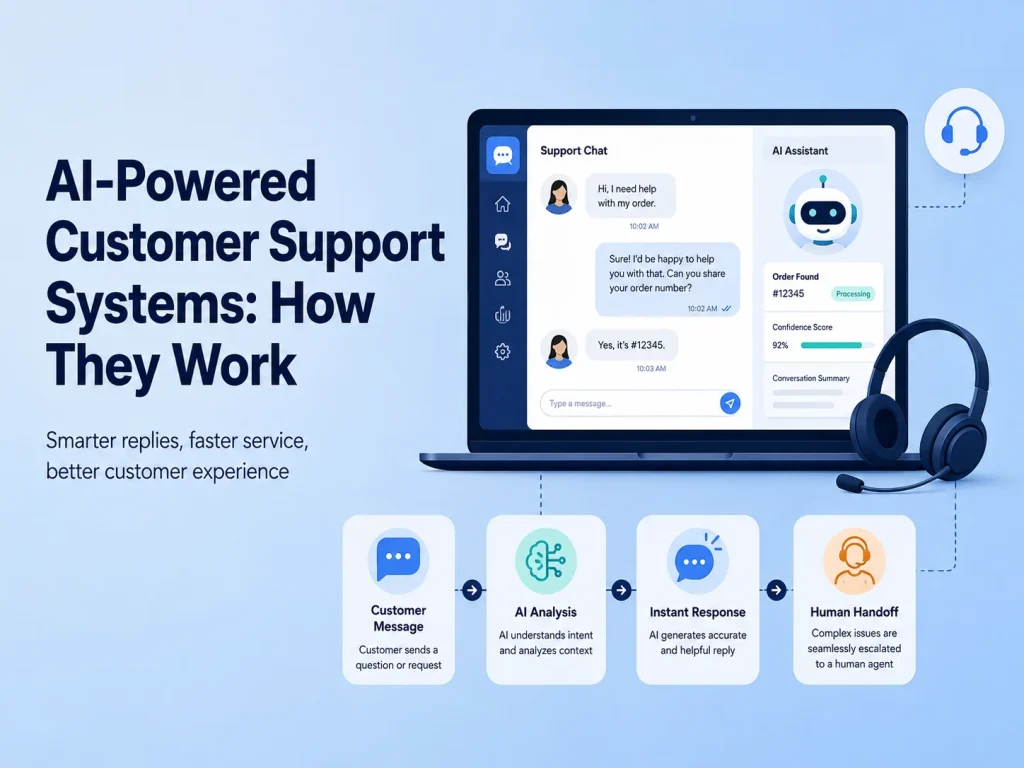
Consider customer support. AI can understand a customer’s message, determine the likely issue, summarize the conversation, and identify important details. Traditional automation can then create the support ticket, assign the correct team, store the information in the database, and send a notification.
The same approach can work for lead management. AI can review an incoming enquiry and extract information such as the requested service, company type, or urgency. Standard business logic can then create the CRM record, assign a salesperson, schedule follow-up tasks, and update the lead status.
- AI: understand, summarize, classify, extract, recommend
- Traditional automation: calculate, validate, update, notify, approve, synchronize
This separation is important because AI-generated results are not always perfectly predictable. Financial calculations, access permissions, payment confirmation, account ownership, inventory updates, and other sensitive business rules should generally remain controlled by reliable application logic.
Which Approach Should Your Business Use?
If the workflow can be written as a clear series of conditions—“when this happens, perform these actions”—traditional automation is often the better solution. Adding AI to a simple deterministic workflow can increase cost and complexity without providing meaningful value.
AI integration becomes more valuable when employees spend significant time reading, interpreting, searching, categorizing, or summarizing information before they can take action. These are often the parts of a workflow that traditional automation struggles to handle.
Businesses should also consider accuracy requirements. An AI-generated product summary may tolerate some variation, while payroll calculations, payment processing, regulatory decisions, or account permissions require much stronger deterministic controls. In high-impact workflows, AI can assist employees without being responsible for the final decision.
Explore Business Automation Solutions
Build Automation Around the Process, Not the Technology
The most effective automation projects begin by examining the existing business process. Where are employees spending unnecessary time? Which tasks are repeated every day? Which steps depend on reading or interpreting information? Which actions already follow predictable rules?
Once those questions are answered, businesses can decide where standard automation is sufficient and where AI can provide additional value. This usually produces a more reliable system than attempting to make every workflow “AI-powered.”
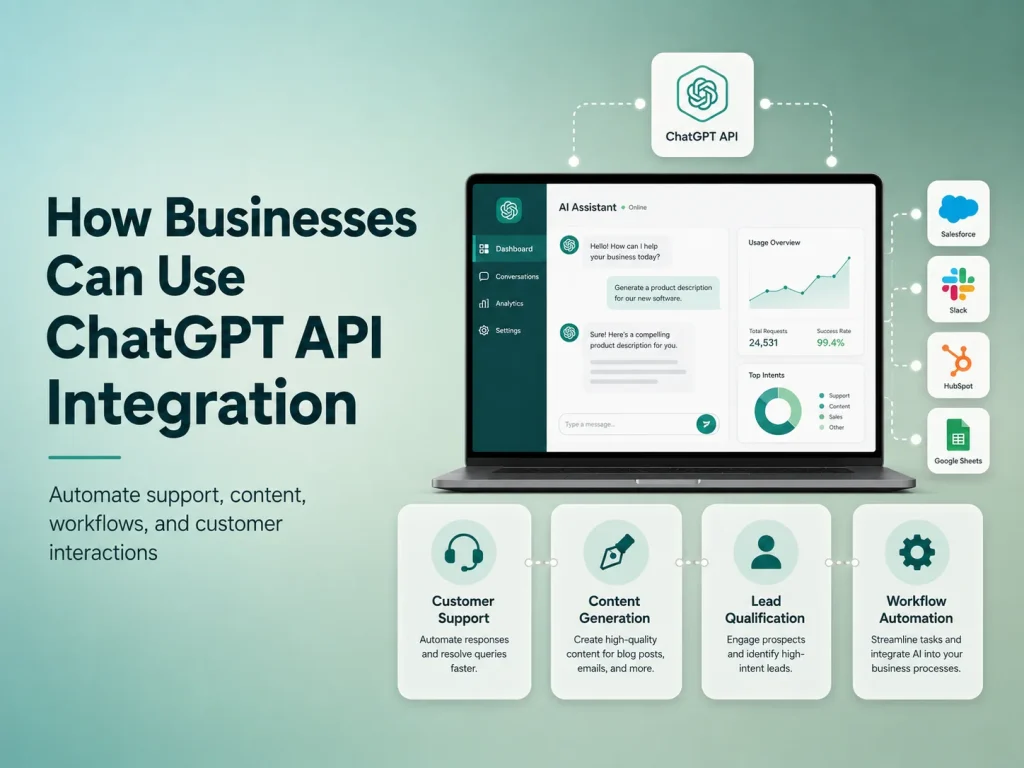
Encoder IT Limited develops custom business automation solutions that can combine AI integration with traditional workflow automation. This can include AI assistants, document processing, customer support systems, CRM workflows, API integrations, SaaS platforms, internal business software, and custom process automation.
Traditional automation remains the strongest choice for predictable rules, while AI expands automation into areas that require interpretation and flexible understanding. Used together, they can reduce manual work without sacrificing the control businesses need for important operations.