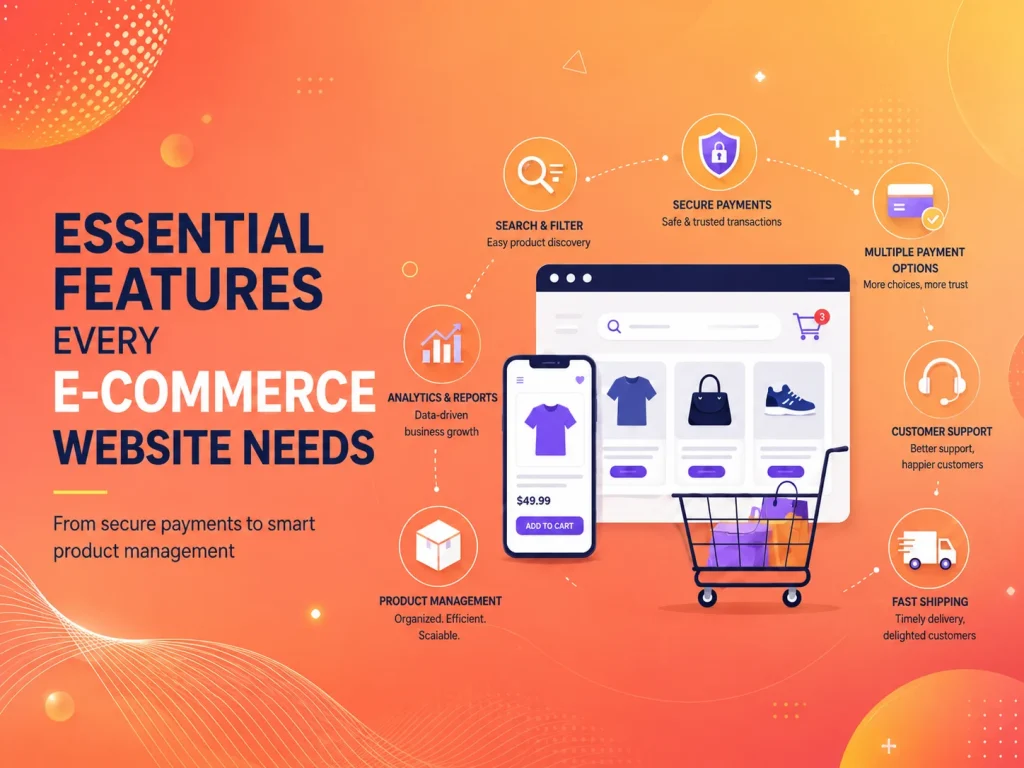
A successful e-commerce website needs more than attractive product pages and a working checkout. Customers should be able to discover products easily, understand what they are buying, trust the store, complete payment without unnecessary friction, and follow their order after purchase.
The exact functionality depends on the type of business, but several essential e-commerce website features provide the foundation for a reliable online shopping experience. These features should work together rather than feeling like separate plugins or tools added over time.
Product Discovery Should Be Fast and Simple
Customers should be able to find the right product without browsing through dozens of unrelated pages. Clear categories, logical navigation, useful search, and filtering become increasingly important as the product catalog grows.
Filters should reflect how customers actually compare products. A clothing store may need size, color, brand, price, and availability filters, while an electronics store may need specifications, compatibility, storage, screen size, or technical features.
Search should also provide useful results when customers use common product names or related terms. A technically accurate search system that returns no results because the customer did not type an exact product title can still create a poor shopping experience.
Once a customer reaches a product page, the information should make the purchasing decision easier. High-quality images, accurate pricing, product variations, availability, descriptions, dimensions, specifications, delivery details, and other important information should be clearly presented.
Cart and Checkout Need to Remove Buying Friction
The shopping cart should give customers a clear summary of what they intend to purchase. Products, quantities, selected variations, discounts, shipping-related information, and totals should be easy to review and change.
Checkout should then require only the information necessary to complete the transaction. Long registration processes, repeated fields, unclear validation errors, and unnecessary steps can cause customers to abandon a purchase they were already prepared to make.
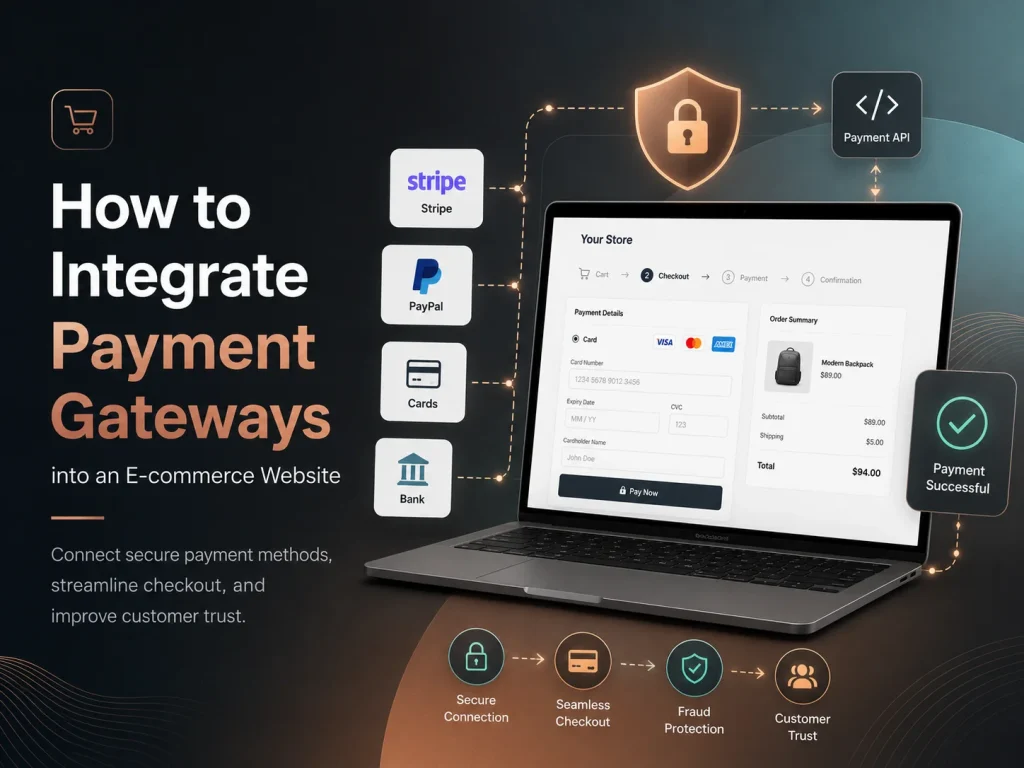
Providing suitable payment options is equally important. The right methods depend on the market and customer base, but the checkout should connect securely with trusted payment providers and give customers clear confirmation when payment succeeds or fails.
- Easy-to-edit shopping cart
- Simple and mobile-friendly checkout
- Multiple appropriate payment methods
- Clear shipping costs and delivery options
- Discount and coupon handling where required
- Reliable payment and order confirmation
Businesses should also plan for failed payments, abandoned transactions, refunds, and cancellations. E-commerce systems need clear order states so customers and administrators can understand what happened without manually investigating every transaction.
Customer Accounts, Orders, and Communication
Customer accounts can make repeat purchases easier by storing useful information such as addresses, order history, saved products, subscriptions, or account preferences. However, businesses should avoid making account creation unnecessarily difficult when a simpler checkout experience would serve the customer better.
After purchase, customers should receive clear confirmation and be able to understand the status of their order. Depending on the business, this may include payment confirmation, processing updates, shipment notifications, tracking information, delivery status, or pickup instructions.
Automated email or mobile notifications can reduce support questions because customers do not need to contact the business simply to ask whether an order has shipped.
Customer support should also remain easy to access. FAQs, contact forms, live chat, support tickets, AI assistants, or other communication options can help customers resolve problems without leaving the store.
Inventory, Security, and Store Management Matter Behind the Scenes
Many essential e-commerce features are not immediately visible to customers. Inventory management, order administration, reporting, security, and integrations are critical to operating the store reliably.
Stock should update correctly when products are purchased, cancelled, returned, or restocked. Stores with product variations need accurate inventory at the variation level rather than only a total quantity for the parent product. Low-stock notifications can help businesses reorder popular products before they become unavailable.
Security needs to protect both customers and administrators. The store should use HTTPS, maintain plugins and software, secure administrator access, validate important actions on the backend, and integrate payment providers using supported secure methods.
Backups and monitoring are important too. If an update causes a problem or an integration stops working, the business should have a reliable way to identify the issue and recover the store.
Build a Better E-commerce Website
Integrations and Analytics Help the Store Grow
As an e-commerce business grows, the store often needs to connect with other systems. Shipping providers can generate rates and tracking information, CRM systems can receive customer data, accounting platforms can receive transaction information, and inventory systems can synchronize stock across several sales channels.
These integrations can reduce manual work, but they should be implemented carefully. The store should record errors, prevent duplicate updates, and provide administrators with enough information to understand when synchronization fails.
Analytics should also be part of the e-commerce foundation. Businesses need to know which products receive attention, which marketing channels generate sales, where customers leave the checkout process, and which pages create problems.
This information can guide improvements in product presentation, navigation, pricing, checkout, marketing, and customer experience instead of relying only on assumptions.
The Best E-commerce Features Support the Buying Journey
Not every store needs subscriptions, loyalty programs, advanced recommendations, AI search, marketplaces, or dozens of integrations. Adding features simply because competitors use them can increase complexity without improving sales.
Encoder IT Limited develops WooCommerce, Shopify, and custom e-commerce solutions with features such as product management, payment gateways, checkout customization, inventory and order systems, shipping integrations, customer accounts, API integrations, performance optimization, and ongoing maintenance.
The essential features of an e-commerce website are the ones that make shopping and store management reliable: customers can find products easily, understand what they are buying, pay securely, receive clear order information, and get support when they need it. Behind the scenes, the business should have accurate inventory, manageable orders, secure administration, useful reporting, and a platform that can continue growing as requirements change.