Mobile applications often handle sensitive information such as user accounts, personal details, payments, business data, documents, location information, and authentication credentials. That makes security an important part of mobile app development from the beginning, not something that should be added only before launch.
A secure mobile app needs protection across the complete system. The mobile interface, backend APIs, database, authentication process, third-party integrations, local device storage, and network communication all work together. A weakness in any one of these areas can affect the security of the entire application.
Protect Authentication and User Access
Strong authentication is one of the first layers of mobile app security. Applications that contain private customer or business information should use reliable login systems, secure password recovery, session management, and additional verification where the risk justifies it. Modern platforms also support stronger authentication approaches such as passkeys and device-based authentication.
Authentication, however, only confirms who the user is. The application must also determine what that user is allowed to do. A normal customer should not be able to access administrator records simply by changing an API request, and one customer should never be able to retrieve another customer’s information by modifying an identifier. OWASP’s mobile security standard treats authentication and authorization as core security areas for exactly this reason.
Important authorization decisions should therefore be enforced by the backend rather than relying on buttons, screens, or restrictions inside the mobile application itself.
Secure APIs, Data, and Network Communication
Most mobile applications communicate with a backend through APIs. Login requests, customer profiles, orders, bookings, subscriptions, payments, and business records may all travel between the app and the server. These connections should use secure encrypted communication, and sensitive requests should be authenticated and validated before information is returned.
Android’s current security guidance recommends secure network communication and careful handling of sensitive data. On Apple platforms, App Transport Security is designed to enforce secure network connections using modern transport-security requirements.
Local storage also deserves attention. Passwords, private API credentials, authentication tokens, or other sensitive information should not simply be written into ordinary files or unprotected preferences. Mobile platforms provide protected storage mechanisms for information that genuinely needs to remain on the device; Apple, for example, provides Keychain services for securely storing small pieces of sensitive data.
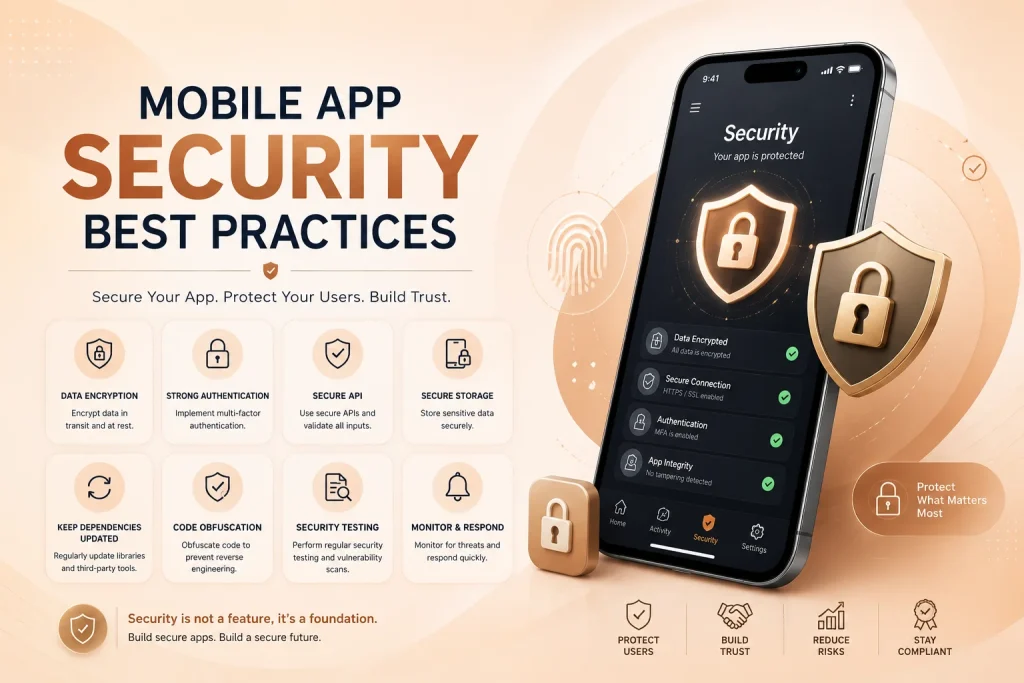
Mobile app security is strongest when protection exists across every layer of the product. Secure login alone is not enough—the application also needs protected APIs, controlled permissions, safe data storage, reliable backend authorization, maintained dependencies, and continuous security reviews after launch.
Request Only the Permissions the App Actually Needs
Mobile applications can request access to powerful device features such as the camera, microphone, contacts, files, notifications, Bluetooth, and location services. Every additional permission increases the amount of information or functionality available to the application, so permissions should have a clear purpose.
If location is only required when a customer searches for nearby stores, the app should not collect location continuously without a genuine business reason. If camera access is needed only to upload a document, the request should appear when the user starts that action instead of unnecessarily asking for access during registration.
Android’s permission guidance emphasizes user control, transparency, and data minimization—using only the data required for the specific task the user is performing. This principle also improves customer trust because users can more easily understand why an application needs access to their device.
Never Put Sensitive Business Logic Only Inside the App
A mobile application runs on a device that the business does not control. Application packages can be inspected, traffic can be analyzed, and attackers can attempt to communicate directly with backend APIs. For that reason, important business decisions should not depend entirely on values sent from the app.
Prices, discounts, subscription status, payment confirmation, user roles, account ownership, administrative permissions, and other sensitive rules should be verified on the server. Hiding an administrator button or disabling a field in the interface does not prevent someone from manually sending a modified request.
The same principle applies to API keys and credentials. Secrets that provide privileged access to payment providers, databases, AI services, or internal systems should generally remain on a secure backend rather than being embedded directly in a downloadable mobile application.
Keep Libraries, Integrations, and the App Updated
Modern mobile apps usually depend on third-party libraries and SDKs for payments, analytics, notifications, authentication, maps, social login, cloud services, and many other functions. These dependencies make development faster, but they also need maintenance.
Development teams should regularly review dependencies, remove packages that are no longer needed, apply relevant security updates, and test new versions before releasing them. Backend systems and APIs require the same attention because mobile security does not stop at the application interface.
Security testing should also be part of the release process. Authentication, permissions, sensitive storage, API authorization, network communication, payment workflows, and important business actions should be checked before major releases. OWASP’s MASVS and Mobile Application Security Testing Guide provide established frameworks for evaluating these areas.
Build Security Into the Development Process
The easiest time to address many security problems is while the application architecture is still being designed. Planning authentication, API permissions, data access, storage, user roles, logging, and third-party integrations early can prevent expensive changes later.
Developers should also avoid exposing sensitive information through debugging logs or overly detailed error messages. Production logs can still provide useful information for diagnosing failures, but passwords, access tokens, payment details, and unnecessary personal information should not be written into them.
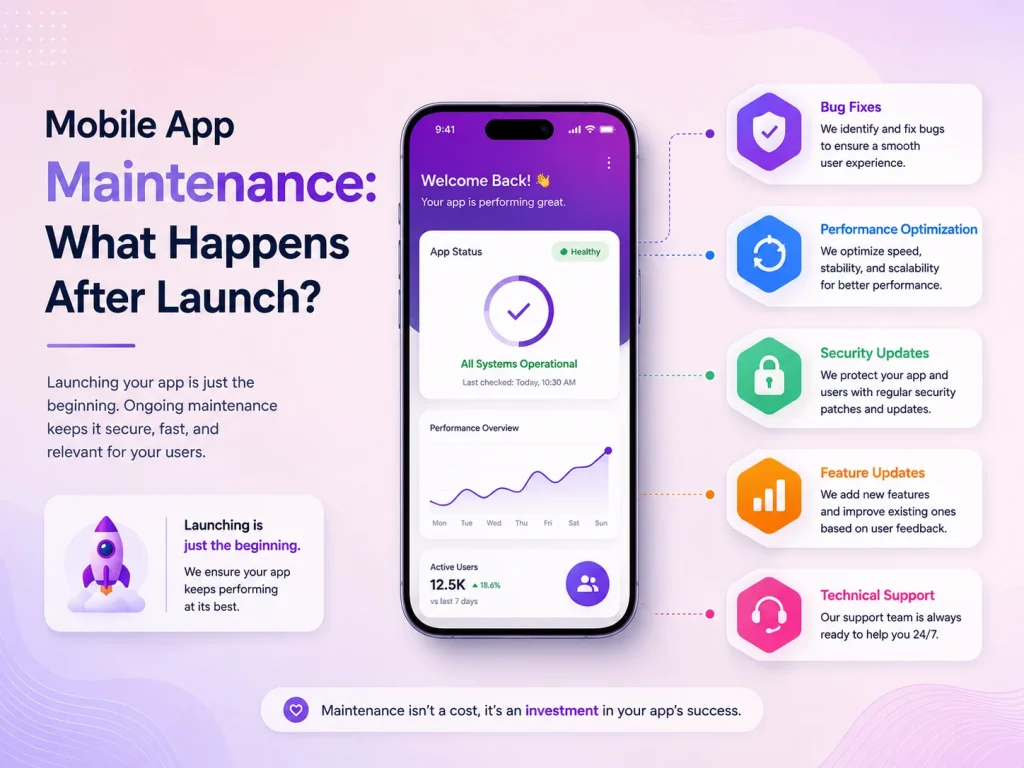
Security also continues after launch. Operating systems change, dependencies receive updates, new vulnerabilities are discovered, and business functionality evolves. Applications that process payments, private customer information, healthcare data, or important business operations may require particularly careful monitoring and maintenance.
Secure Mobile App Development With Encoder IT Limited
Encoder IT Limited develops Android and iOS applications with security considered across the mobile interface, backend APIs, authentication, permissions, integrations, and business workflows.
Our mobile development services include Flutter and React Native applications, native Android and iOS development, secure backend and API development, authentication systems, role-based permissions, payment integrations, third-party services, application modernization, and ongoing maintenance.
We focus on building mobile applications that are not only functional and user-friendly but also structured for reliable long-term operation and secure access to business and customer information.
Request a Quote
Mobile app security cannot be handled by one feature or one development task. It comes from combining secure authentication, backend authorization, encrypted communication, protected data, minimal permissions, maintained dependencies, careful testing, and ongoing updates.
When these practices are considered throughout the application’s lifecycle, businesses can reduce security risks while creating a more dependable mobile experience for their users.