Choosing a mobile app development company is an important business decision because the quality of the development partner can affect the app’s performance, usability, security, scalability, and long-term maintenance. A low-cost proposal may look attractive initially, but poor planning or weak technical decisions can create much higher costs later.
The right company should understand more than how to write code. It should be able to understand your business requirements, recommend an appropriate technical approach, design a user-friendly experience, build the backend correctly, test the product, and continue supporting it after launch.
Look at Relevant Mobile App Experience
Start by reviewing the company’s previous mobile app projects. A strong portfolio can show whether the team has experience with applications similar to what you want to build, such as e-commerce apps, marketplaces, SaaS platforms, booking systems, customer portals, healthcare apps, or internal business applications.
Do not judge a portfolio only by visual appearance. Try to understand the complexity behind the applications. Features such as payments, real-time notifications, user roles, subscriptions, maps, file uploads, chat, dashboards, API integrations, and third-party services usually require more technical experience than a simple informational app.
It is also useful to ask whether the company worked on the complete application or only one part of it. A team that can handle UI/UX design, mobile development, backend APIs, integrations, testing, and deployment may provide a more coordinated development process.
Make Sure They Understand Your Business Before Discussing Technology
A good mobile app development company should first understand what the application needs to achieve. Before recommending Flutter, React Native, native Android, native iOS, or any other technology, the team should understand your users, workflows, business model, integrations, expected growth, and important features.
If a development company immediately recommends a technology without discussing these requirements, the decision may be based more on what the team prefers to build than what the project actually needs.
For example, a relatively standard business application may benefit from cross-platform development because Android and iOS can share much of the same codebase. A highly specialized application using advanced device capabilities may require a different approach. The technology should support the product rather than define it.
Evaluate Communication and Development Process
Technical ability is important, but communication often determines whether a project runs smoothly. Mobile applications involve many decisions during planning, design, development, testing, and launch. If communication is unclear, small misunderstandings can eventually become expensive development changes.
Ask how the company handles requirements, design approvals, development milestones, testing, feedback, and project updates. You should know who will communicate with you, how progress will be reviewed, and how changes to the original scope will be managed.
A structured process does not mean the project cannot change. Mobile products often evolve during development. The important point is that changes should be discussed clearly so everyone understands their effect on budget, timeline, and existing functionality.
Check Their Backend, API, and Security Capabilities
The mobile interface is only one part of many applications. User accounts, payments, subscriptions, bookings, notifications, dashboards, reports, permissions, and business data often depend on backend APIs and databases.
A development company should understand how to design secure authentication, user permissions, API communication, databases, file storage, payment workflows, and third-party integrations. Important business rules should be protected on the backend rather than relying only on restrictions inside the mobile application.
- Mobile UI/UX design
- Android and iOS development
- Backend and API development
- Authentication and user permissions
- Payment and third-party integrations
- Testing and performance optimization
- App Store and Google Play deployment
- Post-launch maintenance
If several of these areas are required, working with a team that can manage them together can reduce coordination problems between separate designers, developers, and backend teams.
Request a Quote
Do Not Choose Based on Price Alone
Price is naturally an important part of choosing a development company, but the cheapest proposal is not always the least expensive option over the life of the product. Poor architecture, weak testing, undocumented code, or rushed development can make future updates much harder.
When comparing proposals, look at what is included. One company may provide only mobile development, while another may include planning, UI/UX design, backend development, testing, deployment, and initial support. Two prices can therefore represent very different levels of work.
You should also understand how future changes will be handled. Mobile applications normally continue evolving after launch, so code quality and maintainability can be more valuable than saving a small amount during the first development phase.
Ask What Happens After Launch
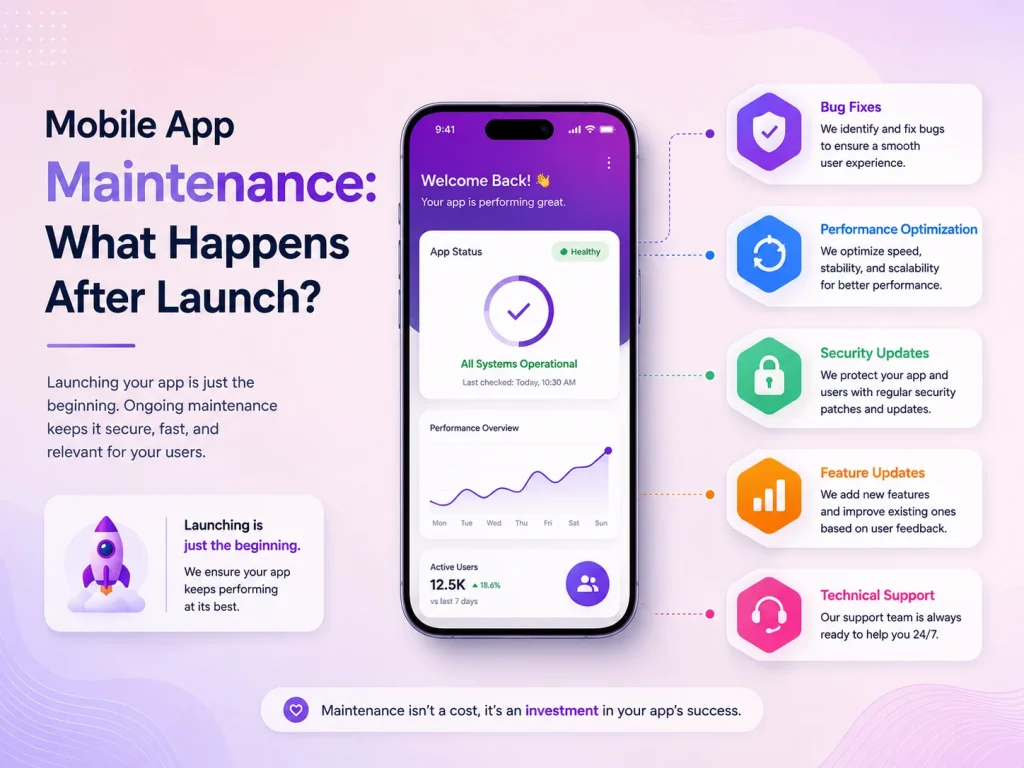
A reliable development partner should have a clear answer about post-launch support. Real users may discover bugs, operating systems will continue changing, SDKs require updates, and new features may become necessary as the business grows.
Ask whether the company offers maintenance, how urgent bugs are handled, whether they can continue developing new features, and how application ownership and source code are managed after completion.
A company that understands the long-term lifecycle of mobile software is generally better prepared to build an application that can be maintained rather than one designed only to reach the first launch date.
Choosing the Right Development Partner
The best mobile app development company is not necessarily the largest team or the one with the longest feature list. Look for a company that asks useful questions, understands your business goals, communicates clearly, explains technical decisions, and has experience delivering the type of product you need.
Encoder IT Limited provides mobile app design and development services for businesses and startups, including Flutter, React Native, native Android and iOS development, backend APIs, payment integrations, third-party services, testing, deployment, and ongoing maintenance.
Before choosing any development partner, compare experience, communication, technical capability, development process, long-term support, and overall value together. A strong team should help you make better product decisions—not simply turn a feature list into code.