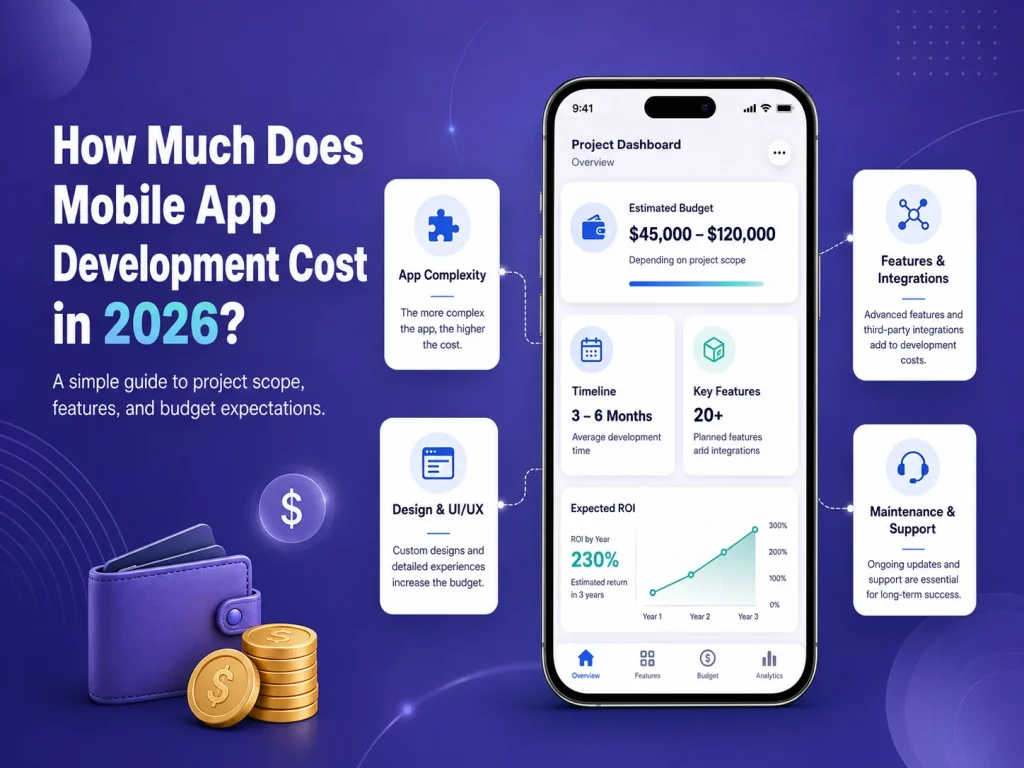
How much does it cost to build a mobile app in 2026? The answer can range from a relatively modest budget for a focused MVP to hundreds of thousands of dollars for a large marketplace, SaaS platform, healthcare system, or enterprise application.
The price depends much more on what the app needs to do than on the number of screens it contains. User accounts, payments, subscriptions, real-time communication, maps, AI features, admin dashboards, backend APIs, third-party integrations, security requirements, and multiple user roles can all significantly change the amount of development work required.
Typical Mobile App Development Costs in 2026
Published industry estimates vary because development companies work in different countries, at different hourly rates, and on very different types of applications. Instead of treating one number as the standard price of an app, businesses should use broad ranges for early budgeting and request a project-specific estimate once the requirements are clear.
| App Type |
Typical Scope |
Planning Range |
| Simple App / MVP |
Basic accounts, content, forms, limited APIs and straightforward workflows |
$10,000–$30,000+ |
| Medium Business App |
Payments, notifications, dashboards, bookings, APIs and customer accounts |
$30,000–$100,000+ |
| Advanced App |
Marketplace features, real-time functions, multiple roles, complex backend or AI |
$100,000–$250,000+ |
| Enterprise Platform |
Large-scale architecture, advanced security, extensive integrations and complex workflows |
$250,000–$500,000+ |
These figures should be treated as planning ranges rather than fixed prices. A focused application built by an experienced offshore team may cost considerably less than the same project developed by a large agency in a high-cost market. At the same time, a seemingly simple app can become expensive if it requires a complicated backend, specialized compliance, or numerous external systems.
What Actually Determines the Cost?
Features and business logic usually have the greatest impact. A basic login screen is relatively straightforward, but a complete authentication system may also include email verification, password recovery, social login, biometric access, multi-factor authentication, session management, permissions, and administrative controls.
The same is true for payments. Adding a button that says “Pay” is only the visible part. A production payment workflow may require payment-provider integration, backend verification, transaction records, failed-payment handling, refunds, subscriptions, notifications, and administrative reporting.
Backend requirements can therefore account for a large part of the project. Many business apps need APIs, databases, admin dashboards, file storage, notifications, reporting, user roles, and integrations with existing systems such as CRM, ERP, accounting, or e-commerce platforms.
UI/UX design also affects the budget. A small application using a straightforward design system requires less work than a large consumer product with extensive custom interactions, animations, onboarding, dashboards, and multiple user experiences.
Does Building for Android and iOS Cost More?
Building separate native applications for Android and iOS can require more development and maintenance because each platform has its own implementation. Native development can still be the right decision when an app needs specialized hardware access, advanced platform-specific behavior, or unusually demanding performance.
For many business applications, technologies such as Flutter and React Native can reduce duplicated work by allowing Android and iOS to share much of the same codebase. This can make cross-platform development attractive for e-commerce apps, booking platforms, customer portals, marketplaces, SaaS applications, and internal business systems.
However, cross-platform development does not remove the cost of backend development, UI/UX design, testing, integrations, security, or project management. It mainly helps reduce the amount of mobile code that needs to be implemented independently for each platform.
Features That Can Increase Your App Budget Quickly
Some requirements naturally involve more development, testing, and infrastructure than standard application features. Businesses should identify these early so they do not receive a low initial estimate followed by major scope increases during development.
- Real-time chat, calling, or live tracking
- Payment processing and subscriptions
- Multiple user roles and complex permissions
- GPS, maps, routes, and location tracking
- AI chatbots, document processing, or intelligent search
- Advanced dashboards and reporting
- Marketplace buyer and seller workflows
- Offline synchronization
- Third-party business system integrations
- Specialized security or regulatory requirements
For example, an app with customer and administrator accounts is very different from a marketplace with customers, vendors, delivery partners, administrators, payments, commissions, refunds, messaging, reviews, and order tracking. Both may be described simply as a “mobile app,” but their development budgets will be very different.
Estimate Your Mobile App Project
Do Not Forget the Costs After Launch
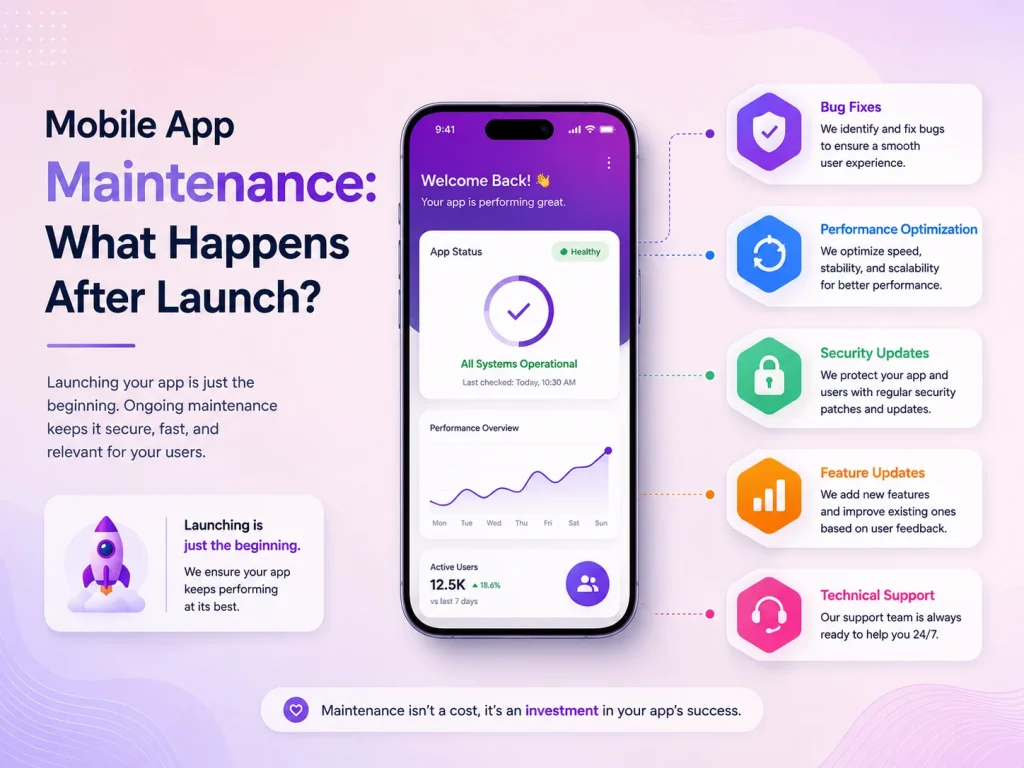
The initial development budget is not the complete lifetime cost of a mobile application. After launch, businesses may need hosting, monitoring, bug fixes, security updates, operating-system compatibility work, third-party service fees, app improvements, and new feature development.
Applications that rely on cloud infrastructure, SMS, email, maps, AI APIs, video services, payment providers, or other external platforms may also have usage-based costs. Those services should be identified during planning so the business understands both development cost and ongoing operating cost.
Maintenance needs vary significantly. A simple application with limited traffic may require occasional updates, while an app processing payments or supporting thousands of active users may require continuous monitoring and more regular development.
How to Keep Mobile App Development Costs Under Control
The best way to reduce costs is usually to control scope rather than reduce development quality. Start by defining the problem the app needs to solve and identify the features required for the first usable version. Features that are valuable but not essential can be moved into later phases.
A clear specification and approved UI/UX design can also prevent expensive changes after development has started. Businesses should clarify user roles, integrations, payment flows, dashboards, and important business rules before those systems are implemented.
It is also useful to request a feature-based estimate instead of receiving only one total price. This makes it easier to understand which modules consume the largest portion of the budget and which features could be postponed if necessary.
Encoder IT Limited develops custom mobile applications for startups and businesses using Flutter, React Native, native Android, and native iOS technologies. Our work can include product planning, UI/UX design, backend APIs, payments, subscriptions, third-party integrations, testing, deployment, and ongoing maintenance.
There is no meaningful fixed price for “a mobile app” in 2026. A realistic estimate comes from understanding the users, features, platforms, backend, integrations, design, security, and expected scale of the product. Businesses that define those requirements before development begins are much more likely to receive an accurate budget and avoid expensive scope changes later.