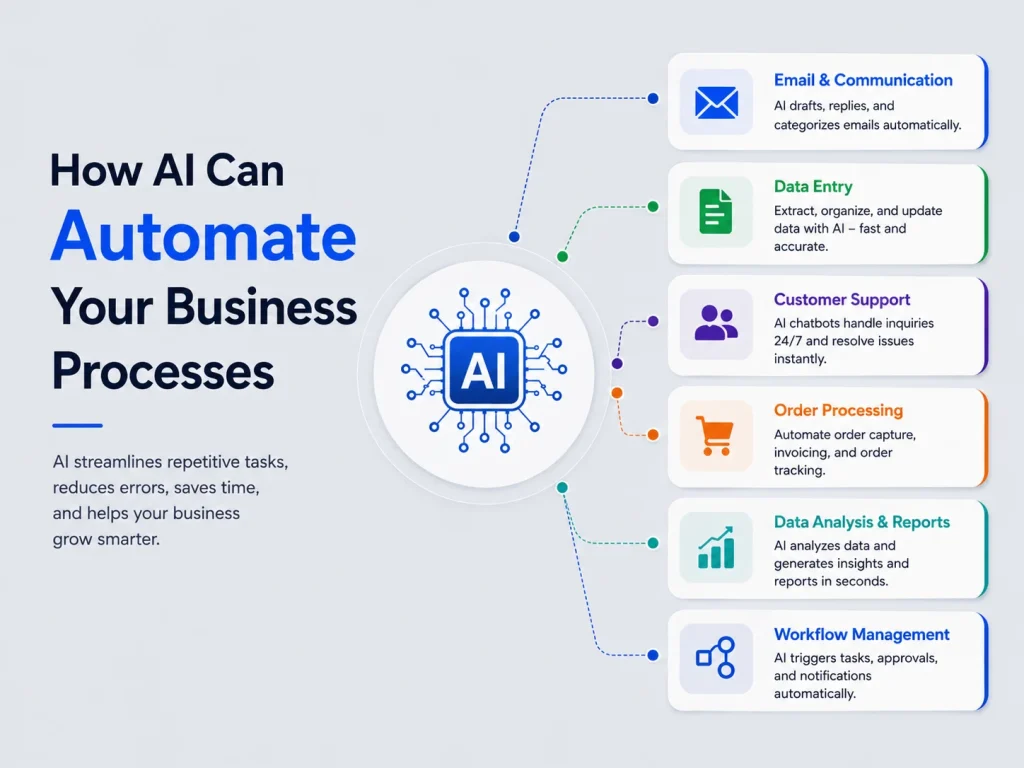
Many businesses still rely on employees to complete repetitive processes manually—reading emails, entering data, preparing reports, categorizing requests, checking documents, updating systems, and moving information between departments. These tasks are necessary, but they can consume valuable time that employees could spend on customers, strategy, and higher-value work.
AI business automation can reduce this workload by helping software understand information, make recommendations, organize data, and support decisions before traditional automation completes the next action. The best results usually come from combining AI with existing business rules, APIs, databases, and workflows rather than trying to replace an entire process with AI.
The first step is identifying where manual work happens most often. Processes that involve repeatedly reading, searching, summarizing, classifying, or copying information are usually strong candidates for AI automation.
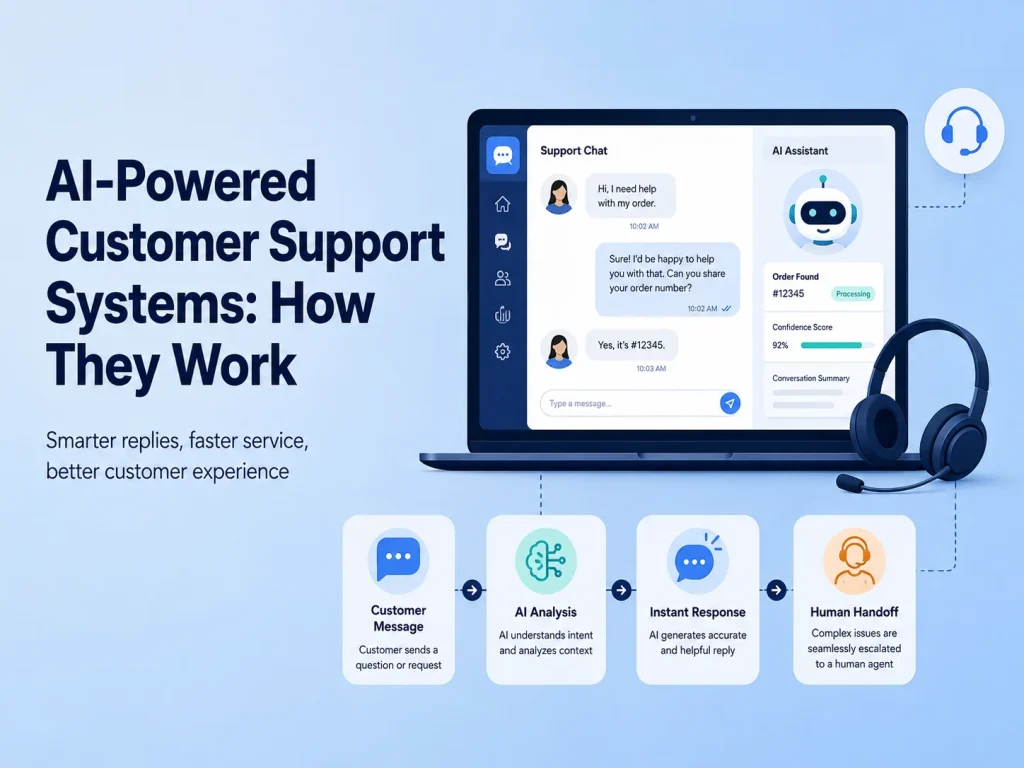
Customer support is a simple example. Employees may receive hundreds of questions about orders, services, appointments, pricing, subscriptions, or account problems. AI can understand the incoming message, identify the topic, search approved business information, and prepare a response. If the request requires human assistance, the system can summarize the conversation and route it to the correct employee.
Sales teams can use a similar workflow. Instead of manually reviewing every enquiry, AI can identify what the prospect is interested in, extract relevant details, summarize requirements, and categorize the lead. Existing CRM automation can then create the record, assign a salesperson, and schedule follow-up activities.
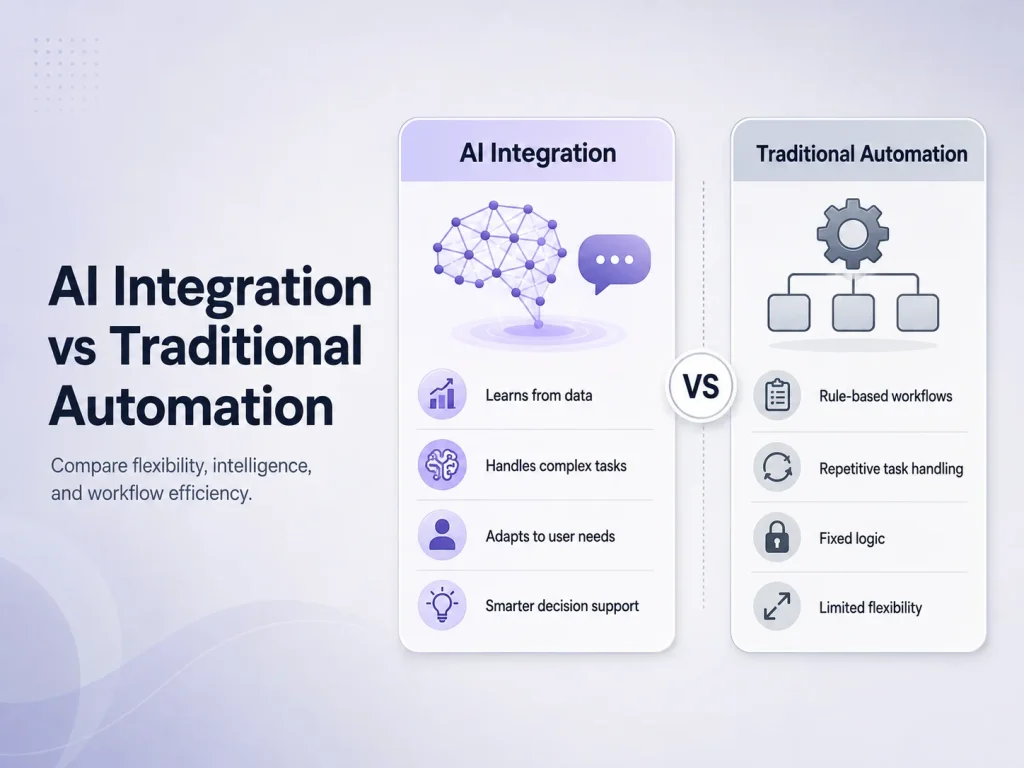
AI automation works best when it removes the repetitive interpretation around a business process while reliable software continues controlling important actions such as approvals, payments, permissions, calculations, and database updates.
This distinction matters because many business processes contain both flexible and predictable steps. AI is useful when information needs interpretation, while traditional automation remains better when the outcome must follow an exact rule.
Where AI Can Automate Everyday Business Work
Document processing is one of the strongest use cases. Businesses may receive invoices, applications, forms, reports, contracts, service records, or other documents that employees manually review. AI can help extract important information, summarize content, classify documents, and prepare structured data for another system.
Internal knowledge is another area where automation can save time. Employees often search through policies, manuals, product information, training materials, or historical records before completing a task. An AI-powered internal assistant can make this information easier to find through natural-language questions instead of requiring employees to manually search multiple folders or systems.
AI can also support routine communication. It may prepare first drafts of customer responses, summarize meeting notes, create report summaries, organize feedback, or convert lengthy information into a format employees can review more quickly.
- Customer support and ticket classification
- Lead processing and CRM preparation
- Document extraction and summarization
- Internal knowledge search
- Email and communication assistance
- Report and data summarization
- Request routing and workflow preparation
Not every business needs all of these applications. The strongest starting point is usually one process that happens frequently, consumes measurable employee time, and has a clear result that can be evaluated after automation is introduced.
Connect AI With the Systems You Already Use
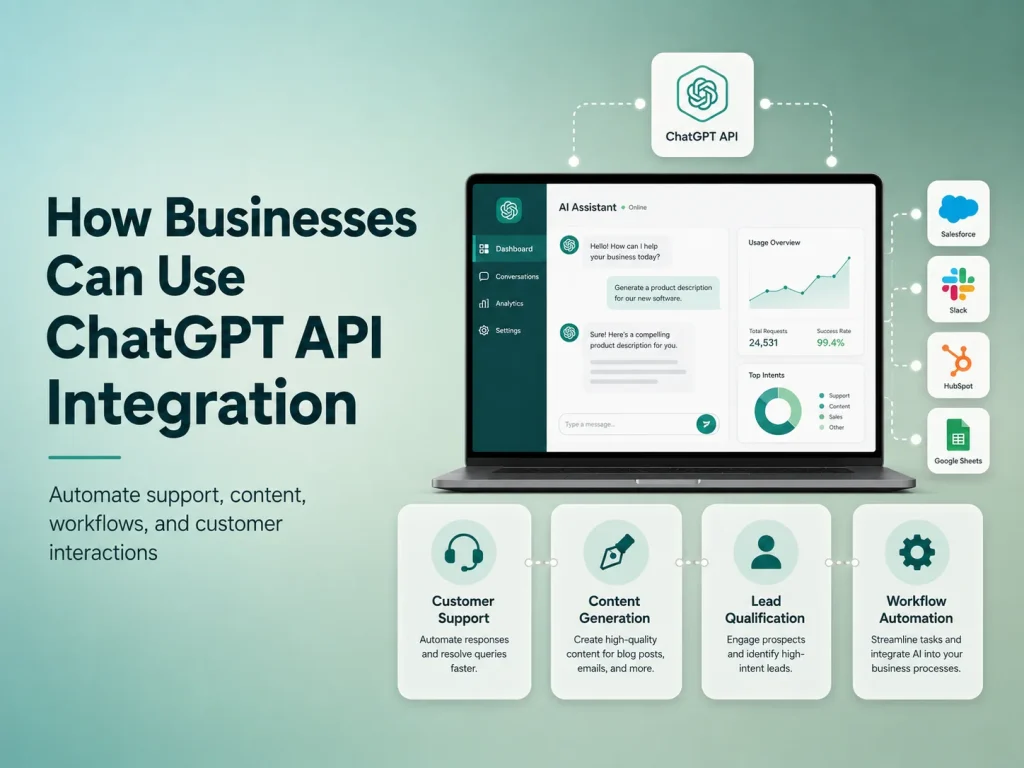
AI automation does not necessarily require replacing your existing CRM, website, mobile app, SaaS platform, ERP, customer portal, or internal software. AI can often be added through APIs and connected with the systems that already manage your business data and workflows.
For example, an AI system can understand an incoming support request, but your existing help-desk software can still create the ticket. AI can extract information from an invoice, while the accounting system remains responsible for storing and processing the financial record. AI can interpret a customer request, while the backend continues checking authentication and permissions before performing an action.
This approach provides more control because businesses can use AI only where interpretation is valuable without changing the systems that already handle predictable operations reliably.
Explore AI Business Automation
Keep Important Decisions Under Reliable Control
AI-generated results can vary, so businesses should decide carefully which actions can happen automatically and which require validation or human review. Low-risk tasks such as summarizing a document may be suitable for greater automation, while payments, financial calculations, account permissions, legal decisions, or other high-impact actions require stronger controls.
Human involvement can also remain part of an automated workflow without removing the benefits. AI might prepare a response, classification, or recommendation while an employee approves it. The employee spends less time preparing the information but still controls the final decision.
Security and privacy should be considered at the same time. AI systems should only receive the information needed for the task, and users should only be able to access data permitted by their role. Sensitive credentials and important business logic should remain protected on backend systems.
Build Automation Around Business Value
The goal of AI automation should not be to automate every task in the company. Some processes are already efficient, some are better handled with simple rule-based automation, and others still benefit strongly from human communication and judgment.
A practical AI automation project begins by measuring the current process. How much time does it take? How often does it happen? Where do delays occur? Which steps require people to interpret information? Once these questions are understood, businesses can automate the parts that create the greatest operational benefit.
Encoder IT Limited develops AI-powered business automation solutions for websites, mobile applications, SaaS platforms, customer portals, and internal software. Our work can include AI assistants, customer-support automation, document processing, workflow automation, intelligent search, API integration, and custom business applications.
AI can make business processes faster and more scalable, but its greatest value comes from using it selectively. When intelligent processing is combined with reliable software workflows and appropriate human oversight, businesses can reduce repetitive work without losing control over the operations that matter most.