Modern businesses rely on web applications for customer management, sales, operations, reporting, communication, inventory, support, and many other daily activities. Artificial intelligence is making these applications more capable by helping them understand language, process documents, search large amounts of information, identify patterns, and assist users with tasks that previously required significant manual effort.
AI-powered web applications combine traditional business software with intelligent features. Instead of replacing the existing application structure, AI can work alongside databases, APIs, user accounts, dashboards, permissions, and business workflows to make the software more useful and efficient.
The strongest AI applications are usually built around a clear business need. A company may want to reduce customer-support workload, help employees find information faster, automate document processing, improve lead management, or create a more personalized customer experience. AI becomes valuable when it improves these real processes rather than simply being added as a feature because it is popular.
What Makes a Web Application AI-Powered?
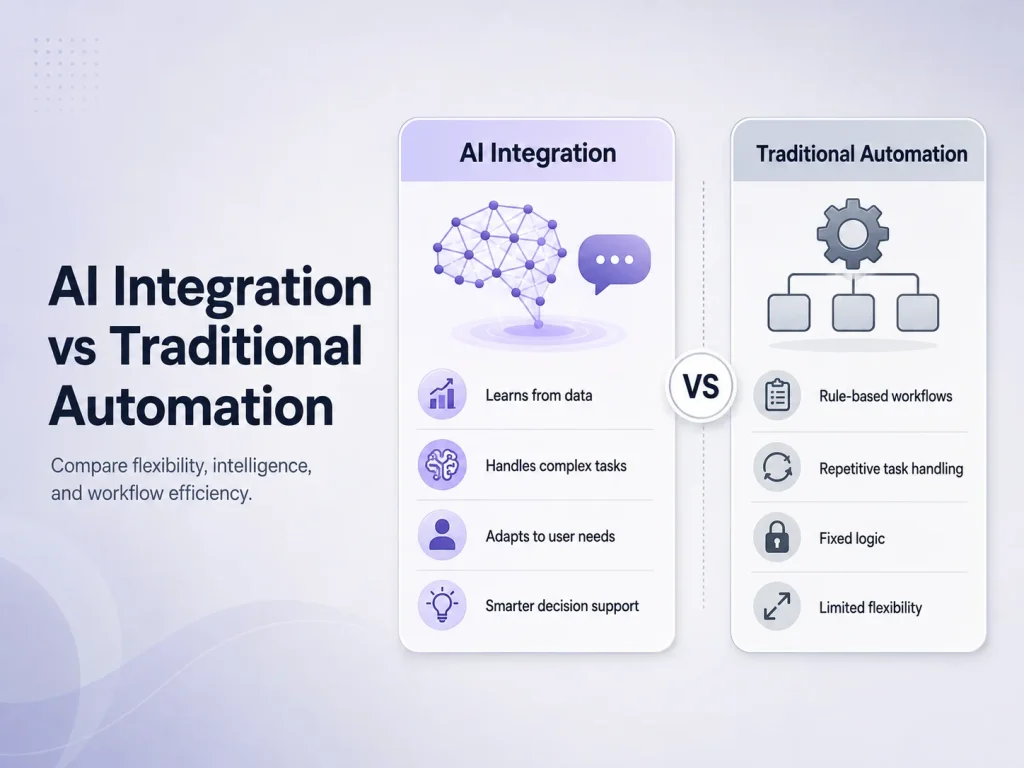
A traditional web application normally follows predefined rules. Users enter information, click buttons, and the system processes the request according to programmed logic. This approach remains essential for payments, permissions, calculations, database updates, approvals, and other predictable operations.
AI adds another layer. It can help the application work with information that is harder to handle using fixed rules alone. Customers can ask questions using normal language, employees can upload documents for analysis, users can search information without knowing exact keywords, and the system can summarize or categorize large amounts of text.
For example, a customer portal might already contain orders, invoices, subscriptions, and support tickets. Adding AI could allow the customer to ask, “Which invoices are still unpaid?” or “Summarize my last three support requests.” The application retrieves authorized data from the existing system while AI helps interpret the request and present the result naturally.
Where AI Can Improve Business Web Applications
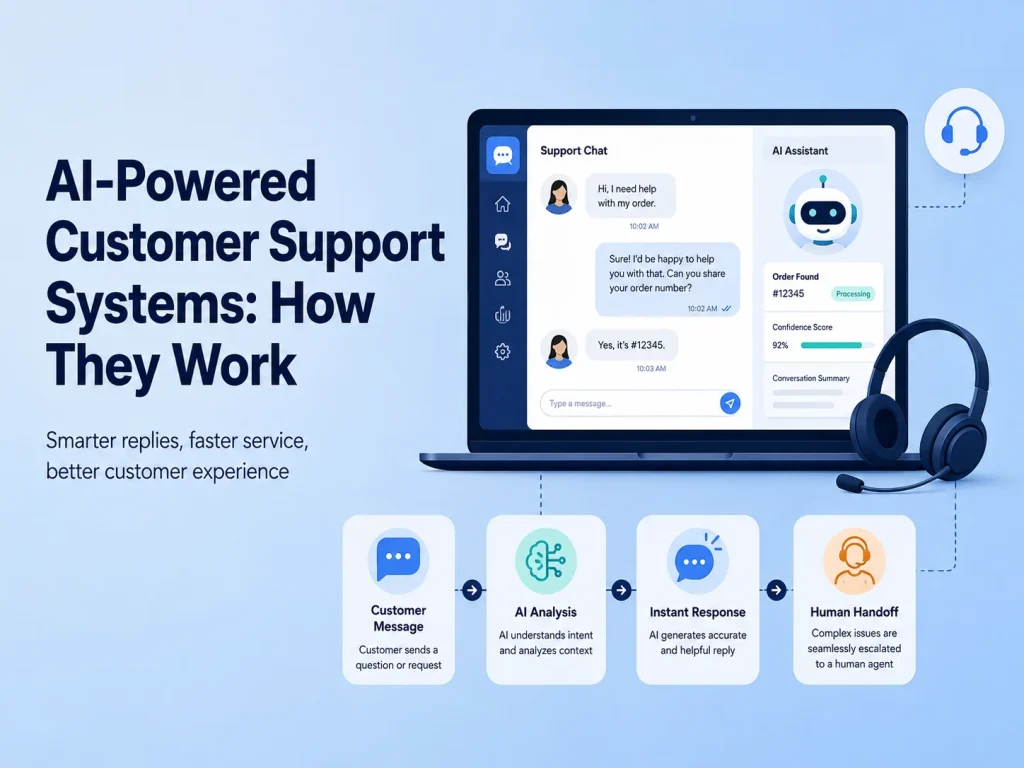
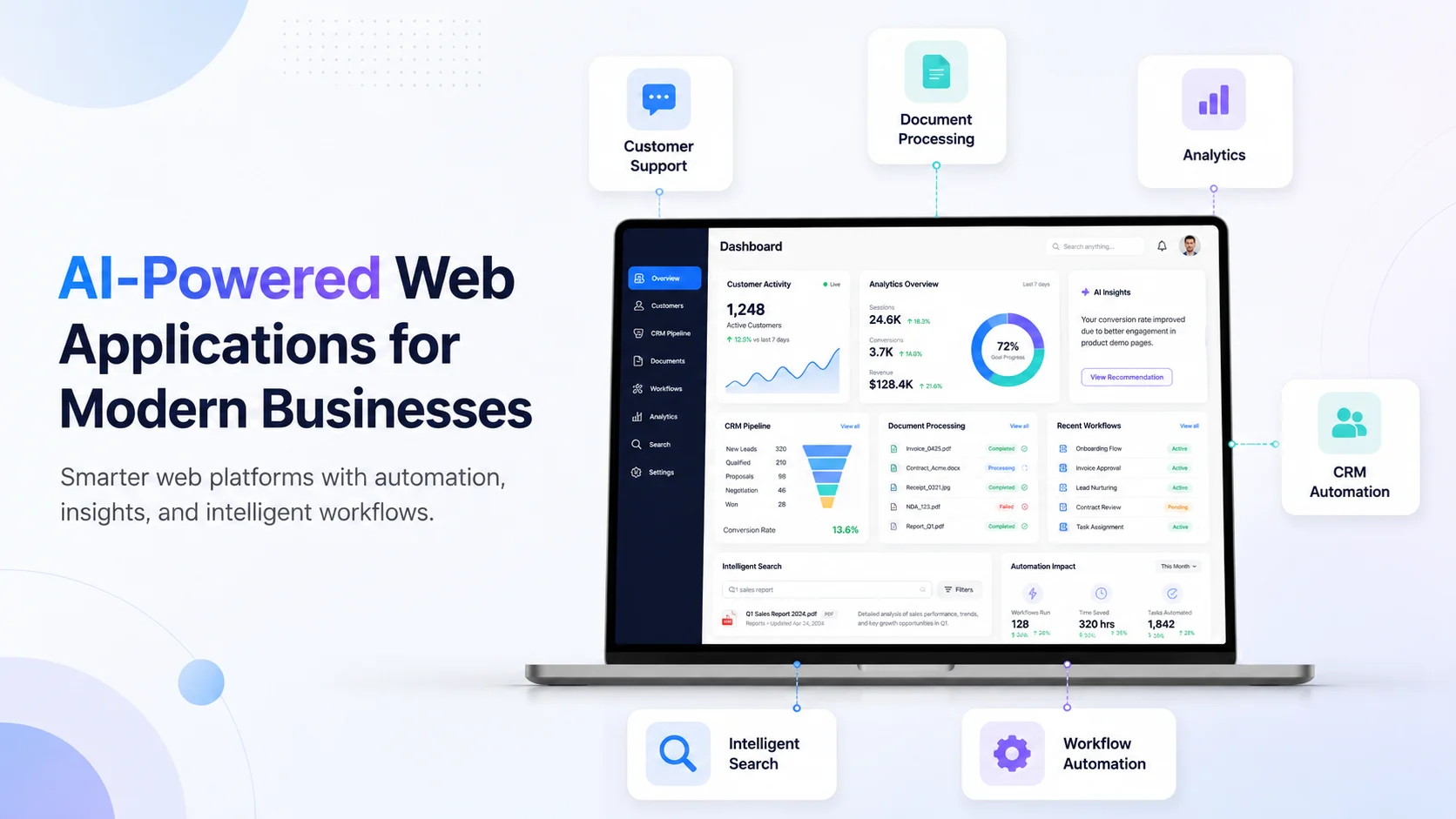
Customer support is one of the most visible uses. An AI assistant can answer common questions, search company documentation, collect information before creating a support ticket, or summarize a conversation before transferring it to an employee. This can make support more efficient without removing the option to speak with a real person.
AI can also improve internal business applications. Employees often spend time searching policies, reading reports, reviewing customer histories, or locating information across different systems. An internal AI assistant can make approved business knowledge easier to access and summarize relevant information before an employee begins working on a task.
Document-heavy workflows provide another opportunity. Businesses receive forms, invoices, reports, applications, contracts, and other files that may require employees to identify important details manually. An AI-powered web application can assist with extracting information, classifying documents, preparing summaries, or identifying fields that should be reviewed.
An effective AI-powered web application does more than generate answers. It connects intelligent processing with real business data, permissions, APIs, and workflows so that AI becomes a useful part of the software employees and customers already depend on.
Sales teams can also benefit. AI may summarize enquiries, categorize leads, identify important customer requirements, or prepare information before a salesperson follows up. In an e-commerce system, AI can support product discovery, recommendations, customer questions, and intelligent search. In SaaS products, it can help users understand data, navigate complex features, or find information more quickly.
AI Works Best When Connected With Existing Business Systems
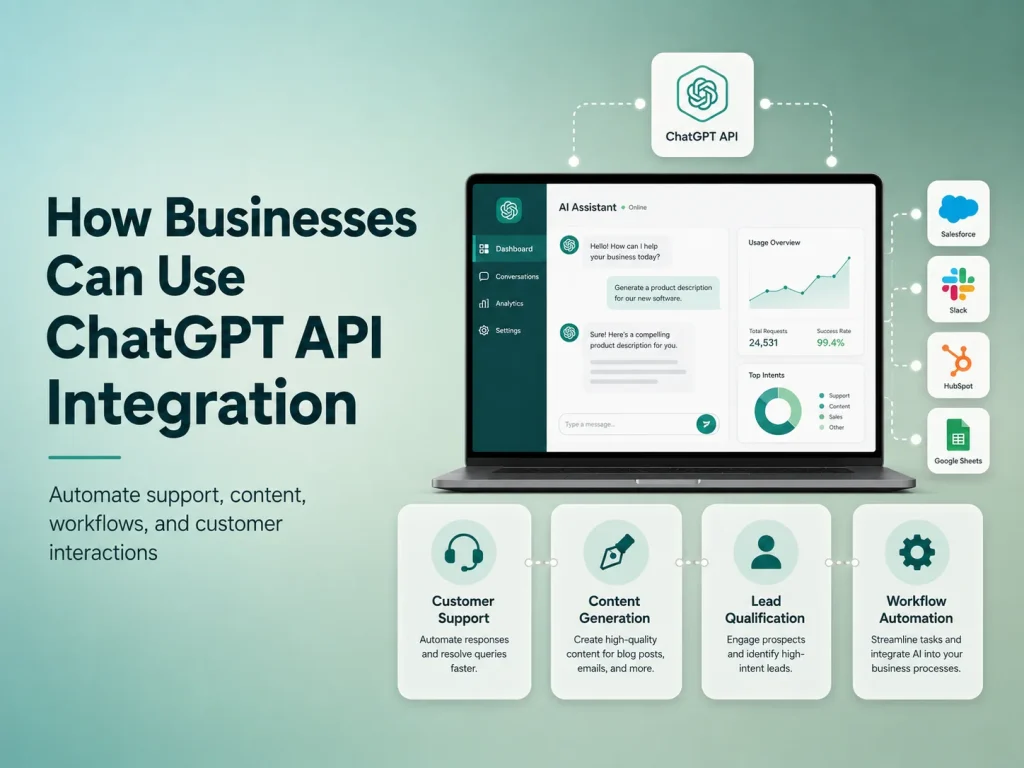
For many companies, building an AI-powered application does not mean replacing existing software. AI functionality can often be integrated into current systems through APIs and added to specific parts of the workflow.
A CRM can gain AI-generated customer summaries. A business dashboard can allow managers to ask questions about available data. A customer portal can provide intelligent search. A support platform can automatically categorize incoming tickets. An existing SaaS product can add an AI assistant without rebuilding its authentication, billing, database, or administrative tools.
This approach is usually more practical because traditional software is still better for many business operations. AI can interpret a customer request, but normal application logic should verify permissions before returning private data. AI can identify information from an invoice, while standard code handles the actual accounting transaction. AI can suggest an action, while the backend controls whether the action is permitted.
Combining these technologies gives businesses flexibility without sacrificing the reliability required for important workflows.
Common Features in AI-Powered Business Applications
- AI chatbots and customer-support assistants
- Intelligent search across business information
- Document extraction and summarization
- Lead and enquiry classification
- Personalized recommendations
- Internal knowledge assistants
- Automated report and conversation summaries
- AI-assisted workflow and task management
Not every business needs all of these features. A better strategy is to identify one or two areas where employees or customers currently experience the most friction. A focused AI feature that saves meaningful time or improves an important customer journey can provide more value than adding several AI tools that are rarely used.
Security, Accuracy, and Human Control Still Matter
AI-powered applications may work with customer messages, internal documents, account information, financial records, or other sensitive business data. Access to this information should follow the same authentication and permission rules used throughout the rest of the application.
Businesses should also decide how AI-generated results will be used. A summary or suggested customer response may be appropriate for automatic assistance, while financial decisions, account permissions, legal actions, healthcare decisions, or other high-impact processes may require human review and deterministic validation.
AI can also produce incomplete or incorrect information. Applications should therefore be designed to handle uncertainty instead of presenting every generated response as guaranteed fact. Reliable source data, controlled access, validation, monitoring, and clear escalation paths are important parts of a production-ready AI system.
Build an AI-Powered Web Application
Turning AI Into Practical Business Software
The most successful AI web application projects usually begin by examining the existing process. Which tasks consume employee time? Where do customers repeatedly need assistance? Which documents or messages require manual interpretation? What information is difficult to find quickly?
Once the problem is clear, the application can be designed so AI handles the parts that benefit from interpretation while traditional software continues managing predictable business rules. This creates a solution that is easier to control, test, and maintain.
Encoder IT Limited develops custom AI-powered web applications, SaaS platforms, customer portals, internal business systems, AI assistants, intelligent search solutions, document workflows, API integrations, and business automation software.
AI-powered web applications are becoming valuable because they allow businesses to combine intelligent capabilities with the software they already use to operate. The real opportunity is not simply adding AI to a dashboard—it is building applications that reduce unnecessary work, make business information easier to use, and help customers and employees complete important tasks more efficiently.