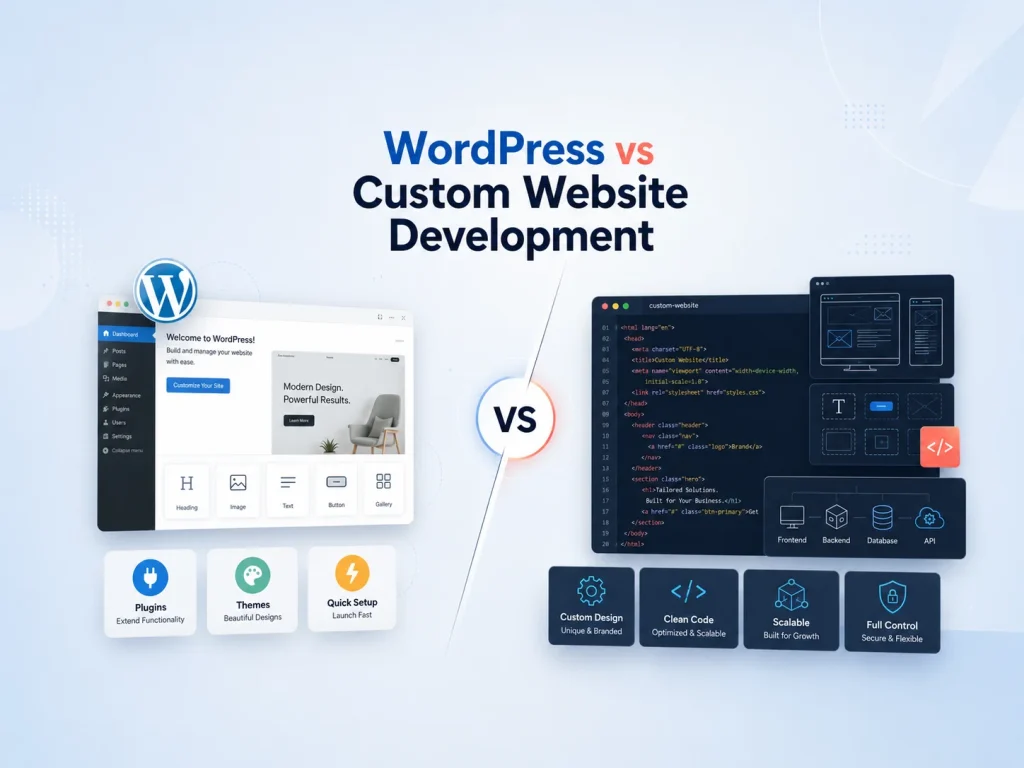
Choosing between WordPress and custom website development is an important decision when planning a new business website. Both approaches can produce professional, responsive, high-performing websites, but they differ in development flexibility, content management, maintenance, cost, and how easily specialized functionality can be introduced.
WordPress provides an established content management system with themes, plugins, user management, blogging tools, and a large development ecosystem. Custom website development gives developers greater freedom to design the frontend, backend, database, and functionality around specific business requirements without depending on a predefined CMS structure.
The right choice depends on what the website needs to accomplish. A service company focused on marketing, SEO, content publishing, and lead generation may benefit greatly from WordPress. A business requiring highly specialized workflows, application-like functionality, or unusual system architecture may need a more custom solution.
WordPress Provides a Flexible Content Management Foundation
WordPress is particularly useful when businesses need to manage website content regularly. Administrators can create pages, publish blog posts, upload media, manage menus, and update website information through a familiar dashboard without editing source code.
A custom WordPress theme can provide a distinctive design while still using WordPress for content management. Businesses are not limited to ready-made templates; developers can build the frontend specifically around a Figma design, brand guidelines, or custom UI/UX requirements.
Plugins can also extend the platform with functionality such as forms, SEO tools, multilingual content, memberships, e-commerce, marketing integrations, and many other common website features.
This combination makes WordPress a practical option for corporate websites, service businesses, blogs, news platforms, portfolios, content-heavy websites, and WooCommerce stores.
| Area |
WordPress Development |
Custom Website Development |
| Content Management |
Built-in CMS with editor and administration tools |
CMS functionality must be built or integrated if required |
| Development Speed |
Often faster for standard business websites |
Usually requires more development from the beginning |
| Customization |
Highly customizable through themes, plugins, and custom code |
Maximum control over architecture and functionality |
| Common Features |
Many available through existing WordPress tools |
Developed specifically for project requirements |
| Maintenance |
Core, themes, plugins, and custom code require maintenance |
Custom application dependencies and infrastructure require maintenance |
| Best Fit |
Marketing, content, business, publishing, and e-commerce websites |
Highly specialized websites and application-like platforms |
Custom Website Development Gives Greater Architectural Control
Custom website development usually means building the website around a specific technical architecture rather than using WordPress as the main platform. Developers may use technologies such as React, Next.js, Laravel, Node.js, or other frameworks depending on the project.
This approach can provide greater control when the website needs unusual functionality or behaves more like a web application. Complex customer portals, advanced dashboards, marketplaces, specialized booking systems, interactive platforms, or tightly integrated business workflows may benefit from a custom architecture.
Developers can decide exactly how authentication, databases, APIs, caching, frontend rendering, user permissions, and other technical components should work.
The tradeoff is that functionality WordPress already provides may need to be developed or integrated separately. Content editing, media management, user administration, SEO controls, and other CMS features do not automatically appear simply because a custom framework is being used.
WordPress Can Still Support Significant Custom Development
One common misconception is that choosing WordPress means being limited to a prebuilt theme and a collection of plugins. WordPress can also serve as the foundation for highly customized websites.
A development team can create a completely custom theme, custom post types, custom fields, WordPress REST API endpoints, custom plugins, WooCommerce functionality, external API integrations, and specialized administrative tools.
This makes the decision less binary than it initially appears. A business may use WordPress for content management while developing the design and important functionality completely from scratch.
For many projects, this approach provides a useful balance: the business receives a familiar CMS while developers retain considerable control over the customer-facing experience.
Consider the Website’s Main Business Purpose
If the website primarily needs to attract visitors, explain services, publish content, generate leads, and support SEO, WordPress is often a practical choice. Marketing teams can manage content without relying on developers for every update.
WordPress can also work well when the website includes e-commerce through WooCommerce, custom enquiry workflows, integrations with CRM platforms, booking functionality, or other common business requirements.
Custom development becomes more attractive as the project moves away from a traditional website and toward a software platform. If users need complex accounts, dashboards, permissions, workflows, real-time features, or large amounts of interactive data, a custom web application architecture may provide a cleaner foundation.
The distinction should therefore be based on functionality rather than branding. A company can have a completely unique, professionally designed WordPress website, just as a custom-coded website can still be visually simple.
Discuss the Right Website Approach for Your Business
Cost Depends on How Much Custom Functionality You Need
WordPress can reduce development effort because many foundational capabilities already exist. Content management, media handling, users, pages, posts, navigation, and many common integrations do not need to be developed from zero.
This can make WordPress more cost-effective for business websites where those existing capabilities match the project requirements.
A completely custom website may require more frontend and backend development, particularly when the business also needs an administration system for managing content. However, custom development can be worthwhile when the business would otherwise spend significant time forcing unique requirements into a platform that was not designed for them.
Businesses should compare the complete project rather than only the initial development quote. Hosting, premium plugins, maintenance, future features, integrations, developer support, and internal content-management requirements can all influence long-term cost.
WordPress is sometimes described as inherently slow, while custom development is assumed to be automatically faster. In practice, performance depends heavily on how the website is built.
A WordPress website with an efficient custom theme, optimized images, appropriate caching, reliable hosting, and carefully selected plugins can perform very well. Problems usually appear when websites accumulate heavy page builders, unnecessary plugins, oversized media, poorly optimized scripts, or inefficient custom code.
A custom website can also become slow if it loads excessive JavaScript, performs inefficient database queries, uses poorly designed APIs, or depends on large third-party resources.
Businesses should therefore evaluate the planned architecture, code quality, hosting, caching strategy, and frontend performance rather than assuming one platform automatically guarantees better speed.
Maintenance Is Different, Not Optional
WordPress websites require regular updates to WordPress core, themes, plugins, and custom integrations. Businesses should maintain backups, test important updates, monitor security, and remove software that is no longer required.
A custom-developed website removes some WordPress-specific maintenance but introduces other responsibilities. Frameworks, libraries, servers, dependencies, APIs, databases, and custom application code still need security updates and ongoing support.
Neither option eliminates maintenance. The difference is where that maintenance occurs and which technical skills are required to manage it.
Which Option Should Your Business Choose?
WordPress is usually a strong choice when content management is important and the project fits reasonably well within a business website, publishing, marketing, or e-commerce model. Custom WordPress development can provide a unique design and specialized functionality without sacrificing the convenience of an established CMS.
Fully custom development may be more appropriate when the project has extensive application logic, highly specialized workflows, unusual architecture requirements, or functionality that would require WordPress to be modified far beyond its natural role.
A third option is to combine approaches. WordPress can operate as a content backend while a separate custom frontend or application handles presentation and advanced functionality. The best architecture depends on the specific project rather than following one development approach for every business.
Encoder IT Limited provides custom WordPress development as well as fully custom website and web application development. Our services can include custom WordPress themes and plugins, WooCommerce development, React and Next.js frontends, Laravel and Node.js development, API integrations, performance optimization, and ongoing website maintenance.
The best choice between WordPress and custom website development is the one that matches your business requirements without introducing unnecessary complexity. WordPress provides an efficient and flexible foundation for many business websites, while custom development offers greater architectural freedom when specialized functionality becomes the central requirement.