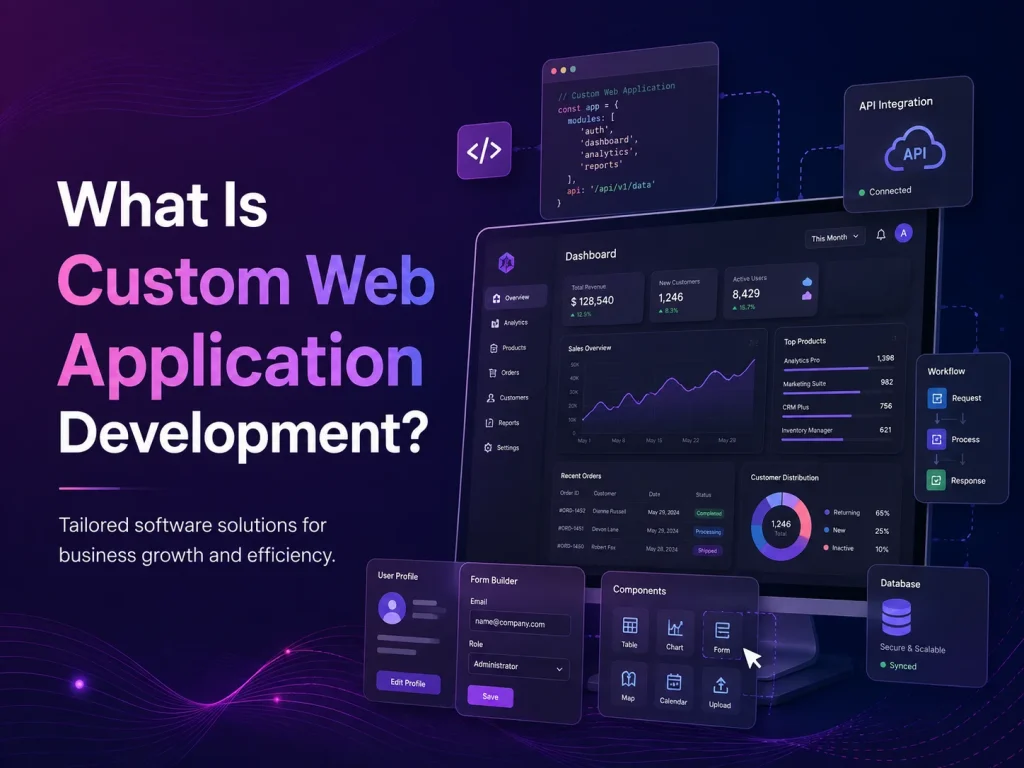
Custom web application development is the process of designing and building browser-based software around the specific requirements of a business, organization, or product. Unlike a standard website that mainly presents information, a web application allows users to log in, manage data, complete tasks, communicate, generate reports, process transactions, or perform other business activities through an interactive system.
Custom web applications can be developed for customers, employees, managers, partners, or entire organizations. Examples include SaaS platforms, customer portals, business management systems, booking applications, marketplaces, CRM systems, inventory platforms, dashboards, workflow tools, and internal administration software.
The main advantage of custom development is that the software can be designed around the way the business actually operates rather than forcing the organization to adapt every process to the limitations of an existing product.
How Is a Custom Web Application Different From a Website?
A traditional business website usually focuses on communication. Visitors browse pages, learn about services, read articles, view products or projects, and complete relatively simple actions such as submitting a contact form or requesting a quote.
A web application is more interactive. Users may have accounts, dashboards, permissions, saved information, workflows, notifications, payment functionality, reports, or other features that depend on backend business logic and a database.
For example, a recruitment website may display available jobs and company information. A recruitment web application could allow employers to create positions, candidates to submit applications, recruiters to update statuses, managers to review candidates, and administrators to generate reports.
The application is therefore not simply displaying information—it is actively managing processes and data.
What Can a Custom Web Application Do?
The functionality depends entirely on the business problem being solved. A small internal application may manage a few important workflows, while a larger platform may contain dozens of interconnected modules and serve thousands of users.
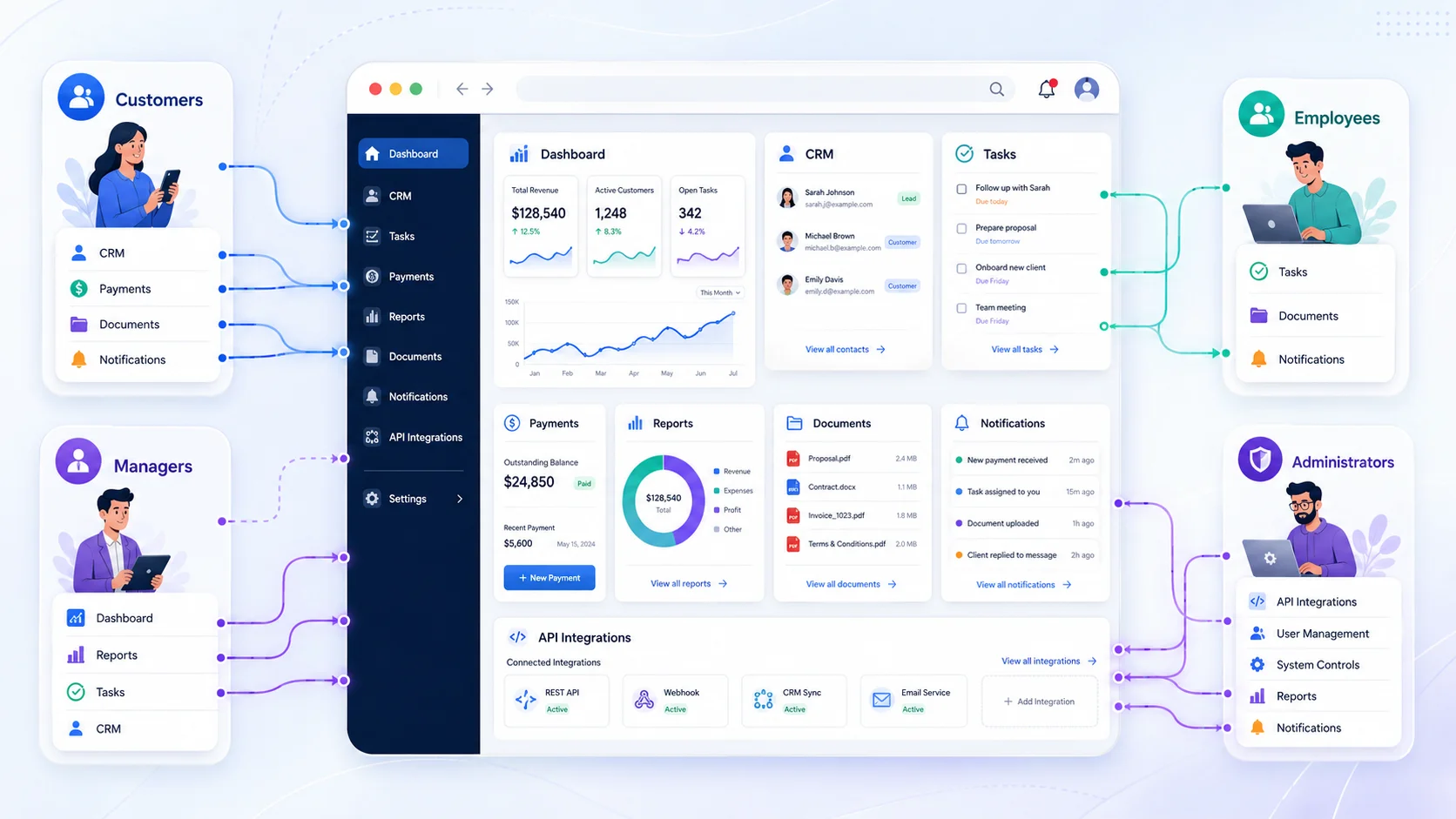
Common functionality includes user accounts, role-based permissions, dashboards, customer records, employee management, task assignment, approval workflows, subscriptions, payment processing, scheduling, document management, reporting, notifications, and third-party integrations.
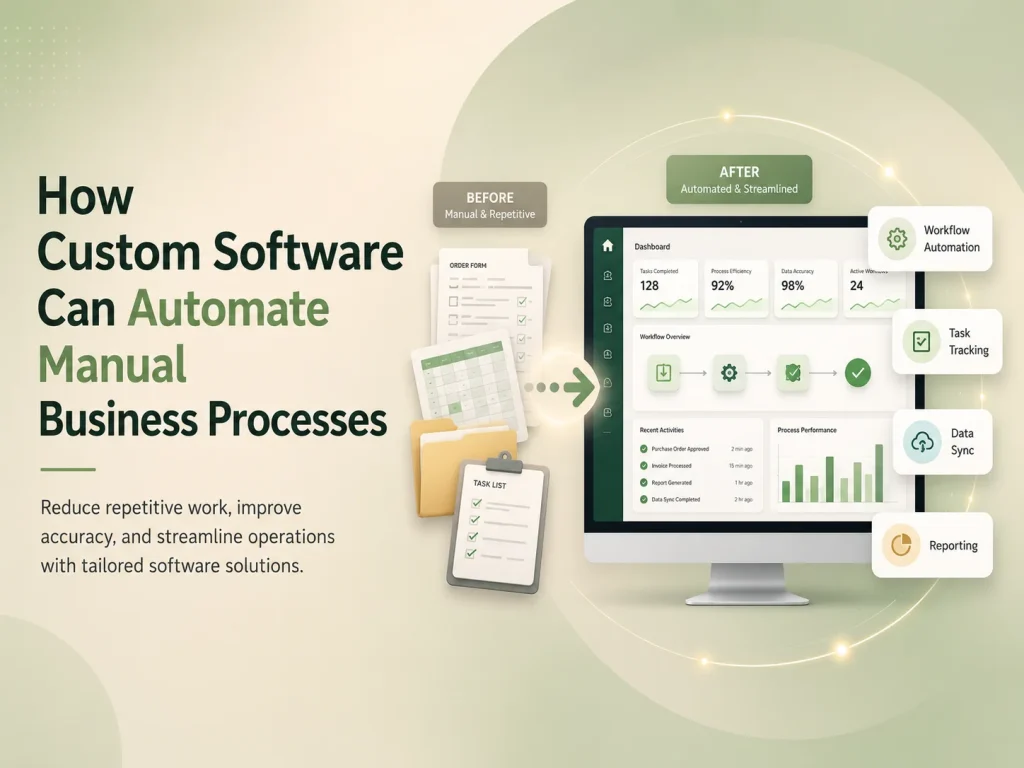
A custom system can also automate actions that employees previously handled manually. When a customer submits a request, for example, the application might create a record, assign it to the appropriate employee, send a confirmation message, schedule a follow-up, and update a management dashboard automatically.
- User registration and secure authentication
- Role-based dashboards and permissions
- Customer and employee management
- Task, workflow, and approval automation
- Subscription and payment processing
- Reporting and analytics
- Document and file management
- Notifications and communication
- API and third-party software integrations
- Multi-tenant SaaS functionality
These features do not need to be built into every application. Good custom development begins with the most important workflows and introduces additional functionality only when it creates real business value.
Why Businesses Choose Custom Development
Many businesses initially manage operations through spreadsheets, email, shared documents, and several separate software products. This can work well during the early stages of growth, but problems often appear when the amount of data, employees, customers, or transactions increases.
Employees may start entering the same information into multiple systems. Managers may spend time collecting updates manually. Reports may depend on several spreadsheets, while customers may need to contact employees simply to check the status of a request.
A custom web application can bring these processes into one connected platform. Information entered once can be used across relevant workflows, while automation can reduce repetitive administrative tasks.
Custom development is also valuable when existing software almost fits the business but requires too many workarounds. If employees continuously adapt their processes around software limitations, a purpose-built application may eventually provide a cleaner solution.
Discuss Your Custom Web Application
How Custom Web Application Development Works
The development process usually begins with requirements and workflow planning. Before selecting technologies or designing screens, the team needs to understand who will use the application, what those users need to accomplish, and how information moves through the business.
User flows and wireframes can then define how people move through the application. UI/UX design establishes the visual interface, navigation, forms, dashboards, tables, responsive behavior, and reusable components.
Frontend development creates the interface users interact with, while backend development handles application logic, authentication, permissions, databases, APIs, automation, and integrations. The exact technology stack depends on the application requirements.
Testing should cover both individual features and complete workflows. A payment system, for example, needs testing for successful payments, failures, cancellations, duplicate requests, refunds, and the way those events affect related orders or accounts.
After deployment, the application normally continues to evolve. New workflows, reports, integrations, user roles, and automation can be introduced as the business grows.
Custom Web Applications Can Integrate With Existing Systems
Building custom software does not necessarily mean replacing every tool the company already uses. In many cases, a custom application works best as a central platform connected to specialized external services.
APIs can connect the application with payment gateways, accounting platforms, CRM systems, e-commerce stores, calendars, email services, cloud storage, shipping providers, AI services, and other software.
For example, an internal order-management application could receive orders from an e-commerce store, confirm payment information, send requests to a fulfillment provider, update inventory, and display the complete process inside one administrative dashboard.
This allows the business to keep reliable third-party tools while creating custom workflows around the areas that make its operation unique.
Security and Scalability Should Be Part of the Foundation
Custom web applications often contain customer, employee, financial, operational, or other important business information. Authentication, authorization, secure sessions, protected APIs, encrypted connections, backups, and proper data access controls should therefore be considered during development.
Role-based permissions are particularly important. A customer should only access their own records, while employees and managers should receive functionality appropriate to their responsibilities. Important access rules should be enforced on the backend rather than relying only on what is visible in the interface.
Scalability also needs practical planning. A new application does not necessarily need infrastructure designed for millions of users, but its database, code structure, background jobs, APIs, and deployment approach should leave reasonable room for future growth.
Monitoring and logging can help developers identify application errors, failed integrations, slow processes, and other operational problems after launch.
When Does Custom Web Application Development Make Sense?
Custom software is not always necessary. If an established SaaS product already solves the business problem effectively, using that platform may be faster and more economical than developing a new application.
Custom development becomes more attractive when the software needs to support unique workflows, detailed permissions, specialized calculations, multiple user types, extensive automation, or deep integration with existing business systems.
It may also be appropriate when software itself is part of the company’s product. SaaS startups, marketplaces, customer platforms, specialized booking systems, and industry-specific management applications often need functionality that cannot be created cleanly with generic software alone.
Encoder IT Limited develops custom web applications and SaaS platforms using technologies such as React, Next.js, Laravel, Node.js, APIs, databases, payment systems, and modern cloud infrastructure. Our work can include UI/UX design, dashboards, workflow automation, customer portals, multi-tenant platforms, integrations, and ongoing application development.
Custom web application development is ultimately about turning a specific business process or product idea into software that people can use through the web. When the application is designed around real users, clear workflows, reliable architecture, security, and future growth, it can become much more than a digital tool—it can become a central part of how the business operates.