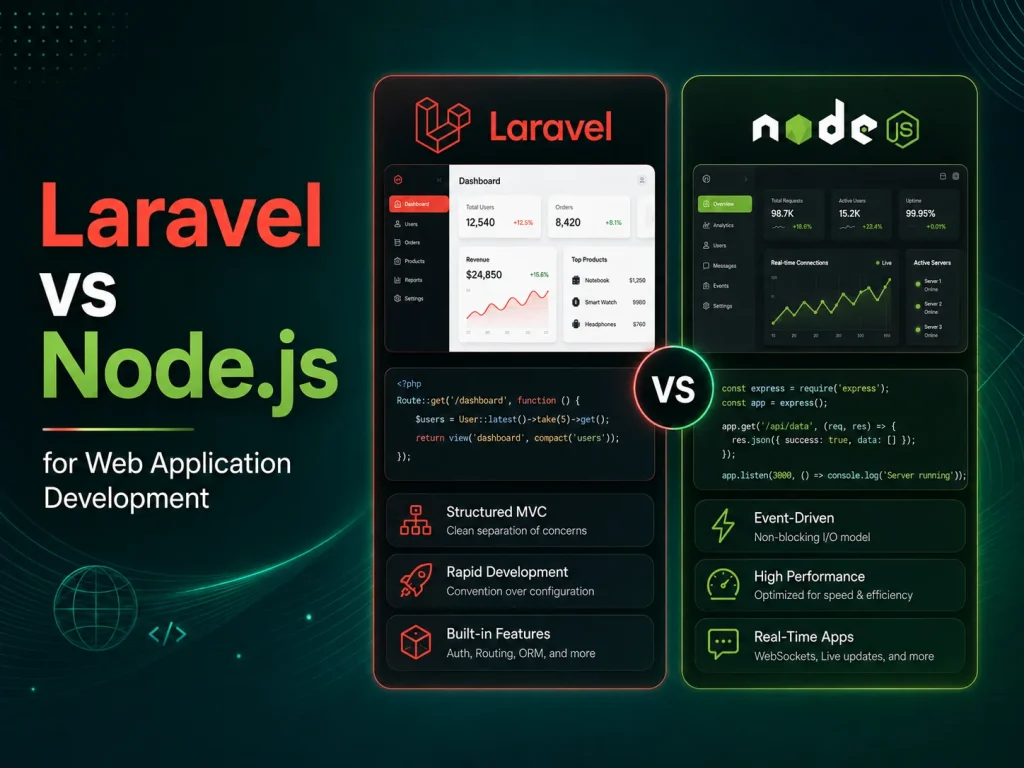
Laravel and Node.js are both widely used for building modern web applications, APIs, SaaS platforms, dashboards, customer portals, and business management systems. However, they are not exactly the same type of technology. Laravel is a PHP web application framework, while Node.js is a JavaScript runtime that is typically combined with frameworks and libraries to create a complete backend application.
Because of this difference, choosing between Laravel and Node.js for web application development is less about identifying a universal winner and more about selecting the development approach that fits your application, team, architecture, integrations, and long-term maintenance requirements.
Both technologies can support serious business applications. Laravel provides a structured framework with many common web development capabilities available within its ecosystem, while Node.js gives development teams considerable flexibility in designing JavaScript or TypeScript-based backend systems.
Laravel Provides a Structured Web Application Framework
Laravel gives developers an organized foundation for building backend applications with PHP. Common requirements such as routing, database access, authentication, authorization, validation, queues, scheduled jobs, caching, testing, and API development can be handled using established Laravel patterns and its surrounding ecosystem.
This structured approach can be particularly useful for applications containing significant business logic. Customer management platforms, booking systems, administration portals, e-commerce backends, subscription systems, workflow applications, and internal business software often contain many connected database records, forms, permissions, notifications, and approval processes.
Laravel’s Eloquent ORM also provides a structured way to work with relational database models and their relationships. For applications where users, organizations, subscriptions, invoices, tasks, permissions, products, orders, and other records are closely connected, this can make backend development easier to organize.
Laravel is relatively opinionated about how common parts of an application should be structured. For many development teams, that consistency can make larger projects easier to understand because developers entering the codebase have familiar conventions to follow.
Node.js Offers a Flexible JavaScript-Based Backend
Node.js allows JavaScript to run on the server and is designed around asynchronous, event-driven application patterns. Development teams normally combine Node.js with additional frameworks and packages depending on the project architecture.
This flexibility makes Node.js attractive for APIs, real-time applications, collaboration tools, messaging systems, streaming services, dashboards with frequent updates, microservices, and applications that communicate with several external services.
Another practical advantage appears when a development team already uses JavaScript or TypeScript heavily on the frontend. A React, Next.js, Vue, or other JavaScript-based frontend can be supported by a Node.js backend while allowing developers to work within the same broader language ecosystem.
However, flexibility also means architectural decisions need to be made carefully. The team must choose how authentication, validation, database access, application structure, background processing, logging, testing, and other backend concerns will be organized. Using an established Node.js framework and clear development standards can help prevent the codebase from becoming inconsistent as the application grows.
| Area |
Laravel |
Node.js |
| Technology Type |
PHP web application framework |
JavaScript runtime for server-side applications |
| Development Style |
More structured and convention-driven |
Flexible; architecture depends heavily on selected frameworks and tools |
| Primary Language |
PHP |
JavaScript or TypeScript |
| Database Applications |
Strong built-in framework patterns for relational business applications |
Multiple database libraries and ORM approaches available |
| Asynchronous Work |
Queues and background jobs are well supported |
Asynchronous and event-driven programming is fundamental to the platform |
| Real-Time Applications |
Supported through Laravel’s real-time ecosystem |
Natural fit for event-driven and connection-heavy applications |
| Architecture Choices |
Many common decisions already have established Laravel conventions |
Teams have greater freedom to select architecture and supporting tools |
| Typical Fit |
Business systems, SaaS platforms, portals, e-commerce and workflow applications |
APIs, real-time systems, SaaS platforms, integrations and JavaScript-centric applications |
Technology comparisons frequently focus on which option is faster, but real-world application performance depends on far more than the backend language or runtime. Database queries, caching, API design, infrastructure, application architecture, background processing, frontend performance, and external integrations can all become bottlenecks.
Node.js’s asynchronous architecture can be particularly effective when an application handles many I/O operations, such as API requests, network communication, real-time connections, or other tasks where the application spends time waiting for external resources.
Laravel can also support high-traffic applications through caching, queues, background workers, optimized database access, distributed infrastructure, and appropriate deployment architecture. A properly designed Laravel application can scale significantly, just as a poorly designed Node.js application can experience performance problems.
Businesses should therefore avoid choosing Node.js simply because they have heard that it is faster or rejecting Laravel because it uses PHP. The more important question is whether the complete architecture can meet expected traffic, processing, reliability, and maintenance requirements.
Which Is Better for SaaS and Business Applications?
Laravel is often a strong choice when the application contains substantial structured business logic. A SaaS platform may need organizations, users, roles, subscriptions, invoices, permissions, notifications, reports, scheduled processes, and administration tools. Laravel provides established patterns for many of these requirements, which can help teams move from requirements to implementation efficiently.
Node.js can be particularly attractive when the product is heavily API-driven, requires frequent real-time communication, integrates with many external services, or when the development organization wants JavaScript or TypeScript across much of the technology stack.
For example, a collaboration application with live messages, presence indicators, event streams, and continuously updating dashboards may fit naturally within a Node.js architecture. A business management platform centered on customers, employees, permissions, billing, approvals, documents, and complex relational workflows may fit particularly well with Laravel.
These are not limitations. Node.js can build complex database-driven business applications, and Laravel can support real-time functionality. They simply illustrate areas where the development experience may naturally align with particular types of requirements.
Discuss Your Web Application Requirements
Consider Your Team and Long-Term Maintenance
The existing skills of the development team can be more important than small technical differences between the technologies. An experienced Laravel team may deliver a reliable application faster than a team learning a new Node.js architecture during the project. Likewise, a company with an experienced TypeScript and Node.js team may gain little by introducing PHP without a clear reason.
Businesses should also consider how easily the system can be maintained after launch. A web application may continue evolving for many years, with new modules, integrations, reports, user roles, and business rules added over time.
A consistent architecture, automated testing, clear database design, secure authentication, proper logging, deployment procedures, and good documentation will usually have a greater long-term impact than choosing one popular backend technology over another.
The surrounding technology stack matters too. If the company already operates Laravel applications, staying within that ecosystem may simplify infrastructure and developer support. If the organization already uses JavaScript and TypeScript throughout its frontend, backend, and serverless services, Node.js may create a more unified development environment.
Choose the Technology Around the Application
There is no universal answer to Laravel vs Node.js. Laravel is a strong option for teams that value a structured, productive framework with established solutions for common web application requirements. Node.js is a strong option for teams that value an asynchronous JavaScript environment, architectural flexibility, and a unified JavaScript or TypeScript development ecosystem.
Encoder IT Limited develops custom web applications and SaaS platforms using Laravel, Node.js, React, Next.js, APIs, databases, payment systems, workflow automation, dashboards, and third-party integrations. The technology stack can be selected around the product requirements rather than forcing every project into the same architecture.
The best backend technology is the one that helps your team build the required functionality securely, maintain it consistently, integrate it with the rest of your systems, and continue extending the application as the business grows. Laravel and Node.js can both achieve that goal when they are matched with the right project and supported by good software architecture.