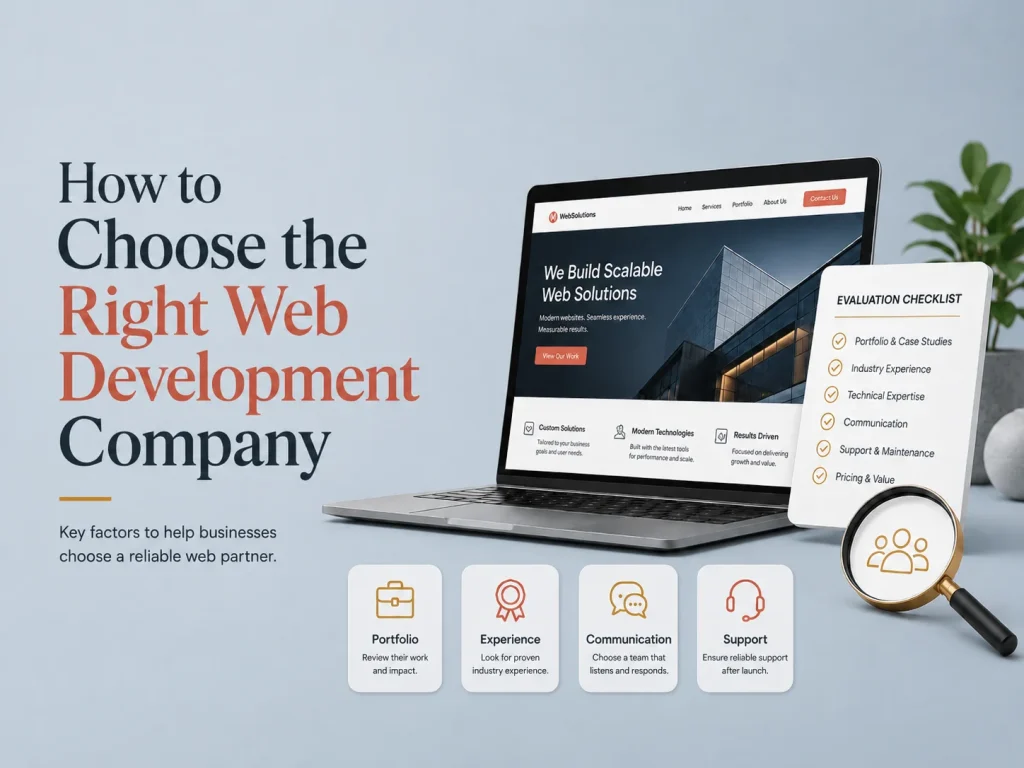
Choosing the right web development company can have a major impact on the quality, performance, security, and long-term success of your website. The right partner should do more than build pages from a design—they should understand your business goals, recommend suitable technology, plan for future growth, and create a website that is practical to maintain after launch.
Price and portfolio are important, but they should not be the only factors in your decision. A company may show attractive websites while having limited experience with custom functionality, e-commerce, APIs, performance optimization, or the type of business platform you actually need.
Start With Your Business Requirements
Before comparing development companies, define what the website needs to accomplish. A service business may need a professional website focused on lead generation. An e-commerce company may require products, payments, shipping, inventory, and customer accounts. Another business may need a customer portal, booking system, dashboard, API integration, or custom web application.
The clearer your requirements are, the easier it becomes to evaluate whether a development company has the right experience. You do not need a complete technical specification, but you should understand your main pages, important features, target users, required integrations, and the actions you want visitors to take.
A good development company should also ask questions before recommending technology. If a team immediately pushes WordPress, Shopify, Laravel, React, or another platform without understanding your requirements, the recommendation may be based more on what they prefer to build than what your business actually needs.
Review Experience Beyond Visual Design
A portfolio is a useful starting point, but look deeper than screenshots. Try to understand what the company actually developed. Did they build the complete website? Did they handle UI/UX design, frontend development, backend systems, integrations, or only one small part of the project?
Relevant experience matters particularly when your website needs more than standard content pages. Payment gateways, subscriptions, multilingual websites, customer accounts, custom filters, booking systems, dashboards, CRM integrations, or complex forms require different development skills from a simple marketing website.
You should also look for evidence that the company can work with the type of platform your project requires. A strong WordPress team may be ideal for a content-focused business website, while a custom SaaS product or complex customer portal may require experience with technologies such as Laravel, Node.js, React, or Next.js.
Pay Attention to Communication and Development Process
Many website projects experience problems because expectations were unclear rather than because developers could not write the code. Good communication helps prevent misunderstandings about features, design, timelines, content, integrations, and project scope.
Ask how the company handles discovery, design approval, development milestones, testing, revisions, and launch. You should understand how progress will be shared and who will be responsible for communication throughout the project.
A professional process should provide enough structure to keep the project organized while still allowing reasonable changes when new information appears. If a requirement changes during development, the company should explain how that change affects the timeline, budget, and existing functionality instead of simply adding it without discussion.
- Do they understand your business before proposing a solution?
- Can they show relevant project experience?
- Do they provide UI/UX, frontend, and backend expertise where required?
- Can they handle APIs and third-party integrations?
- Is their testing and launch process clearly defined?
- Do they provide maintenance after the website goes live?
Compare Technical Quality, Not Just the Initial Price
The cheapest quote can sometimes become the most expensive option if the website later needs to be rebuilt. Poorly organized code, excessive plugins, weak security, slow performance, or an unsuitable technical architecture can make even small future changes difficult.
When comparing proposals, check what each price includes. One company may quote only for development while another includes planning, custom UI/UX design, responsive implementation, testing, performance optimization, deployment, and post-launch support. Two proposals with different prices may therefore represent very different levels of work.
You should also consider ownership and maintainability. Ask whether you will receive access to the source code, website administration, hosting information, and other important project assets. A business should not become unnecessarily dependent on one company simply because basic access was never properly transferred.
Performance, security, and SEO-friendly development should also be considered during the build. A professional website needs clean responsive layouts, optimized assets, reliable forms, proper technical structure, and a foundation that can be maintained as browsers, platforms, and business requirements change.
Discuss Your Website Project
Think About What Happens After Launch
A website usually continues evolving after it goes live. Businesses add services, publish content, update branding, launch marketing campaigns, integrate new software, and improve pages based on customer behavior. Security updates, backups, performance monitoring, and compatibility maintenance may also be required.
This is why the development relationship should not be evaluated only around the first launch date. Ask whether the company can support future improvements, fix urgent issues, maintain integrations, and help the website grow when your requirements change.
For some businesses, occasional maintenance is enough. For e-commerce stores, custom platforms, or websites that play an important role in daily operations, ongoing technical support may be much more valuable.
Choose a Partner That Fits the Project
The right web development company should combine technical ability with an understanding of business goals. They should be able to explain why they recommend a particular solution, identify potential risks, communicate clearly, and build something that remains useful after the first version is delivered.
Encoder IT Limited provides website design and development services including custom business websites, WordPress and WooCommerce development, Shopify, UI/UX design, custom web applications, API integrations, performance optimization, and ongoing maintenance.
When choosing a development company, look beyond the lowest price or the most visually impressive portfolio. Relevant experience, communication, technical quality, development process, long-term support, and an understanding of your business are much stronger indicators of whether the partnership will succeed.