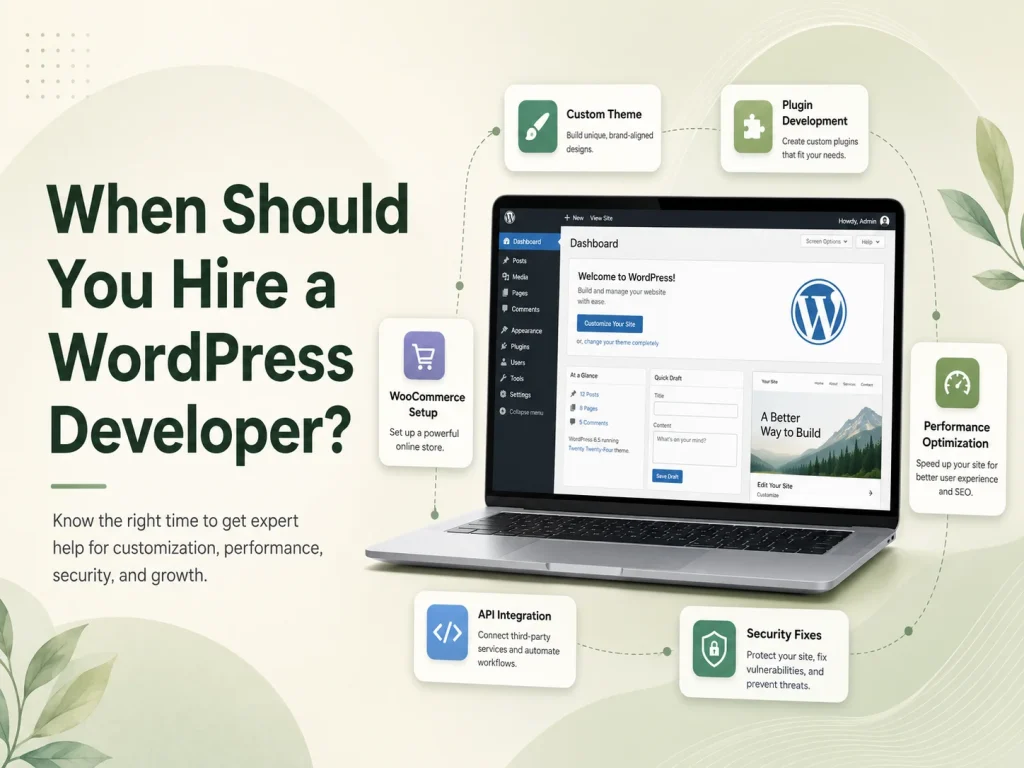
A modern business website needs more than a professional appearance. It should communicate the brand clearly, load efficiently, work across different devices, support search visibility, and allow the internal team to manage content without creating inconsistent layouts.
Custom WordPress theme development gives businesses greater control over these areas by building the website around specific design and functionality requirements instead of adapting the company to the limitations of a generic prebuilt theme.
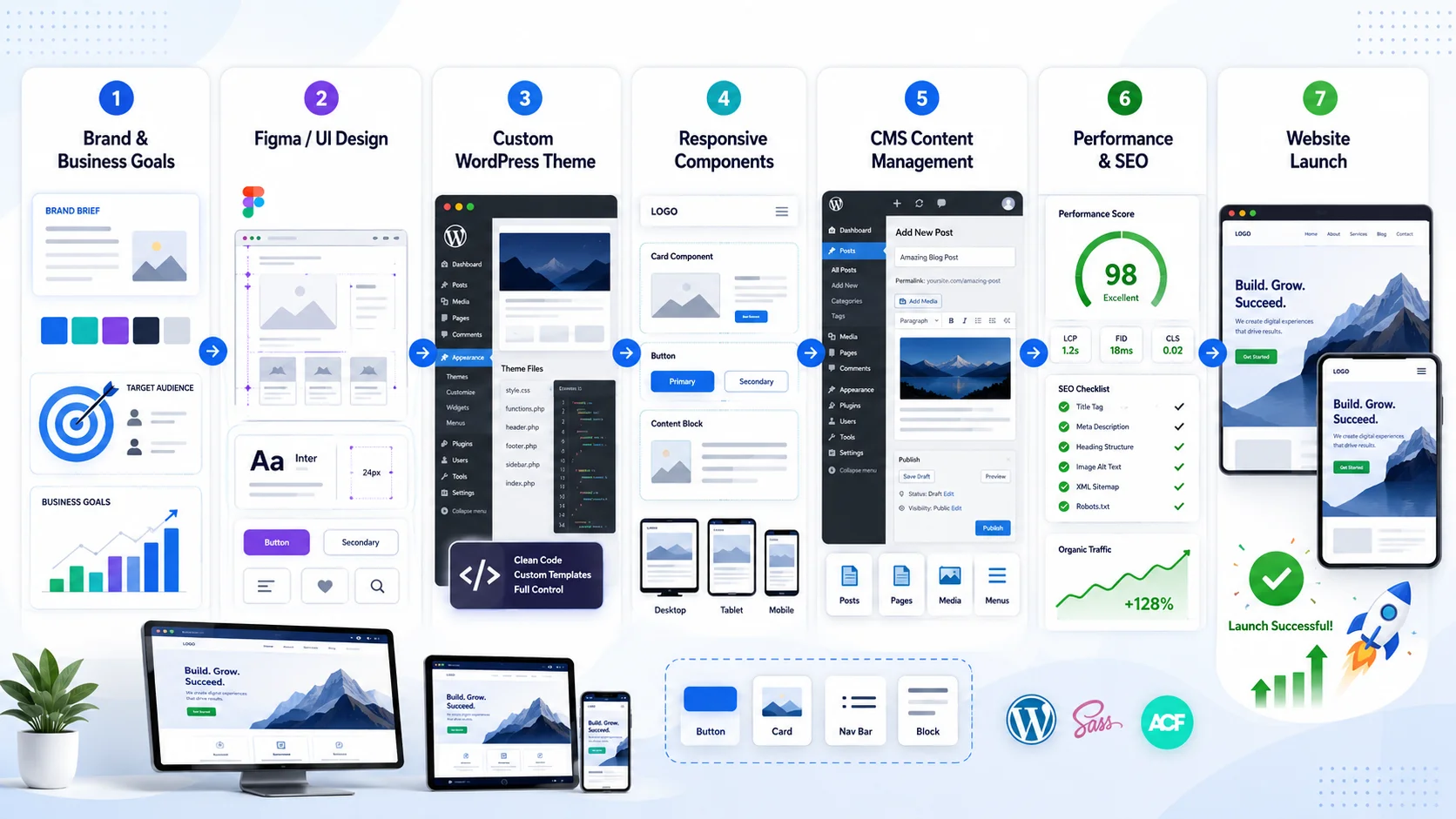
A custom theme can be developed from an original UI/UX design, Figma file, existing brand system, or complete website redesign. The goal is to create a WordPress website that looks distinctive while remaining responsive, editable, maintainable, and suitable for long-term business use.
Why Businesses Choose a Custom WordPress Theme
Prebuilt WordPress themes can be useful when a business needs to launch quickly and has relatively standard requirements. They often include many layouts, configuration options, and components intended to serve different industries.
The disadvantage is that businesses may end up adapting their content and branding around the theme instead of designing the website around their customers. A company may also load functionality, styles, scripts, and page components that it never actually uses.
Custom theme development starts with the opposite approach. Developers build the templates and components required for the specific website. Navigation, service sections, landing pages, blog layouts, case studies, forms, calls to action, and other areas can be designed around the company’s actual content and conversion goals.
This can create a more consistent brand experience while reducing the need for repeated design workarounds.
A Custom Theme Gives You More Control Over UI/UX
Business websites often need specific visual hierarchy and user journeys. A service company may want visitors to move from a landing page into service information and then toward a consultation request. A software company may need product pages, integrations, pricing, case studies, and conversion-focused landing pages.
With a custom theme, these journeys can be designed deliberately rather than assembled from whichever layouts happen to be available in a multipurpose theme.
Typography, spacing, buttons, cards, forms, navigation, colors, containers, and responsive rules can follow one design system throughout the website. Reusable components help maintain consistency as new pages are introduced later.
Responsive behavior can also be planned properly. Desktop layouts do not simply need to shrink on mobile. Columns may stack differently, navigation may change, interactive areas need touch-friendly controls, and content priorities may shift on smaller screens.
Keep Content Editable Without Giving Up Design Control
A custom WordPress theme should not require a developer every time the business needs to update a heading, testimonial, service, image, or call to action.
Frequently changing content can be managed through WordPress blocks, custom fields, reusable sections, custom post types, or other structured content-management approaches. Marketing teams can then update information while the theme controls the underlying visual presentation.
This balance is important. Making every font size, margin, color, and layout position individually editable may sound flexible, but it can eventually produce inconsistent pages. A strong custom theme gives editors control over content while protecting the design system.
- Reusable page sections and components
- Editable service and landing-page content
- Custom post types for structured information
- Flexible blog and resource templates
- Consistent calls to action
- Responsive image and media handling
- Controlled typography, spacing, and branding
Performance problems often appear when WordPress websites rely on large multipurpose themes, excessive plugins, page-builder extensions, oversized images, and scripts that load even when a page does not use them.
A custom theme can be developed around the functionality the website actually needs. This can reduce unnecessary frontend assets and provide developers with greater control over CSS, JavaScript, images, fonts, and templates.
That does not mean a custom theme is automatically fast. Poorly written custom code can still create performance problems. Images need optimization, scripts should be loaded efficiently, caching should be configured appropriately, and database queries should remain controlled.
The advantage is that developers can make these decisions specifically for the project rather than working around a large collection of generic theme functionality.
Build a Custom WordPress Website
SEO Should Be Supported by the Theme Structure
A visually impressive website still needs a strong technical foundation for search engines and visitors. Custom theme development allows developers to create semantic page structures with logical headings, navigation, internal linking, and appropriate HTML elements.
Templates can also be designed so important content appears naturally within the page rather than being hidden inside complicated visual structures. Blog posts, service pages, case studies, and other content types can each have layouts appropriate to their purpose.
Performance and mobile responsiveness also contribute to the overall quality of the website experience. Search optimization should therefore be considered alongside frontend development rather than treated as a separate task after launch.
SEO plugins can still be used for metadata and other publishing controls, while the custom theme is responsible for rendering the website cleanly and consistently.
Separate Theme Design From Important Business Functionality
A WordPress theme should primarily control presentation. Critical business logic such as payment workflows, CRM synchronization, advanced calculators, customer portals, or specialized API integrations may be better implemented through custom plugins.
This separation becomes valuable when the website is redesigned in the future. If all important functionality lives inside the theme, replacing that theme can affect business processes that have nothing to do with visual design.
For example, a custom plugin may handle data synchronization with a CRM while the theme determines how lead forms and customer-facing content appear. The business can later redesign the website without rebuilding the integration.
A well-structured WordPress project therefore uses the theme and plugins for different responsibilities while allowing them to work together where necessary.
Custom Theme Development Can Reduce Long-Term Design Workarounds
Generic themes often begin conveniently but may become harder to adapt as business requirements grow. Teams may add custom CSS, child-theme modifications, additional plugins, and page-specific overrides to achieve layouts the original theme was not designed for.
Over time, these workarounds can make updates and troubleshooting more difficult. A custom theme provides an opportunity to build the required layouts correctly from the beginning and maintain one consistent component system.
This is particularly useful for businesses that expect to publish new landing pages, services, case studies, blog content, or campaigns regularly. Reusable components can speed up future page creation without allowing each new page to become visually unrelated to the rest of the site.
When Is a Custom WordPress Theme Worth It?
A custom theme is usually worth considering when branding, design accuracy, performance, content flexibility, or long-term maintainability are important to the business.
It can be especially useful when the company already has a Figma design, needs a distinctive digital identity, has outgrown a generic theme, or wants more control over how marketing pages and conversion journeys are built.
A prebuilt theme may still be the more practical choice for a small website with a limited budget and simple requirements. Custom development should provide meaningful business value rather than being selected only because it sounds more advanced.
Encoder IT Limited develops custom WordPress themes for business websites, service companies, e-commerce stores, and content-driven platforms. Our work can include Figma-to-WordPress development, custom Gutenberg components, responsive frontend development, custom plugins, WooCommerce customization, API integrations, performance optimization, and ongoing maintenance.
A custom WordPress theme gives modern businesses greater control over how their brand, content, and customer journey are presented online. When the theme is built with reusable components, responsive design, performance, SEO structure, and practical content management in mind, WordPress can provide both the flexibility marketing teams need and the technical foundation developers need for long-term growth.