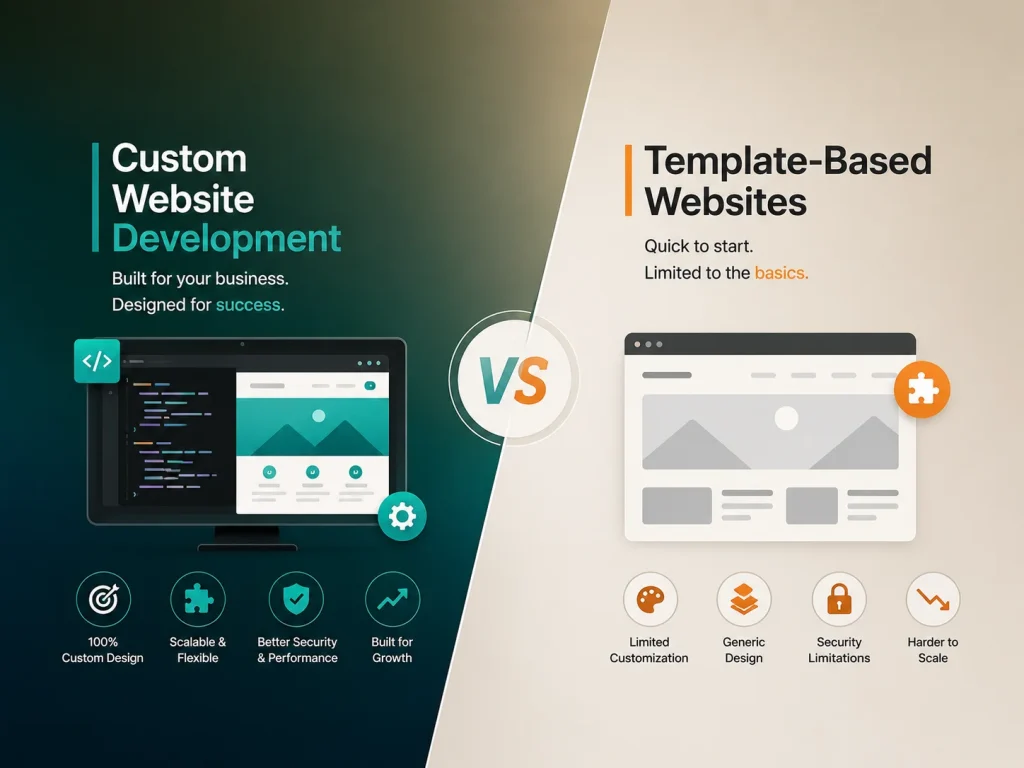
When businesses plan a new website, one of the first decisions is whether to use a ready-made template or invest in custom website development. Both approaches can produce professional websites, but they are built for different needs, budgets, timelines, and long-term goals.
A template-based website can be a practical solution when the project is relatively simple and the business needs to launch quickly. Custom development becomes more valuable when the website needs a unique design, specialized functionality, deeper integrations, or room to grow beyond the limitations of an existing theme.
How Template-Based Websites Work
A template-based website starts with a pre-designed theme or layout. Instead of designing every page and component from the beginning, the development team adapts an existing structure by changing colors, fonts, images, content, and selected sections.
This approach is common with platforms such as WordPress, Shopify, and other website builders. It can significantly reduce the amount of initial design and development work, which is why template websites are often suitable for small businesses, portfolios, landing pages, blogs, and straightforward company websites.
The main limitation is that the website needs to work within a structure originally created for many different businesses. Heavy customization may eventually require overriding the template, adding multiple plugins, or changing code that was not designed around the specific project.
What Makes Custom Website Development Different?
Custom website development starts with the actual business requirements. The structure, page layouts, user journeys, components, and functionality can be designed specifically around the company’s brand, customers, services, and objectives.
This does not necessarily mean every line of code must be written from zero. Developers can still use established frameworks, content-management systems, and reusable libraries. The difference is that the final website architecture and experience are built around the project rather than forcing the project into a predefined template.
A custom website may include unique service flows, customer dashboards, advanced forms, booking systems, product configurators, API integrations, membership features, custom search, multilingual workflows, or other functionality that would be difficult to manage cleanly through a generic theme.
| Area |
Template-Based Website |
Custom Website |
| Initial Cost |
Usually lower |
Usually higher |
| Launch Speed |
Generally faster |
Requires more planning and development |
| Design Flexibility |
Limited by the template |
Designed around the brand and users |
| Custom Features |
Often dependent on plugins or extensions |
Can be developed around specific requirements |
| Scalability |
Suitable for simpler growth |
Better suited to complex future requirements |
| Maintenance |
Can be simple until heavy customization is added |
Depends on the quality of the custom architecture |
Cost Should Be Considered Together With Long-Term Value
A template website normally has a lower initial development cost because much of the design and functionality already exists. For a small business that mainly needs pages for services, company information, contact details, and a blog, this may be all that is required.
Problems can appear when a template website gradually becomes something it was never designed to support. A business may install multiple plugins to create custom workflows, modify theme files heavily, and add workarounds for features that do not fit the original structure. Over time, these changes can make updates, troubleshooting, and performance optimization more difficult.
Custom development costs more at the beginning because additional time is spent on requirements, UI/UX design, development, testing, and architecture. That investment can make sense when the website plays an important role in generating revenue or supporting business operations.
The right comparison is therefore not simply “Which option is cheaper?” It is whether the website needs enough customization to justify building a stronger foundation from the beginning.
Both custom and template-based websites can perform well in search engines and provide a good user experience. The development approach alone does not guarantee SEO rankings, fast loading, or conversions.
However, templates often include components, scripts, styles, or features that a particular website does not actually use. If these are poorly managed, they can add unnecessary weight. Custom development gives developers greater control over what is included, which can make it easier to build around specific performance goals.
User experience can also be more flexible with a custom approach. Navigation, page hierarchy, calls to action, forms, and content can be designed around the customer’s journey rather than around the sections available in a theme.
For template projects, careful theme selection is important. A clean, maintained template with only the necessary functionality can be much better than an overly complicated theme containing dozens of unused features.
When a Template Website Is the Better Choice
Custom development is not necessary for every business. A template-based website can be the smarter option when requirements are straightforward, the budget is limited, the launch timeline is short, and the business does not need unusual functionality.
- Small company websites with standard pages
- Personal or professional portfolios
- Simple blogs and content websites
- Early-stage businesses validating an idea
- Campaign or promotional landing pages
In these situations, investing heavily in functionality that the business may never need can be unnecessary. A well-configured template can provide a professional result while keeping the initial project focused.
When Custom Development Is Worth the Investment
Custom development becomes more attractive when the website is expected to support important business processes or provide an experience competitors cannot easily reproduce with the same theme.
This may include businesses that need customer portals, complex e-commerce functionality, custom booking workflows, advanced integrations, multiple user roles, personalized dashboards, business automation, or a distinctive user experience.
It can also make sense when an existing template website has reached the point where every new feature requires another workaround. In that situation, continuing to customize the old structure may become more expensive than rebuilding the most important parts properly.
Encoder IT Limited develops both customized CMS websites and fully custom web solutions. Depending on the project, we can work with WordPress, WooCommerce, Shopify, or custom technologies such as Laravel, React, and Next.js.
Choose the Right Website Approach
The best option depends on what the website needs to do today and what the business expects from it in the future. Template websites provide speed and affordability for straightforward requirements, while custom development provides greater flexibility and control when the website needs to become a more important part of the business.
Instead of choosing based only on initial price, consider functionality, design flexibility, integrations, maintenance, scalability, and how closely the website needs to support your actual business processes.