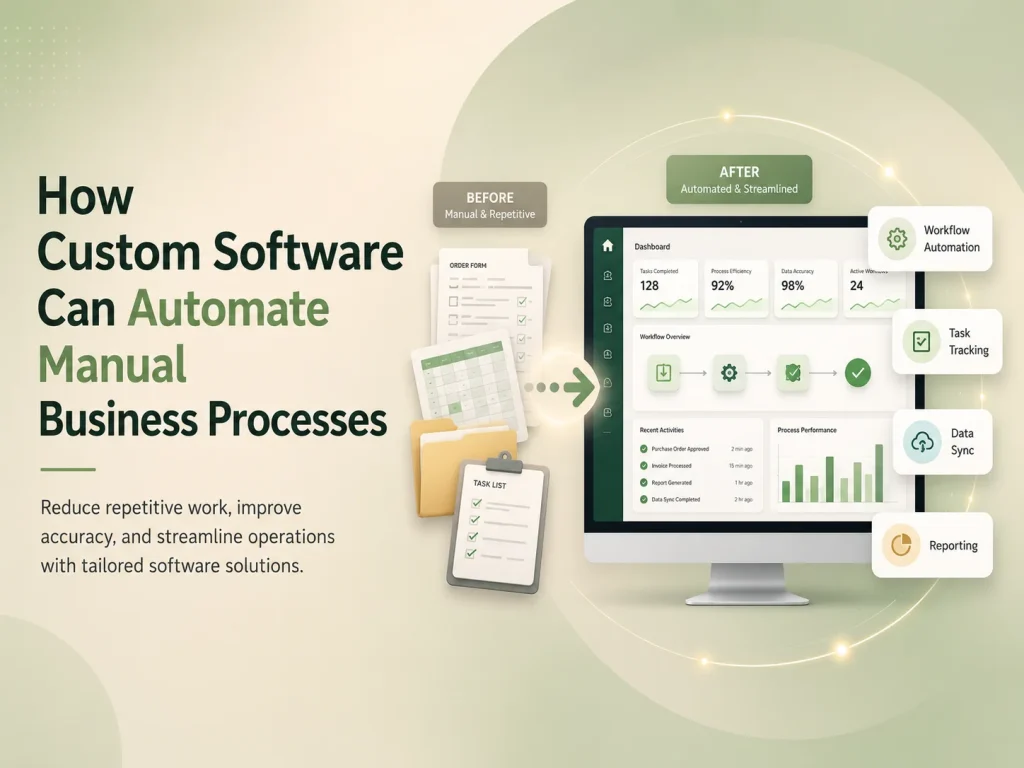
Businesses rely on software for customer management, operations, finance, scheduling, inventory, communication, reporting, and many other daily activities. One of the first decisions is whether to use an existing software product or invest in a system designed specifically around the organization.
Custom software and off-the-shelf software can both be effective, but they solve different problems. Off-the-shelf solutions provide ready-made functionality that can often be deployed quickly, while custom software gives businesses greater control over workflows, integrations, permissions, automation, and future development.
The better option depends on how closely existing software matches the business, how important the process is, and whether adapting operations to a generic system creates more limitations than benefits.
What Is Off-the-Shelf Software?
Off-the-shelf software is developed for a broad group of customers rather than one specific organization. Examples can include accounting systems, CRM platforms, project management tools, help desk software, HR systems, e-commerce platforms, and subscription-based SaaS products.
One of the biggest advantages is speed. Businesses can often create an account, configure basic settings, import data, and begin using the software without waiting for a complete development project.
Existing platforms may also include documentation, customer support, mobile applications, integrations, regular updates, and features that would require significant time to develop independently.
The limitation is that the business usually needs to work within the structure provided by the software. Settings and extensions may provide flexibility, but important workflows cannot always be changed exactly as the organization wants.
What Is Custom Software?
Custom software is designed around the specific processes, users, data, and requirements of a business. Instead of adapting the organization to a predefined workflow, developers can build the application around how the company actually operates.
A custom system might include customer management, employee roles, approvals, task automation, dashboards, reporting, subscriptions, scheduling, inventory, document management, or integrations with existing services.
The business can also control how different users interact with the system. Employees, managers, customers, partners, and administrators may each have different dashboards, permissions, and workflows based on their responsibilities.
Custom development requires greater planning and investment at the beginning. The organization also needs to consider ongoing maintenance, hosting, security, feature development, and technical support rather than expecting a software vendor to manage everything.
| Area |
Off-the-Shelf Software |
Custom Software |
| Initial Setup |
Usually faster |
Requires design and development |
| Initial Cost |
Often lower |
Usually requires higher upfront investment |
| Customization |
Limited to available settings and extensions |
Designed around specific requirements |
| Business Workflows |
Business may need to adapt to the software |
Software can adapt to the business |
| Integrations |
Depends on supported integrations and APIs |
Can be developed around required systems |
| Scalability |
Depends on vendor plans and product limits |
Can be planned around expected growth |
| Maintenance |
Main platform maintained by the vendor |
Business or development partner manages maintenance |
When Off-the-Shelf Software Is Usually the Better Choice
Businesses should not build custom software simply because customization sounds attractive. If an existing product already solves the problem well, purchasing that solution can be significantly more efficient.
Standard functions such as accounting, email marketing, video meetings, document storage, or basic project management often have mature products available. Rebuilding these features independently may add cost without creating meaningful competitive value.
Off-the-shelf software can also be a practical choice for smaller organizations that need to improve operations quickly but are not yet ready for a larger software investment.
- The business process is relatively standard
- An existing product already covers most requirements
- Fast implementation is important
- The available subscription cost fits the business
- Advanced customization is not required
- The organization prefers vendor-managed updates and infrastructure
The important point is to evaluate the real workflow rather than selecting software based only on its feature list. A system may advertise hundreds of features while still missing the few functions most important to the business.
When Custom Software Starts to Make More Sense
Custom development becomes more attractive when a business has processes that are difficult to represent inside existing tools. Employees may be maintaining multiple spreadsheets, copying information between systems, or creating complicated workarounds because the current software does not match how the company operates.
Another common situation is when several different systems are required to complete one workflow. A company might use one application for customers, another for scheduling, a spreadsheet for approvals, email for task assignments, and another platform for reporting. Custom software can potentially bring these processes into one connected application.
Specialized industries may also have requirements that generic software does not handle cleanly. Unique approval structures, customer portals, multi-location operations, complex permissions, specialized calculations, regulatory workflows, or internal business rules can justify a more tailored platform.
Custom development can also become important when software itself is part of the company’s product. A SaaS business, marketplace, booking platform, customer portal, or specialized management system may require functionality that cannot simply be assembled from generic applications.
Discuss Your Custom Software Requirements
Consider the Long-Term Cost, Not Only the Initial Price
Off-the-shelf software often appears less expensive because the initial subscription is much lower than the cost of developing a custom application. However, businesses should consider how costs change as the organization grows.
Some platforms charge per user, transaction, storage level, location, or feature tier. A system that is affordable for ten employees may become significantly more expensive with several hundred users.
There may also be indirect costs. Employees might spend additional time entering the same information into several systems, building manual reports, or correcting errors caused by disconnected workflows.
Custom software has a higher development cost, but the business has greater control over which features are built and how processes are automated. The financial decision should therefore consider development, subscriptions, maintenance, employee time, integrations, training, and future growth together.
A Hybrid Approach Can Often Be the Most Practical
The decision does not always need to be completely custom or completely off-the-shelf. Many businesses benefit from combining both approaches.
A company might build a custom operations platform while continuing to use established services for payments, accounting, email delivery, cloud storage, communication, or analytics. APIs can connect these tools so employees still work through a unified workflow.
This approach allows the business to invest development resources in the processes that make it unique while avoiding the unnecessary cost of rebuilding mature third-party services.
For example, a custom customer management platform could connect to an existing payment provider, accounting service, email system, and calendar. The company controls its core workflow while relying on specialized providers for functions they already handle effectively.
Choose Software Around the Business Problem
The right decision should begin with a clear understanding of the problem rather than a preference for a particular technology. Businesses should document how work is currently completed, where employees lose time, which systems need to communicate, and what limitations are preventing growth.
If an existing platform can solve those problems without significant compromises, off-the-shelf software may be the most sensible choice. If the business is continuously adapting its operations around software limitations, custom development may provide greater long-term value.
Encoder IT Limited develops custom web applications and SaaS platforms for businesses that need workflow automation, dashboards, customer portals, role-based permissions, API integrations, reporting, subscription systems, and other specialized software functionality.
Custom software provides greater flexibility and control, while off-the-shelf software offers faster deployment and lower initial complexity. The strongest decision is the one that solves today’s operational problems without creating unnecessary limitations as the business continues to grow.