Choosing the right platform is one of the most important decisions when building a business website. The platform affects how easily your team can update content, how much customization is possible, how the website can grow, and how much ongoing development and maintenance may be required.
WordPress is a strong choice for many business websites because it combines flexible content management with extensive development possibilities. It can support a simple service website, a content-heavy corporate platform, a multilingual site, a membership website, or an online store through WooCommerce.
However, the main reason to choose WordPress is not simply its popularity. Its value comes from giving businesses a practical way to manage content while still allowing developers to create custom designs, functionality, integrations, and scalable website structures.
WordPress Makes Website Content Easier to Manage
Business websites change continuously. Services evolve, employees join the company, case studies are added, landing pages are created, and new articles are published for marketing and SEO.
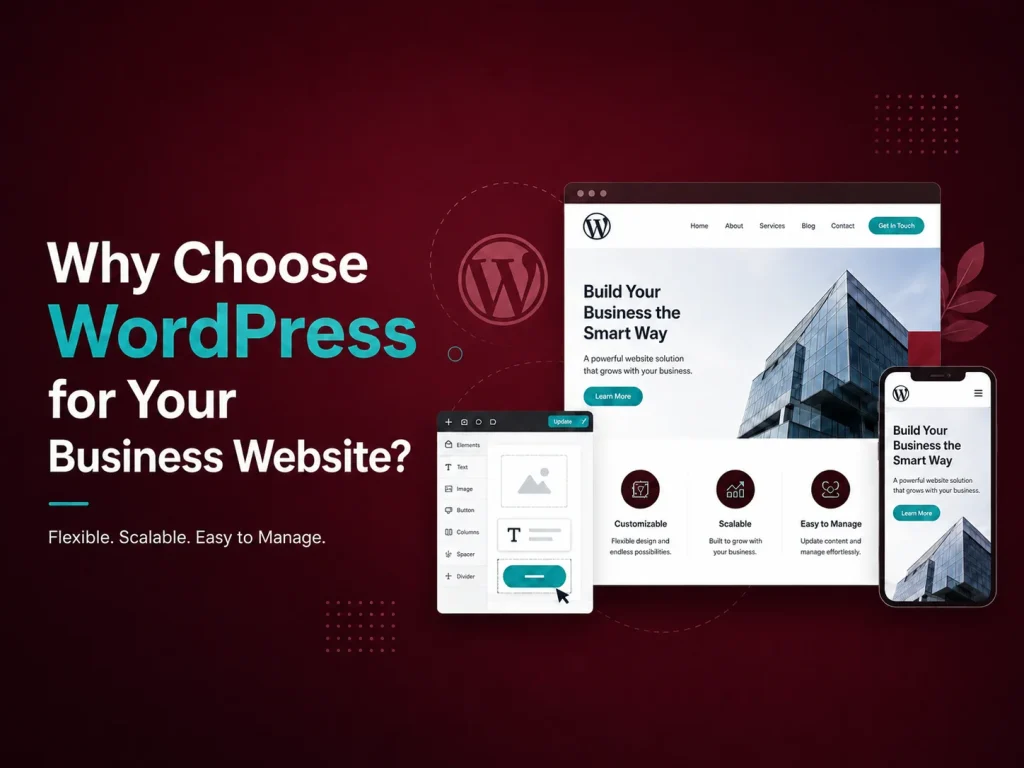
WordPress provides a content management system that allows authorized employees to make many of these updates through an administrative dashboard rather than editing website code.
Pages, blog posts, images, menus, categories, and other content can be managed from one place. Custom development can extend this further with structured areas for services, projects, testimonials, team members, locations, FAQs, or other information specific to the business.
This can reduce dependency on developers for routine content changes while still allowing the technical team to control the overall website structure and design.
You Are Not Limited to Ready-Made WordPress Themes
Some businesses associate WordPress with generic templates that make many websites look similar. While ready-made themes are available, WordPress can also be used as the foundation for a completely custom-designed website.
A custom WordPress theme can be developed from Figma, existing brand guidelines, or a new UI/UX design. Developers can control typography, spacing, navigation, responsive layouts, service sections, calls to action, blog templates, and other visual elements.
This gives businesses the convenience of WordPress content management without requiring the public website to look like a standard template.
Custom themes can also be structured around reusable components. Marketing teams can create new pages using approved content sections while the theme preserves consistent branding and layout rules across the website.
WordPress Works Well for Content Marketing and SEO
Businesses that rely on search visibility often need to publish useful content regularly. WordPress was built with publishing at its core, making it well suited to blogs, guides, case studies, news, resources, landing pages, and other content-driven strategies.
Content can be organized through categories, tags, custom post types, internal links, and structured page templates. SEO tools can provide editors with controls for metadata and other optimization settings, while developers can build the theme with clean HTML structure, responsive layouts, and performance in mind.
WordPress also makes it easier for marketing teams to continue publishing after the initial website launch. This is important because SEO is not usually a one-time development task; businesses often need to keep improving existing pages and publishing new relevant content.
WordPress Can Grow Beyond a Basic Business Website
A business may initially need only a homepage, service pages, company information, blog content, and a contact form. Over time, the website may require more advanced functionality.
WordPress can be extended through established plugins or custom development depending on the requirement.
- WooCommerce online stores
- Customer enquiry and quotation systems
- Booking and appointment functionality
- Membership and subscription features
- Multilingual websites
- CRM and marketing integrations
- Payment gateway integration
- Custom customer portals
- Third-party API integrations
- Custom reporting and administrative tools
Existing plugins can be useful for common functionality, while custom plugins can be developed when the business has specialized workflows that generic solutions cannot support effectively.
The key is to extend WordPress carefully rather than installing a large number of overlapping plugins for every new requirement.
Build Your Business Website With WordPress
WordPress Gives Businesses Control and Flexibility
With a properly managed WordPress installation, businesses have considerable control over their website’s content, design, custom code, and integrations. The site can be moved between suitable hosting providers, redesigned through a new theme, or extended with custom functionality as requirements change.
This flexibility can be particularly useful for businesses that do not want their entire website strategy tied to a rigid website builder with limited development options.
Developers can work directly with WordPress themes, plugins, databases, REST APIs, custom post types, user roles, and other platform features. This allows WordPress to support projects ranging from straightforward marketing sites to more customized business platforms.
At the same time, businesses should avoid unnecessary customization. If WordPress already provides a reliable way to handle a requirement, rebuilding it from scratch may increase development and maintenance without creating additional value.
WordPress Can Be Cost-Effective for Many Business Websites
Building every part of a content management system from the beginning would require significant development. WordPress already provides administration, content publishing, user management, media handling, and many other foundational capabilities.
This allows development resources to focus more heavily on the parts that make the business website unique, such as branding, UI/UX, custom templates, integrations, conversion journeys, and specialized functionality.
The total cost still depends on the project. A professionally designed custom WordPress website with advanced integrations will require more investment than installing a simple prebuilt theme.
Businesses should also include hosting, maintenance, premium software where required, security, backups, and future development in long-term planning rather than considering only the initial website build.
WordPress itself does not automatically guarantee a fast or secure website. Implementation and ongoing maintenance have a major impact on both.
A site with oversized images, unnecessary plugins, a heavy theme, excessive third-party scripts, and poor hosting can become slow. A carefully developed WordPress website with efficient templates, optimized media, appropriate caching, and controlled dependencies can provide a much better experience.
Security requires similar attention. WordPress core, themes, and plugins should remain updated, administrator access should be controlled, backups should be maintained, and unused software should be removed.
Custom code and integrations should follow secure development practices, particularly when handling user information, payments, API credentials, or protected administrative functionality.
When WordPress May Not Be the Right Choice
WordPress is versatile, but it is not automatically the best platform for every digital product. If the main requirement is a complex software application with highly specialized workflows, extensive real-time functionality, advanced multi-tenant architecture, or application logic that has little connection to content publishing, a custom web application may provide a more appropriate foundation.
A SaaS platform, complex internal operations system, or specialized marketplace may be better served by technologies designed specifically around application development.
In some cases, businesses can also combine approaches. WordPress may handle the public marketing website and blog while a separate web application provides the secure customer or employee platform.
The technology should be chosen around the business requirement rather than using WordPress simply because it is familiar.
A Strong Choice for Many Modern Business Websites
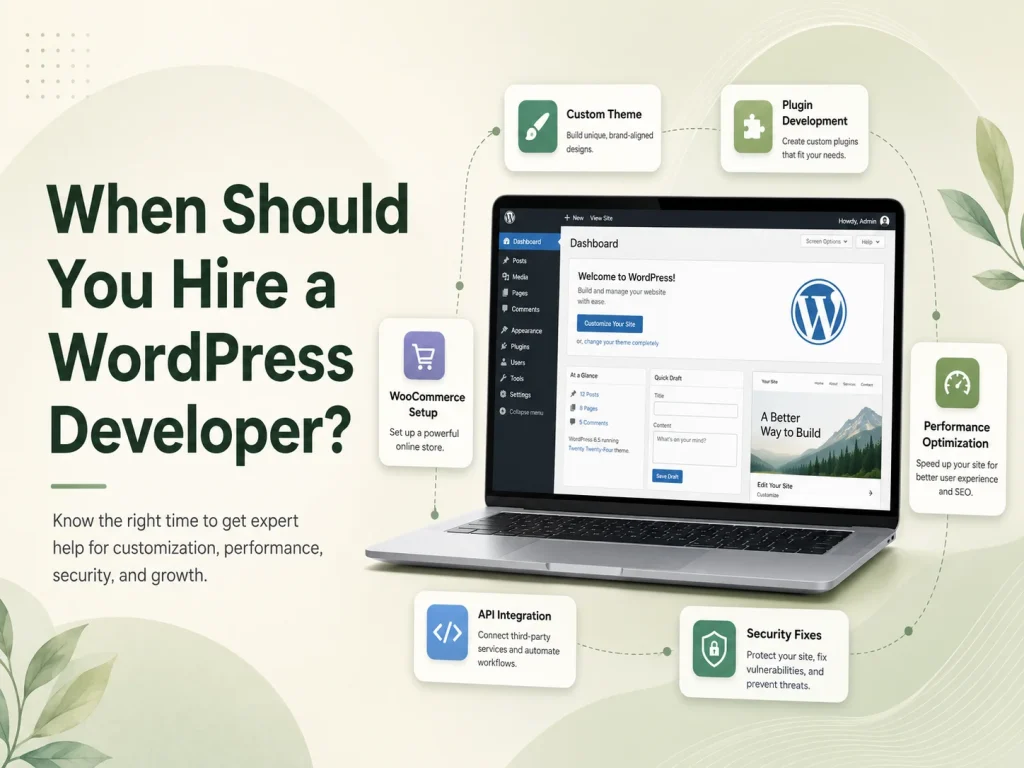
Encoder IT Limited develops custom WordPress websites for service businesses, corporate organizations, e-commerce stores, and content-driven platforms. Our work can include custom theme and plugin development, Figma-to-WordPress conversion, WooCommerce, API integrations, performance optimization, security improvements, and ongoing maintenance.
WordPress remains a practical choice for businesses that need a website that is easy to manage, flexible to customize, strong for content publishing, and capable of expanding as requirements change. When it is developed with a clean custom design, appropriate plugins, good performance practices, and ongoing maintenance, WordPress can provide a strong foundation for a professional business website without adding unnecessary technical complexity.