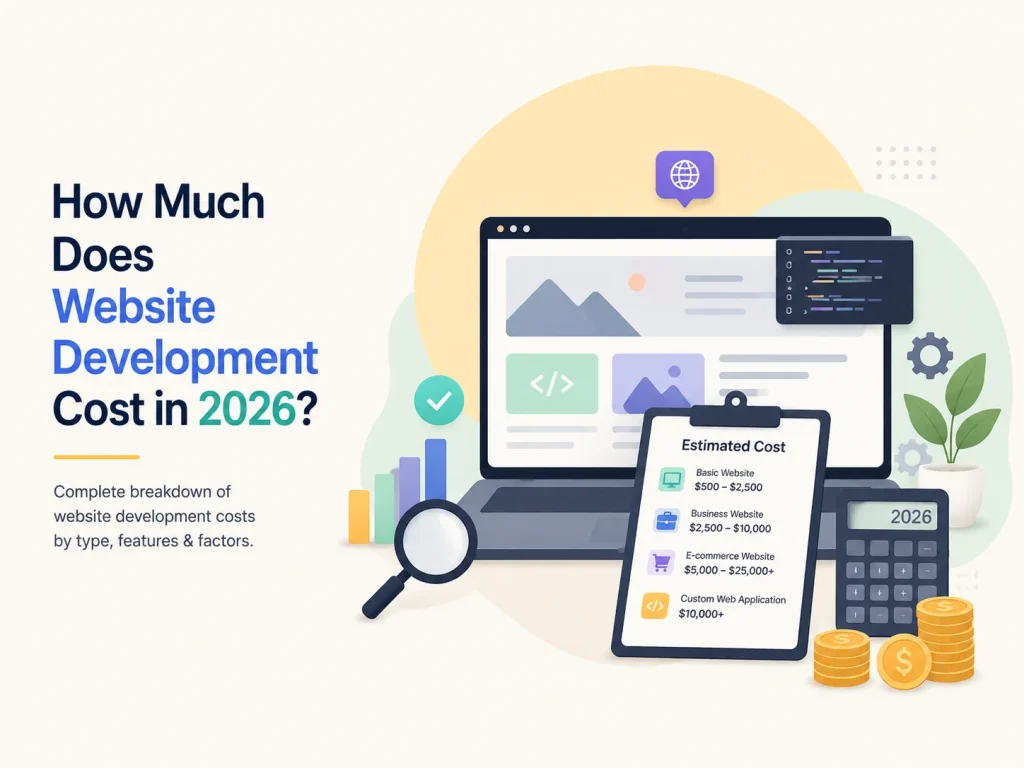
One of the first questions businesses ask before starting a new website is, “How much does website development cost in 2026?” There is no single price because a five-page company website, a custom e-commerce store, and a large business platform require very different levels of design, development, testing, and integration.
A professional website can cost anywhere from a relatively small budget for a straightforward business site to tens of thousands of dollars or more for a highly customized platform. The final price depends on what the website needs to achieve, how much functionality is required, whether the design is custom, and how much work is needed behind the visible pages.
Typical Website Development Cost in 2026
For early budgeting, businesses can think about website costs in broad categories rather than expecting one universal price. Current industry pricing varies considerably between freelancers, offshore teams, specialized agencies, and larger development companies.
| Website Type |
Typical Requirements |
Planning Range |
| Basic Business Website |
Small number of pages, responsive design, contact forms and standard content |
$1,000–$5,000+ |
| Professional Custom Website |
Custom UI/UX, CMS, multiple page types, integrations and advanced functionality |
$5,000–$15,000+ |
| E-commerce Website |
Products, payments, checkout, customer accounts, shipping and store management |
$5,000–$25,000+ |
| Advanced Custom Platform |
Portals, dashboards, complex APIs, automation, multiple user roles or custom business logic |
$15,000–$50,000+ |
These are planning ranges rather than fixed prices. A small business using an existing WordPress structure and established components may spend less, while a website with completely custom functionality, extensive integrations, large amounts of content, or specialized business workflows can cost considerably more.
The development team’s location and experience also influence pricing. Current Clutch data shows many web-development agencies listed around $25–$49 per hour, although rates can be significantly higher for specialized teams and particular markets.
What Makes a Website More Expensive?
Design is one major factor. A website built from a lightly customized template generally requires less work than one designed from the beginning around a company’s brand, content, customers, and conversion goals. Custom UI/UX work may include wireframes, responsive layouts, reusable components, interactive elements, and separate designs for important page types.
The amount of functionality often has an even greater impact. A contact form is relatively simple, but functionality such as customer accounts, subscriptions, booking systems, payment processing, product filters, dashboards, memberships, multilingual content, or custom search requires additional development and testing.
Integrations can also increase the budget. A business website may need to connect with a CRM, ERP, accounting platform, payment gateway, email marketing system, shipping service, inventory platform, third-party API, or internal company software. The more systems that need to exchange information reliably, the more backend work is usually involved.
Content size matters too. A ten-page company website is very different from a platform containing hundreds of products, locations, services, articles, or landing pages. Content migration, redirects, image optimization, CMS configuration, and quality checks can become significant parts of a redesign project.
WordPress, E-commerce, or Fully Custom Development?
The technology used should match the website rather than being chosen only by price. WordPress can be an efficient solution for many company websites, blogs, service businesses, and content-heavy platforms because it provides an established content-management system while still allowing extensive customization.
WooCommerce or Shopify can provide a strong foundation for many online stores. The budget then depends on product structure, custom design, checkout requirements, shipping, payment methods, integrations, and whether standard platform functionality is enough. BigCommerce’s current 2026 cost guidance, for example, places small-to-mid-sized custom e-commerce builds with integrations and light backend development around $5,000–$25,000.
Fully custom development becomes more appropriate when the website behaves more like business software than a traditional marketing site. Customer portals, SaaS platforms, complex marketplaces, advanced dashboards, unique workflows, and specialized integrations may require technologies such as Laravel, Node.js, React, or Next.js rather than relying entirely on an off-the-shelf CMS.
The cheapest platform at the beginning is therefore not always the most economical long-term choice. Businesses should consider how easily the website can be updated, maintained, integrated, and expanded as requirements grow.
Request a Quote
Do Not Budget Only for the Initial Website Build
A website continues to create costs after launch. Domain registration, hosting, backups, security, premium software, maintenance, content updates, monitoring, and ongoing development may all become part of the operating budget.
E-commerce websites may also have payment-processing charges, application subscriptions, shipping integrations, or platform fees. High-traffic websites can require more capable hosting and infrastructure than a small company site.
Maintenance is particularly important for business-critical websites. CMS software, plugins, frameworks, integrations, and server environments change over time. Regular updates and testing can help prevent a website that worked well at launch from gradually developing security, compatibility, or performance problems.
How to Get a More Accurate Website Development Estimate
The easiest way to improve pricing accuracy is to define the project before requesting quotes. Businesses should identify the main pages, required functionality, integrations, user roles, design expectations, content needs, and examples of important workflows.
It is also useful to separate essential launch requirements from features that could be introduced later. This can prevent an initial project from becoming unnecessarily large while still allowing the website architecture to support future growth.
When comparing quotes, check what is actually included. One proposal may cover only development, while another includes UI/UX design, responsive implementation, CMS configuration, testing, deployment, performance optimization, and post-launch support. Comparing only the final price can therefore be misleading.
Encoder IT Limited provides website design and development services for businesses requiring professional company websites, custom WordPress development, WooCommerce and e-commerce solutions, custom web applications, API integrations, and ongoing website maintenance.
Website development cost in 2026 ultimately depends on the value and complexity of the website being built. A simple business presence and a platform responsible for sales or daily operations should not have the same budget. The best approach is to define what the website needs to accomplish first, then invest in the design and technology required to support those goals reliably.