
WPSearch.ai is an AI-powered WordPress plugin discovery and intelligence platform designed to help users find, evaluate, compare, and select plugins based on real requirements instead of relying only on keywords, download counts, or star ratings. The platform combines large-scale WordPress plugin data processing, mathematical scoring models, AI-generated insights, security intelligence, semantic discovery, and automated comparisons within one decision-support system.
Industry: WordPress, SaaS, AI & Developer Tools
Project Type: AI-Powered Plugin Search & Data Intelligence Platform
Services: Custom Web Development, AI Integration, Data Engineering, Algorithm Development, Search Optimization & Automation
Core Technologies: PHP, WordPress, MySQL / MariaDB, JavaScript, OpenAI GPT API, REST APIs, cURL, Cron Automation & WPScan Data Integration
Website: wpsearch.ai
Project Overview
Choosing the right WordPress plugin can be surprisingly difficult. The official ecosystem contains thousands of plugins covering similar use cases, but traditional discovery often depends heavily on exact keywords, total active installations, star ratings, or manual research across multiple plugin pages. These signals are useful, but they do not always reveal whether a plugin is actively growing, well maintained, secure, compatible, responsive to users, or genuinely suitable for a specific website.
WPSearch.ai was created to transform this process from basic plugin lookup into intelligent software evaluation. Instead of simply listing plugins, the platform collects and processes large amounts of plugin information, evaluates multiple technical and business signals, organizes plugins into meaningful categories, and uses AI to help users understand which options are most relevant to their actual requirements.
The public platform combines intent-based search, structured plugin analysis, category-aware rankings, security information, AI-generated summaries, recommendation guidance, and side-by-side comparisons. Behind the interface is a substantial automated data-processing architecture responsible for continuously collecting, calculating, transforming, and preparing plugin information for fast frontend discovery.
The Challenge
The main problem was not simply collecting WordPress plugin data. The greater challenge was converting large volumes of inconsistent technical, popularity, maintenance, security, pricing, review, and historical information into useful recommendations that users could understand and trust.
Popularity alone can create misleading rankings. A plugin with millions of installations may dominate a smaller but rapidly growing alternative even when the newer plugin has stronger maintenance activity or better suitability for a particular use case. Similarly, comparing plugins from completely different categories using the same raw scale can produce unfair results.
The platform also needed to process recurring updates across a large dataset without creating duplicate jobs, database conflicts, overlapping cron executions, or expensive frontend queries. AI-generated descriptions and verdicts introduced another challenge: large-language-model responses needed to follow predictable structures so that automated results could be stored and reused reliably.
The final architecture therefore needed to solve several problems simultaneously: fair plugin scoring, automated data ingestion, AI content generation, security analysis, category-level normalization, reliable background processing, fast search delivery, and understandable presentation for both technical and non-technical WordPress users.
Goals & Requirements
- Build an intelligent alternative to keyword-only WordPress plugin discovery.
- Collect and process large-scale WordPress plugin information automatically.
- Create a proprietary multi-factor scoring model using technical, growth, business, and social signals.
- Normalize rankings within relevant plugin categories instead of relying only on global popularity.
- Measure historical installation growth instead of evaluating only static installation totals.
- Use AI to generate structured plugin descriptions, pros, cons, audience insights, and executive verdicts.
- Provide security risk analysis based on known plugin vulnerabilities.
- Create an interactive recommendation workflow based on website type, builder compatibility, requirements, and user preferences.
- Automatically generate structured plugin comparisons.
- Prevent overlapping background jobs and duplicate cron processing.
- Reduce expensive frontend database operations through pre-computed search datasets.
- Maintain an architecture capable of continually refreshing plugin intelligence as source data changes.
Our Approach
We approached WPSearch.ai as a data and decision-engineering project rather than a conventional WordPress directory. The first stage involved identifying which signals actually help users evaluate plugins, how those metrics differ across categories, and how raw WordPress ecosystem information could be converted into normalized and comparable data.
From there, the platform was separated into multiple processing layers. Data ingestion collects plugin information, scoring jobs calculate derived metrics, AI pipelines transform raw information into structured insights, security jobs evaluate vulnerability information, and search-processing jobs prepare lightweight datasets for frontend discovery.
Heavy calculations are handled before users perform searches whenever possible. This reduces the need to execute complex calculations or large relational queries during every frontend request and allows the user-facing experience to remain responsive while the underlying data-processing system continues operating independently.
The Solution
WPSearch.ai was developed as a combination of an AI discovery interface and a large automated intelligence engine. The user-facing platform makes plugin research simple, while the backend continuously performs the mathematical, security, content, and data-processing work required to generate useful recommendations.
AI-Powered Intent Search
Traditional plugin directories depend heavily on users knowing the correct plugin name or search terminology. WPSearch.ai takes a different approach by allowing users to describe what they want to accomplish and using that intent to guide plugin discovery.
This creates a more natural search experience for users who understand their business requirement but may not know the exact WordPress terminology. Search results can then be supported by additional quality, relevance, growth, and category signals rather than being ordered only by raw popularity.
Multi-Factor WPS Scoring Engine
At the core of the platform is a proprietary composite scoring system that evaluates more than 21 signals across areas such as plugin performance, technical quality, user experience, business suitability, historical growth, maintenance activity, and social proof.
Instead of allowing one large metric such as active installations to dominate the ranking, the algorithm combines several weighted dimensions. Statistical shaping, logarithmic transformations, and category-relative normalization help create a more balanced representation of plugin quality and momentum.
RMS Installation Growth Analysis
Static installation totals provide historical scale but do not necessarily show current momentum. To improve this, the platform calculates installation growth across multiple historical periods and uses a Root Mean Square growth model to identify meaningful growth patterns.
The mathematical model evaluates the magnitude of historical growth rather than relying on a single snapshot. This helps distinguish plugins that are actively gaining adoption from those whose installation counts may be large but relatively stagnant.
The underlying growth calculation follows the RMS model:
√(Σ growth² / n).
This provides a consistent quantitative signal that can be incorporated into the wider WPS scoring process.
Category-Aware Ranking & Statistical Normalization
Comparing every WordPress plugin against one universal scale can produce misleading results because different plugin categories naturally have very different installation volumes, review counts, update patterns, and market sizes.
WPSearch.ai therefore performs category-aware normalization before applying additional non-linear amplification. Min-max normalization, statistical differences, cubic shaping, logarithmic scaling, and fractional power transformations help preserve meaningful differences between strong and average plugins without allowing extreme raw values to dominate the ranking.
This allows a strong niche plugin to be evaluated fairly within its relevant market instead of being automatically overshadowed by plugins from categories with much larger audiences.
AI Content & Executive Verdict Engine
Plugin research requires more than numerical scores. Users also need to understand what a plugin does, where it performs well, its limitations, and which types of websites or users are most likely to benefit from it.
An automated OpenAI-powered pipeline processes structured plugin information and produces machine-readable outputs for long and short descriptions, pros and cons, audience classifications, taxonomy information, and higher-level recommendation content.
The executive verdict engine can combine plugin features with review information, ratings, maintenance signals, support activity, and other available data to create a clearer summary of the plugin’s overall strengths, weaknesses, and suitability.
Dynamic Security Intelligence
Security is an important factor when selecting WordPress plugins, particularly when plugins have a long version history or previously reported vulnerabilities. WPSearch.ai includes a dedicated security scoring process that evaluates known vulnerability information and converts it into an understandable risk rating.
The risk model weighs vulnerability severity using different values for Critical, High, Medium, and Low threats. It also considers vulnerability density and applies logarithmic penalty scaling so that multiple reported issues influence the score without producing uncontrolled linear growth.
The resulting security information gives users more context than a simple secure or vulnerable label by showing risk levels and relevant historical vulnerability information alongside the wider plugin evaluation.
AI Recommendation Wizard
Not every user wants to start with an open search. The recommendation wizard provides a guided path for users who want the platform to narrow their choices based on practical website requirements.
The backend maps information such as website type, page-builder compatibility, expected functionality, budget preference, traffic level, and configuration experience to relevant plugin groups. This allows recommendations to become more contextual as the user progresses through the decision process.
Automated Plugin Comparison Engine
Plugin selection often requires users to open several tabs and manually compare features, pricing, ratings, performance, compatibility, strengths, and weaknesses. WPSearch.ai automates much of this research through structured comparison pages.
The comparison generation pipeline can organize multiple plugins into a side-by-side format containing overview information, feature comparisons, use cases, pros and cons, pricing considerations, and a final recommendation. This converts fragmented research into a more consistent decision-making experience.
Automated Data Ingestion & Cron Architecture
Maintaining plugin intelligence requires continuous processing because versions, installation counts, compatibility, reviews, support activity, descriptions, and security information change over time. The backend therefore contains a large collection of scheduled ingestion and processing jobs responsible for keeping different datasets updated.
High-frequency background processing creates the possibility of two instances of the same task executing simultaneously. To prevent this, database-backed atomic locking was implemented around critical jobs. Execution wrappers use guaranteed lock-release patterns so that failures or exceptions do not permanently block later processing.
This architecture enables heavy data-processing operations to run independently while reducing duplicate work, race conditions, and inconsistent updates across dependent datasets.
High-Performance Search Data Preparation
Executing complex scoring calculations and large relational queries every time a visitor searches would create unnecessary frontend latency. WPSearch.ai therefore moves expensive data preparation into background processes wherever practical.
Frequently required search information is transformed into pre-computed JSON datasets and search indexes. Different chunking jobs prepare information such as short descriptions and installation counts so the frontend can retrieve lightweight search data without repeatedly rebuilding the same information from heavy database queries.
The result is an architecture where computationally expensive processing happens asynchronously, while user-facing search remains focused on retrieving and presenting already-prepared information.
Technology Stack
WPSearch.ai combines traditional WordPress development with data engineering, statistical modeling, AI automation, security intelligence, and custom background-processing architecture.
- Backend: PHP (OOP) & WordPress Custom APIs
- Database: MySQL / MariaDB
- Frontend: JavaScript, HTML5 & CSS3
- AI: OpenAI GPT API & Structured JSON Prompt Pipelines
- Data Processing: Custom Mathematical & Statistical Algorithms
- API Integration: WordPress APIs, REST APIs & External Data Sources
- Security Intelligence: Vulnerability Data & WPScan Integration
- Data Ingestion: cURL, Concurrent Requests & Automated ETL Workflows
- Parsing: DOMDocument & HTML Parsing Utilities
- Automation: Distributed Cron Jobs & Database-Backed Concurrency Locks
- Search Optimization: Pre-Computed JSON Chunks & Fuzzy Search Indexing
Key Technical Challenges
Creating Fair Rankings Across Different Plugin Categories
Problem: Raw metrics such as downloads and reviews vary dramatically between plugin categories. Applying the same scale globally would naturally favor large categories and established plugins.
Solution: Category-level normalization was combined with growth calculations, weighted metrics, logarithmic transformations, and non-linear statistical amplification to preserve useful differences without allowing one raw metric to dominate.
Outcome: Plugin rankings can reflect relative quality and momentum within relevant categories rather than functioning as a simple popularity leaderboard.
Running Large Automated Pipelines Reliably
Problem: Numerous scheduled tasks continuously collect, calculate, enrich, and transform plugin data. Overlapping jobs could produce duplicate processing, inconsistent data, unnecessary API usage, or race conditions.
Solution: Atomic database-backed job locks and fail-safe execution wrappers were implemented around critical cron operations. Locks are released even when processing encounters exceptions.
Outcome: Heavy recurring jobs can operate more predictably while reducing duplicate execution and concurrency-related data problems.
Combining AI Automation with Structured Application Data
Problem: Free-form LLM responses are difficult to integrate into automated application workflows because formatting and field availability can vary between responses.
Solution: AI generation pipelines were built around structured prompts and expected JSON schemas for descriptions, pros and cons, classifications, comparisons, and recommendation verdicts.
Outcome: AI-generated information becomes reusable application data instead of remaining unstructured text that requires manual editing for every plugin.
Before vs After
The main transformation was turning WordPress plugin selection from a manual directory-search process into a data-driven discovery and evaluation workflow.
| Before | After |
|---|---|
| Search depended heavily on exact plugin names or keywords. | Users can describe requirements and discover plugins through intent-based search. |
| Plugins were often judged mainly by downloads and star ratings. | Multiple technical, growth, maintenance, business, and social signals contribute to evaluation. |
| Large plugins naturally dominated smaller niche alternatives. | Category-aware normalization provides more contextual comparison. |
| Historical installation totals provided limited information about momentum. | RMS growth analysis helps identify changes in installation trajectory. |
| Security research required checking separate vulnerability sources. | Security information and risk scoring are incorporated into plugin analysis. |
| Comparing similar plugins required opening and researching multiple pages. | Structured side-by-side comparisons organize important decision factors. |
| Plugin descriptions and analysis required significant manual research. | AI pipelines generate structured descriptions, insights, pros, cons, and verdicts. |
| Heavy database processing could occur during frontend requests. | Background processing and pre-computed datasets reduce repeated frontend work. |
Results & Impact
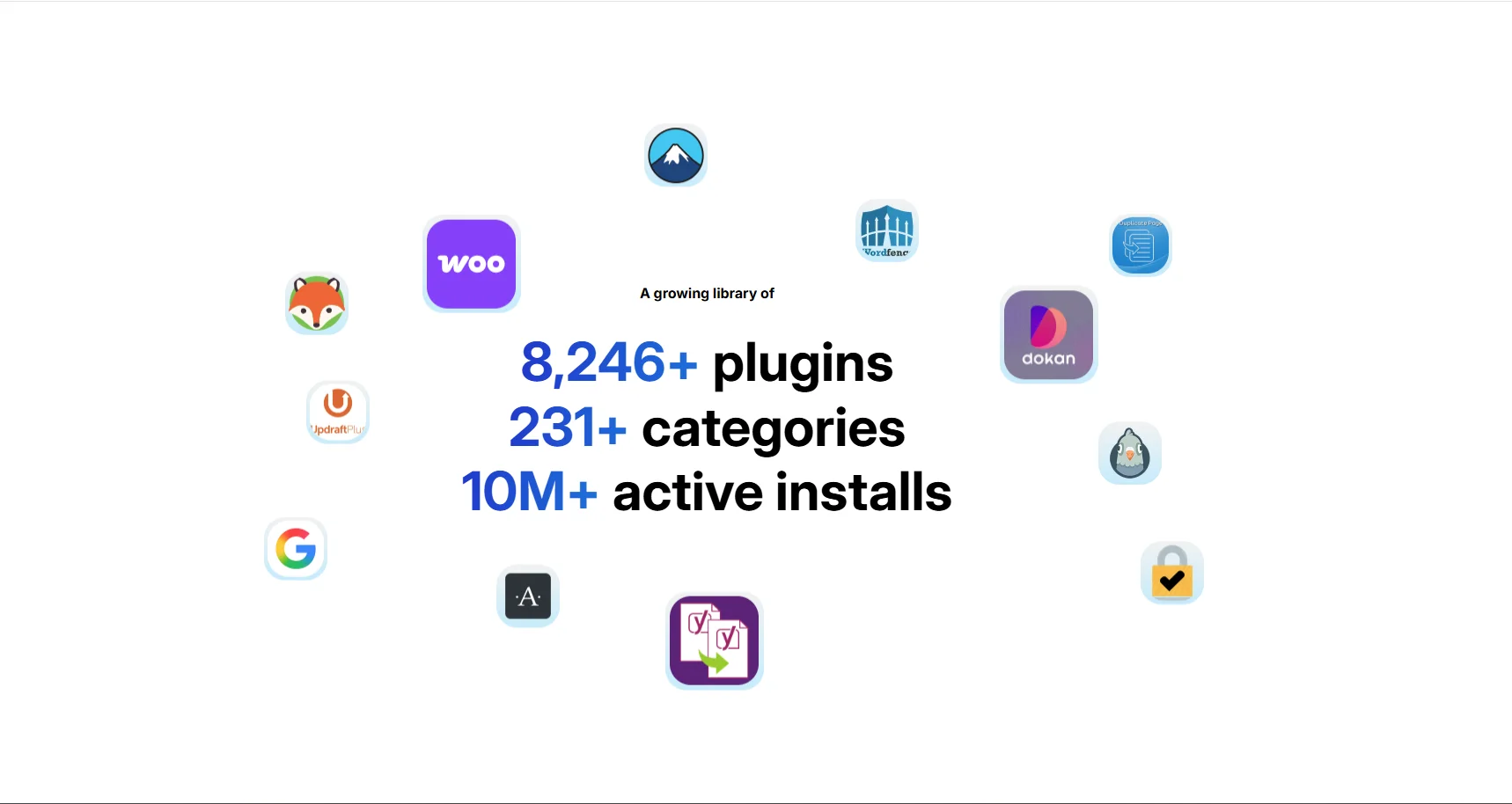
WPSearch.ai transforms raw WordPress ecosystem information into a structured plugin intelligence layer. The public platform currently presents thousands of plugins across hundreds of focused categories while the underlying processing architecture is designed to handle significantly larger plugin datasets and recurring background enrichment.
The system reduces the amount of manual research required to evaluate plugins by combining search relevance, scoring, growth analysis, maintenance information, security intelligence, AI-generated explanations, and comparisons within the same experience. Users can move from describing a requirement to evaluating shortlisted plugins without manually assembling the same information from multiple sources.
- 21+ Evaluation Signals: Multiple weighted metrics contribute to the proprietary plugin scoring process.
- Large-Scale Data Processing: Automated ingestion and enrichment pipelines are designed to process tens of thousands of WordPress plugin records.
- Automated AI Analysis: Structured AI pipelines generate descriptions, classifications, pros, cons, and recommendation content.
- Security-Aware Decisions: Vulnerability information contributes to dedicated plugin risk scoring.
- Faster Discovery: Pre-computed search data reduces reliance on expensive frontend relational processing.
- Automated Comparisons: Plugin differences can be transformed into structured side-by-side decision guides.
- Reliable Background Processing: Atomic locking helps prevent conflicting or duplicated cron execution.
Project Gallery
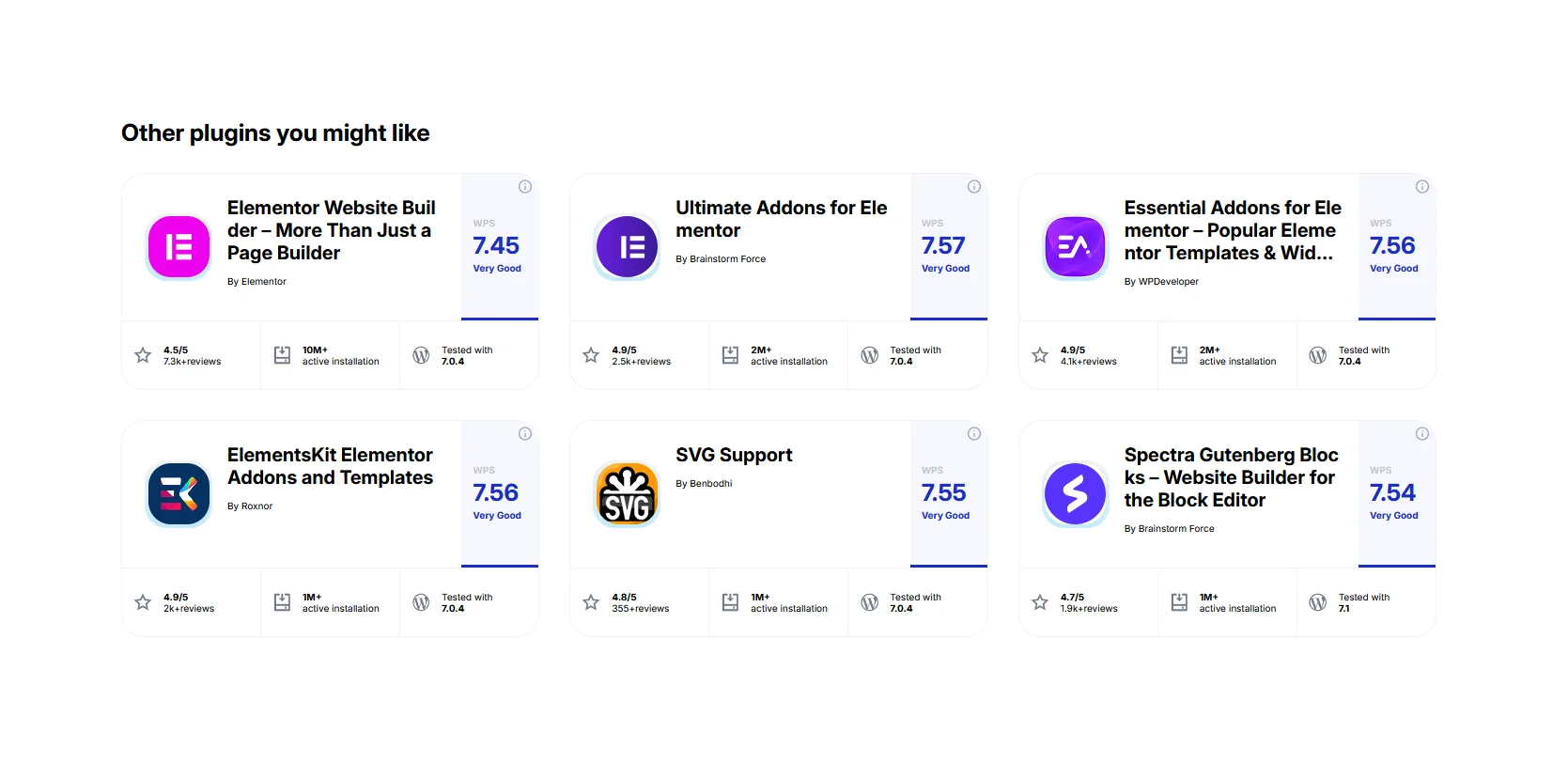
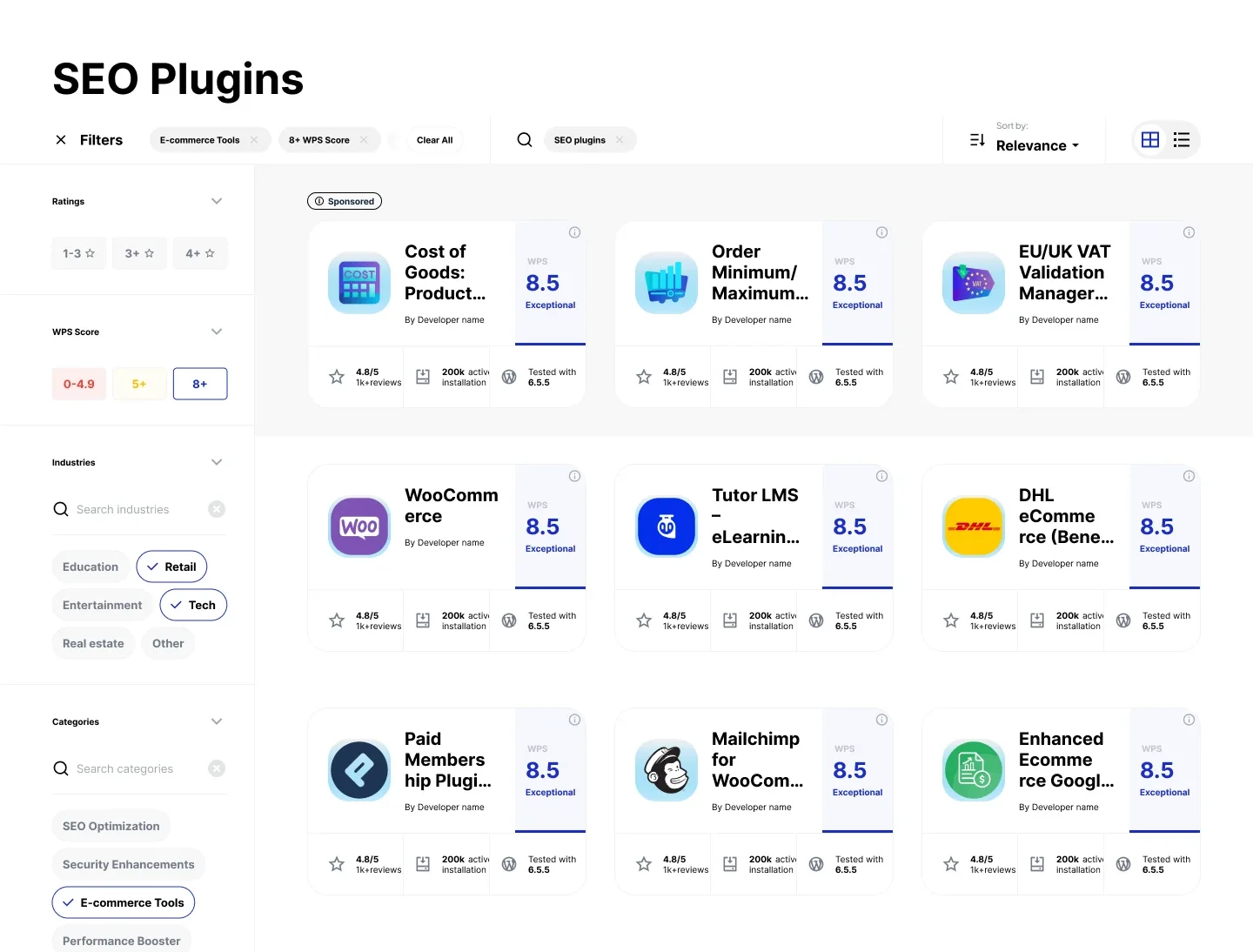
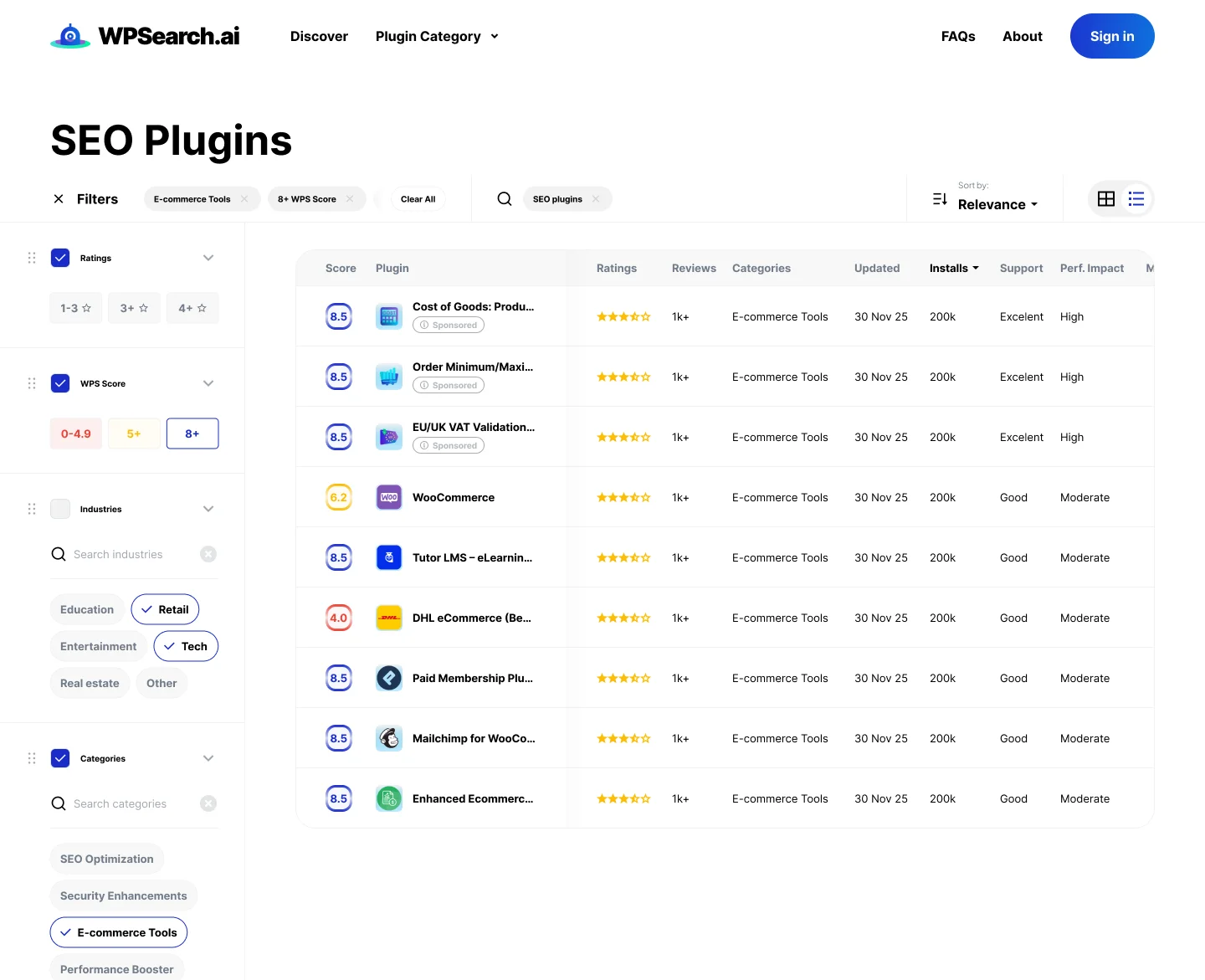
The case study gallery should demonstrate both the user-facing discovery experience and the depth of plugin intelligence available after a user selects a result.


Project Summary
WPSearch.ai demonstrates how artificial intelligence, statistical modeling, data engineering, security intelligence, and WordPress development can be combined to solve a practical software-selection problem. Instead of providing another directory of plugin names, the platform converts large amounts of WordPress ecosystem data into structured information that helps users understand which plugins are more appropriate for their requirements.
The project includes a proprietary multi-factor scoring engine, category-aware normalization, historical growth analysis, AI-generated plugin intelligence, security risk evaluation, guided recommendations, automated comparisons, distributed cron processing, concurrency control, and optimized search datasets.
The result is a scalable AI-powered discovery platform that reduces manual plugin research and helps WordPress users make more informed decisions using relevance, real data, technical signals, security information, and structured comparisons.
Have a Similar AI or Data-Driven Project?
Whether you need an AI-powered search platform, recommendation engine, custom scoring system, automated data pipeline, SaaS product, or intelligent WordPress application, Encoder IT Limited can turn complex data and business requirements into a scalable digital solution.